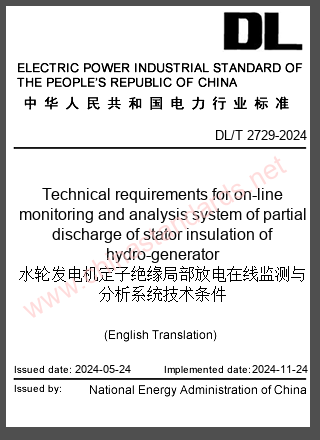
DL/T 2729-2024 in English
VALIDTechnical requirements for on-line monitoring and analysis system of partial discharge of stator insulation of hydro-generator
- Issued on:2024-05-24
- Implemented on:2024-11-24
- File Format:PDF
- Delivery:Via email within 1~3 business days
$252.00
| Standard No: | DL/T 2729-2024 |
| Document status: | VALID |
| Title in English: | Technical requirements for on-line monitoring and analysis system of partial discharge of stator insulation of hydro-generator |
| Title in Chinese: | 水轮发电机定子绝缘局部放电在线监测与分析系统技术条件 |
| Language: | English |
| File Format: | Electronic (PDF) |
| Delivery: | Via email within 1~3 business days |
| Issued on: | 2024-05-24 |
| Implemented on: | 2024-11-24 |
| Chinese Classification: | K51-Power station equipment automation devices |
| Professional Classification: | DL-Electricity |
| Related Keywords: | stator insulation
technical requirements analysis system online monitoring system partial discharge |
Introduction
Core Technology and Standard Framework
This standard specifies for the first time the technical requirements for the online monitoring system for partial discharge of stator winding insulation of hydro-turbine generators, focusing on solving the three major technical problems of signal acquisition accuracy (±5mV~±8500mV), noise separation technology (combination of time domain/frequency domain) and fault diagnosis model.
| Monitoring method | Measurement point configuration | Frequency range | Core indicators |
|---|---|---|---|
| High voltage end coupling method | ≥6 measurement points/unit | 40MHz~350MHz | Withstand voltage 2 times line voltage +1000V |
| Neutral point coupling method | 1 measurement point/unit | 50kHz~30MHz | Capacitance 1~2nF |
System architecture and key parameters
The system adopts a three-level architecture: sensor layer (capacitive coupler), data acquisition layer (50Ω impedance matching), and analysis layer (PRPD spectrum analysis). The hardware needs to meet the following requirements:
- Temperature adaptability: -10℃~50℃ (storage)/0℃~125℃ (operation)
- Vibration tolerance: 5~500Hz frequency band, acceleration ≤5m/s²
- Data storage: ≥24 months of raw data
Fault diagnosis model
The six-dimensional diagnosis model established based on Appendix A can effectively distinguish the types of insulation faults:
| Fault type | Characteristic phase | Temperature effect | Typical case |
|---|---|---|---|
| Winding looseness | 225° | Negative correlation | Wire rod displacement caused by vibration of a 700MW unit |
| Insulation degradation | 45°/225° | Positive correlation | Aged wire rod of the Three Gorges Power Station after 15 years of operation |
Implementation suggestions
- Measurement point optimization: For large units, it is recommended to adopt a high-voltage end + neutral point composite layout
- Data calibration: Background noise calibration is required regularly (refer to GB/T 20833.2)
- Network security: Configure firewall and access control according to GB/T 36572
Technology evolution
Compared with DL/T 1197-2012, this standard adds:
1) Image recognition and separation method (Article 5.3.2)
2) Polarity advantage quantification index (NQN parameter)
3) Load effect dynamic compensation algorithm

Loading PDF document...
Error loading PDF. Please make sure the file is valid and try again.
We also recommend
-

DL/T 2773-2024 in English
Technical Guidelines for Automatic Start-Stop Control Systems for Gas-Steam Combined Cycle Units
2024-05-24 -
DL/T 1340-2025 in English
Guidelines for Emergency Handling of Faults in Distributed Control Systems of Thermal Power Plants
2025-06-30


