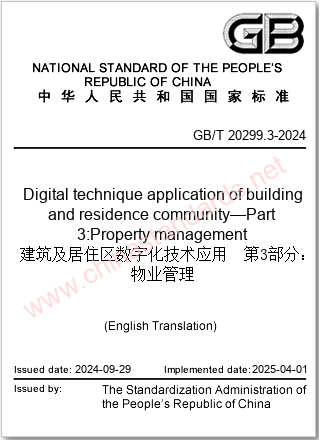
GB/T 20299.3-2024 in English
VALIDDigital technique application of building and residence community—Part 3:Property management
- Issued on:2024-09-29
- Implemented on:2025-04-01
- File Format:PDF
- Delivery:Via email within 5 business days
$418.00
| Standard No: | GB/T 20299.3-2024 |
| Document status: | VALID |
| Title in English: | Digital technique application of building and residence community—Part 3:Property management |
| Title in Chinese: | 建筑及居住区数字化技术应用 第3部分:物业管理 |
| Language: | English |
| File Format: | Electronic (PDF) |
| Delivery: | Via email within 5 business days |
| Issued on: | 2024-09-29 |
| Implemented on: | 2025-04-01 |
| Superseding: |
GB/T 20299.3-2006 Digital technique application of building and residence community - Part 3: Property management
|
| ICS Classification: | 35.240.01-Applications of information technology in general |
| Chinese Classification: | L70-Information processing technology in general |
| Professional Classification: | GB-National Standard |
| Related Keywords: | property management digital technology application standard
property management digital management digital management system digital technique application |
| Related Topics: | Digitizing
technology application digital technology property management "Digitizing GB/T 20299.3 |
《GB/T 20299.3-2024建筑及居住区数字化技术应用 第3部分:物业管理》由TC426(全国智能建筑及居住区数字化标准化技术委员会)归口,主管部门为住房城乡建设部。
Introduction
Interpretation of GB/T 20299.3—2024 Property Management Digital Technology Application Standard
1. Background of Standard Formulation and Analysis of Technology Evolution
With the widespread application of information technology in the fields of housing and urban and rural construction, the property management industry is facing new demands for the integration of online and offline development. The release of GB/T 20299.3—2024 standard aims to improve property management efficiency and service level through digital technology and meet the diversified and multi-level life service needs of residents.
2. Comparison of standard frameworks
| Standard dimensions | 2006 version content | 2024 version new/modified content |
|---|---|---|
| Terms and definitions | Digital application of property management, digital management of property business, etc. | New terms such as digital management of facilities and equipment, BIM operation and maintenance system, etc. |
| Technical requirements | Mainly include database, application system, integrated security management system, etc. | New requirements for the Internet of Things system, and strengthen the application of the BIM operation and maintenance platform. |
| Security requirements | No specific requirements for information security are clearly stated. | Added multi-dimensional security requirements such as system security, network security, and data security. |
3. Interpretation of core technical requirements
3.1 Database and application system
Database design must follow the principles of scientificity, compatibility, and scalability, and support multi-dimensional data interaction and management functions. The application system should have multi-terminal (PC, APP, mini-program) access capabilities and provide flexible role permission allocation functions.
3.2 Internet of Things and BIM Operation and Maintenance
The Internet of Things system must support the interconnection and interaction of cross-system devices and adopt the national standard identification and coding scheme. The BIM operation and maintenance platform should have the functions of dynamic model update, multi-dimensional data integration, and secondary development and expansion.
3.3 Facility and Equipment Management
The digital management system for facilities and equipment shall realize real-time monitoring and intelligent alarm for key equipment such as elevators, fire protection facilities, and power supply and distribution systems, and support data sharing and linkage control of multiple protocols.
4. Implementation Suggestions
< subsection>4.1 Phased Implementation
- First, complete the construction of basic digital systems (such as databases and application platforms).
- Gradually promote the deployment and integration of IoT devices and BIM operation and maintenance systems.
- Finally, realize cross-system data interoperability and business collaboration.
4.2 Security Assurance
- Establish a sound information security management system, and conduct vulnerability scanning and penetration testing regularly.
- Adopt multi-level security protection measures (firewalls, intrusion detection systems, etc.).
- Strengthen personnel training and enhance information security awareness.

Loading PDF document...
Error loading PDF. Please make sure the file is valid and try again.
We also recommend
-
GB/Z 222-2026 in English
Artificial intelligence—Model as a service (MaaS) performance specification
2026-08-27 -

GB/Z 38623-2020 in English
Intelligent manufacturing—Human-computer interaction system—Technological requirements of semantic library
2020-04-28 -
GB/T 42455.2-2024 in English
Smart city—Building and residence community—Part 2:Smart community assessment
2024-09-29 -

GB/T 47177.1-2026 in English
Quantum computing service platform—Part 1 : Architecture and functional requirements
2026-02-27 -

GB/T 37700-2019 in English
Information technology—Industrial cloud—Reference model
2019-08-30 -

GB/T 37938-2019 in English
Information technology—Cloud resources monitoring index system
2019-08-30 -

GB/T 44811-2024 in English
Internet of things—Data quality evaluation methods
2024-10-26


