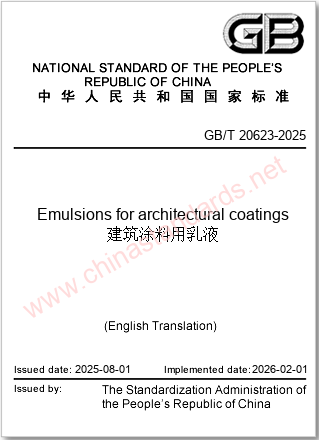
GB/T 20623-2025 in English
VALIDEmulsions for architectural coatings
- Issued on:2025-08-01
- Implemented on:2026-02-01
- File Format:PDF
- Delivery:Via email within 1~3 business days
$233.00
| Standard No: | GB/T 20623-2025 |
| Document status: | VALID |
| Title in English: | Emulsions for architectural coatings |
| Title in Chinese: | 建筑涂料用乳液 |
| Language: | English |
| File Format: | Electronic (PDF) |
| Delivery: | Via email within 1~3 business days |
| Issued on: | 2025-08-01 |
| Implemented on: | 2026-02-01 |
| Superseding: |
GB/T 20623-2006 Emulsions for architectural coatings
|
| ICS Classification: | 87.060.20-Binders |
| Chinese Classification: | G52-Coating auxiliary materials |
| Professional Classification: | GB-National Standard |
| Related Keywords: | architectural coatings emulsion industry
architectural coatings industry architectural coatings general architectural coatings architectural coatings introduction background |
| Related Topics: | GB/T20623-2006
|
《GB/T 20623-2025建筑涂料用乳液》由TC5(全国涂料和颜料标准化技术委员会)归口,TC5SC10(全国涂料和颜料标准化技术委员会涂料用漆基产品和试验方法分会)执行,主管部门为中国石油和化学工业联合会。
Introduction
Background and Significance of the Standard Revision
GB/T 20623-2025, "Emulsions for Architectural Coatings," is the first revision of the 2006 version, reflecting over a decade of technological advancement and increased environmental protection requirements in my country's architectural coatings industry. The new standard, implemented in 2025, is jointly issued by the State Administration for Market Regulation and the Standardization Administration of China, and is managed by the National Technical Committee for Standardization of Paints and Pigments (SAC/TC5).
This revision responds to national green building materials policies and environmental regulations, focusing on three key areas: volatile organic compound control, hazardous substance limitations, and product performance enhancements. Compared to the 2006 version, the new standard features a comprehensive upgrade in technical content, adding multiple environmental indicators and performance requirements.
Analysis of Main Technical Changes
Compared with the 2006 version, the new standard has undergone structural adjustments and substantial technical improvements. The main changes are reflected in the following five aspects:
| Type of change | 2006 version of the standard | 2025 version of the standard | Technical significance |
|---|---|---|---|
| Structural framework | Chapter 4: Scope, requirements, test methods, inspection rules | Chapter 8: Added term definitions, product classification | The system is more complete and the classification is more scientific |
| Environmental indicators | Only VOC, formaldehyde, residual monomers | Added 6 indicators including benzene, SVOC, APEO, etc. | Environmental protection requirements have been greatly improved |
| Performance requirements | Basic physical properties | Increased tensile strength and elongation at break | More comprehensive application performance requirements |
| Test methods | Some methods are outdated | Updated to the latest test standard methods | Improved test accuracy |
| Product classification | No clear classification | Dual classification by function and purpose | Stronger application guidance |
Product classification system
The new standard establishes a complete classification system for emulsions for architectural coatings for the first time, adopting the dual classification principles of function and purpose:
Classification by function
- General type: Suitable for general architectural coatings needs
- Elasticity: With elastic function, elongation at break ≥600%
Classification by purpose
- Class A: Emulsion for overprint varnish
- Class B: Emulsion for other uses
This classification method better meets market demand and provides clear technical guidance for different application scenarios.
Comparison of Technical Requirements and Indicators
The new standard has been comprehensively upgraded in terms of technical requirements, especially the environmental protection indicators and mechanical performance requirements:
Environmental protection indicator requirements
| Test Items | Indicator Requirements | Test Methods | Technical Highlights |
|---|---|---|---|
| Benzene Content | ≤20 mg/kg | GB/T 23990-2009 Method B | New Strictly Controlled Items |
| Sum of Benzene Series | ≤200 mg/kg | GB/T 23990-2009 Method B | New comprehensive control |
| Formaldehyde content | ≤50 mg/kg | GB/T 23993 | More stringent requirements |
| VOC content | ≤20 g/L | GB/T 23986.2-2023 | Substantially reduce the limit |
| SVOC content | Class A≤60 g/L Class B≤40 g/L | GB/T 23986.2-2023 | New control items |
| Total APEO content | ≤1000 mg/kg | GB/T 31414 | New environmental hormone control |
Physical performance requirements
New mechanical performance requirements for elastic emulsions:
- Tensile strength: ≥1.0 MPa under standard conditions
- Elongation at break: ≥600% under standard conditions, ≥200% at -10℃
Test method update and optimization
The new standard has been comprehensively updated in terms of test methods, and the latest national standard test methods have been adopted:
Key testing equipment requirements
The standard clearly stipulates the specifications of key testing equipment, such as:
- Tensile testing machine: in accordance with GB/T 528 requirements
- Gas chromatograph: equipped with hydrogen flame ionization detector
- Headspace sampling device: for residual monomer detection
- High-speed disperser: disc-shaped stirring head, 40mm diameter
Update of detection method
- VOC content detection: adopt the latest method of GB/T 23986.2-2023
- Formaldehyde content detection: adopt acetylacetone spectrophotometry
- APEO content detection: newly added ultrasonic extraction method
- Residual monomer detection: detailed provisions in the normative appendix
Implementation suggestions and technical countermeasures
Production enterprise response strategy
In response to the requirements of the new standard, paint emulsion manufacturers need to upgrade their technology in the following aspects:
| Technical field | Challenge analysis | Solution |
|---|---|---|
| Raw material control | Increased monomer purity requirements | Establish a strict supplier audit system and strengthen incoming material inspection |
| Production process | Residual monomer control is difficult | Optimize polymerization process and adopt post-treatment technology to reduce residual monomer |
| Formula design | APEO additives are prohibited | Develop environmentally friendly alternative additives and optimize the formulation system |
| Quality Control | Increase in testing items and rising costs | Invest in testing equipment and establish a complete quality control system |
Testing Laboratory Construction
It is recommended that enterprise laboratories be equipped with the following key equipment:
- Gas Chromatography-Mass Spectrometry: for VOC and SVOC detection
- Headspace Autosampler: for residual monomer analysis
- Electronic Tensile Testing Machine: equipped with a low-temperature chamber for mechanical property testing
- Constant Temperature and Humidity Chamber: to meet the requirements of standard maintenance conditions
Impact Analysis of Standard Implementation
Impact on the Industry
The implementation of the new standard will have a profound impact on the architectural coatings industry:
- Increased technical threshold: prompting companies to increase R&D investment and eliminate outdated production capacity
- Accelerated product upgrades: promoting the development of environmentally friendly, high-performance emulsion products
- Changes in the market landscape: companies with technological advantages will gain a larger market share
- Internationalization: technical indicators will be aligned with advanced international standards, enhancing international competitiveness
Impact on downstream applications
Improving the quality of emulsions used in architectural coatings will directly improve the performance of the final coatings:
- Significantly improved environmental performance of coatings and significantly reduced VOC emissions
- Improved mechanical properties of coating films and extended service life
- Optimized construction performance and expanded application scope
- Providing better material support for green building certification
Summary and Outlook
GB/T The release and implementation of the national standard 20623-2025 "Emulsions for Architectural Coatings" marks a new stage of development for my country's architectural coatings emulsion industry. The new standard not only raises the environmental performance requirements for products, but also sets higher standards for product quality and application performance.
With the implementation of the standard, the industry is expected to exhibit the following development trends:
- Environmentally friendly emulsions will become the mainstream of the market, and the process of water-based emulsions will be further accelerated
- Demand for functional emulsions, such as those with special functions such as elasticity, antibacterial properties, and self-cleaning, will increase
- Testing technology continues to advance, and rapid testing methods will be widely used
- Industry integration is accelerating, and technological innovation capabilities have become core competitiveness
Related companies are advised to make technical preparations in advance and strengthen R&D and innovation to adapt to the requirements of the new standard and gain a favorable position in future market competition.

Loading PDF document...
Error loading PDF. Please make sure the file is valid and try again.


