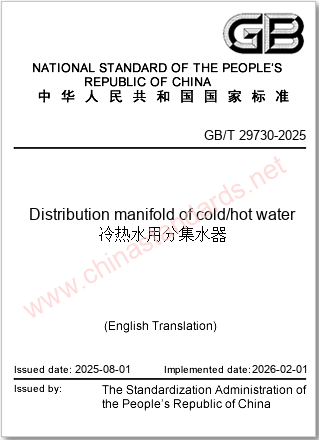
GB/T 29730-2025 in English
VALIDDistribution manifold of cold/hot water
- Issued on:2025-08-01
- Implemented on:2026-02-01
- File Format:PDF
- Delivery:Via email within 1~3 business days
$262.00
| Standard No: | GB/T 29730-2025 |
| Document status: | VALID |
| Title in English: | Distribution manifold of cold/hot water |
| Title in Chinese: | 冷热水用分集水器 |
| Language: | English |
| File Format: | Electronic (PDF) |
| Delivery: | Via email within 1~3 business days |
| Issued on: | 2025-08-01 |
| Implemented on: | 2026-02-01 |
| Superseding: |
GB/T 29730-2013 Distribution manifold of cold/hot water
|
| ICS Classification: | 91.140.30-Ventilation and air-conditioning systems |
| Chinese Classification: | Q76-Building heating and ventilation and air conditioning instrument and equipment |
| Professional Classification: | GB-National Standard |
| Related Keywords: | distribution manifold
manifold materials cold/hot water introductiongb/t29730-2025 standard revision background manifold body manifold regulating valve |
| Related Topics: | water moisture
water return device Secondary collector water cooler |
《GB/T 29730-2025冷热水用分集水器》由TC143(全国暖通空调及净化设备标准化技术委员会)归口,主管部门为住房城乡建设部。
Introduction
GB/T29730-2025 Standard Revision Background and Technological Evolution
The GB/T29730-2025 national standard, "Manifolds for Hot and Cold Water," marks the first comprehensive revision of the 2013 edition, reflecting changes in technological development and market demand in my country's HVAC industry. This revision not only includes structural adjustments and editorial changes, but also achieves significant breakthroughs in technical content.
Major Technical Changes and Innovations
Compared to the 2013 edition, the new standard has undergone 11 major technical adjustments:
| Revision category | 2013 edition | 2025 edition | Technical significance |
|---|---|---|---|
| Definition of terms | 5 basic terms | 3 new terms: electrothermal actuator, electric actuator, flow coefficient | Adapt to the development needs of intelligent control |
| Classification system | Single classification method | Dual classification by material and connection method | Improve product specification system |
| Performance requirements | 6 basic requirements | 4 new performance requirements: corrosion resistance, torsion resistance, pull-out resistance, opening and closing | Improve product reliability standards |
| Test methods | 6 test methods | Increased to 12 test methods, covering comprehensive performance testing | Improve the quality evaluation system |
Classification and marking system for manifolds
Chapter 4 of the standard clarifies the systematic classification method for manifolds:
Classification by material:Copper alloy manifolds (code C), stainless steel manifolds (code S), plastic manifolds (Code P)
Classification by connection method:Internal thread connection (code F), external thread connection (code M), flange connection (code FL)
Marking example: DM-CF-25×20-4 indicates a manifold made of copper alloy, internal thread connection, main pipe DN25, branch pipe DN20, and 4-way branch pipes
Material requirements and quality control
Chapter 5 of the standard sets clear requirements for manifold materials:
Copper alloy manifold Machining materials and hot forging materials must meet the requirements of GB/T5231 or YS/T583, and the lead brass material must not be lower than HPb59-1 grade
Stainless steel manifold The main material must meet the requirements of S11972, S30408 and other grades in GB/T12771
Plastic manifolds can be made of a variety of materials, including PE, PP, PB, and ABS, but must comply with relevant product standards.
Detailed Explanation of Key Performance Requirements
Hydraulic Balance Performance (Clause 6.6)
When the valves on each branch of the manifold are fully open, the flow uniformity requirement is: $$\frac{q_{1}-q_{2}}{q_{1}+q_{2}}\times100\%\leqslant7.5\%$$
This indicator ensures balanced flow distribution across the system branches and avoids hydraulic imbalance.
Flow Regulation Performance (Clause 6.7)
When the manifold regulating valve is 25% open, the flow rate must not exceed 30% of the fully open flow rate, and when it is 50% open, it must not exceed 70% to ensure linear regulation characteristics.
Mechanical Performance Requirements
| Performance items | Test methods | Qualification standards | Applicable products |
|---|---|---|---|
| Bending performance | 7.9 | No damage according to the force specified in Table 2 | Copper alloy, stainless steel |
| Torsional performance | 7.10 | No damage according to the torque specified in Table 3 | Copper alloy, stainless steel |
| Pull-out resistance | 7.11 | 1.178×DN²(N) tensile force for 1h without separation | All types |
Innovation in detection and test methods
The new version of the standard adds systematic test conditions (Clause 7.1) to ensure the comparability and accuracy of the test results:
Test medium: air at room temperature and clean water at 5℃~40℃
Measuring instrument accuracy: not less than Class 1.0
New test methods such as salt spray test, torsion test and pull-out resistance test have been added to improve the product quality evaluation system.
Inspection rules and quality control
Chapter 8 of the standard specifies the specific requirements for factory inspection and type inspection:
Factory inspection items:Appearance, dimensions and connections, and air tightness are mandatory inspection items
Type inspection timing:Must be carried out when new products are finalized, materials and processes are significantly changed, regular inspections are carried out, production is suspended and resumed, etc.
The sampling plan is implemented in accordance with GB/T2828.1, using the special inspection level S-3 and a single sampling plan for normal inspection with an AQL of 6.5
Implementation suggestions and application guidance
Design selection suggestions
Reasonably select the type of manifold according to system requirements: Copper alloy manifolds are suitable for high temperature and high pressure occasions, with an operating temperature of 5-85°C; plastic manifolds are suitable for medium and low temperature systems, with an operating temperature of 5-85°C; Operating temperature 5-60℃
Installation and Use Precautions
Rubber gaskets should be installed on the contact part between the fixing bracket and the manifold body to avoid electrochemical corrosion caused by direct metal contact
The number of branch pipes should follow the standard recommendations: DN25 should not exceed 6, DN32 should not exceed 9, DN40 should not exceed 12, and DN50 should not exceed 15
Key Points for Quality Acceptance
Focus on checking key indicators such as air tightness, pressure strength, and hydraulic balance performance to ensure that the product meets the standard requirements
For automatically controlled manifolds, it is also necessary to verify that the performance of the electric actuator or electric actuator meets the requirements of QB/T5788 or GB/T14536.1
Impact of Standard Implementation and Industry Significance
The implementation of GB/T29730-2025 will have a profound impact on the HVAC industry:
1. 1. Improve product quality and regulate market competition. 2. Promote technological innovation and advance the development of intelligently controlled manifolds. 3. Improve the testing and certification system to ensure project quality. 4. Align with advanced international standards to enhance product competitiveness. Manufacturing companies should familiarize themselves with the new standards as quickly as possible and complete product upgrades and technological transformations. Design firms should conduct system design and equipment selection in accordance with the new standards. Project quality supervision departments should strengthen market supervision and product spot checks based on the new standards.

Loading PDF document...
Error loading PDF. Please make sure the file is valid and try again.
We also recommend
-
GB/T 6165-2021 in English
Test method of the performance of high efficiency particulate air filter—Efficiency and resistance
2021-04-30


