
GB/T 37482-2019 in English
VALIDImplementation guidance for energy management systems in aluminum electrolysis industry
- Issued on:2019-08-30
- Implemented on:2020-03-01
- File Format:PDF
- Delivery:Via email within 5 business days
$476.00
《GB/T 37482-2019电解铝行业能源管理体系实施指南》由TC20(全国能源基础与管理标准化技术委员会)归口,TC20SC3(全国能源基础与管理标准化技术委员会能源管理与节能评估分会)执行,主管部门为国家标准化管理委员会。
Introduction
Analysis of the core framework of the standard
| Core elements | Requirements of the electrolytic aluminum industry | Comparison of general management systems |
|---|---|---|
| Operation mode | Based on the PDCA cycle, with special emphasis on the energy balance test of the electrolytic cell (YS/T480/481) | Conventional PDCA cycle |
| Energy benchmark | It is necessary to establish a dual-dimensional benchmark at the enterprise level (comprehensive power consumption of aluminum liquid) and the process level (current efficiency) | A single organization-level benchmark |
| Key equipment | Key monitoring class=instrument>electrolytic cells, smoke exhaust fans and other equipment, full coverage of motors above 30kW | General equipment management |
Key technical implementation points
Special requirements for energy review
Electrolytic aluminum enterprises need to conduct energy review every year, focusing on:
- Power system: rectification efficiency (≥98%), electrolytic cell voltage (special-shaped cell ≤3.85V)
- Compressed air: gas consumption per ton of aluminum ≤25m³, air compressor operation energy efficiency ratio ≥3.5
- Process control: effect coefficient ≤0.05 times/cell·day, current efficiency ≥93%
Compliance Management Matrix
| Regulation Type | Typical Standard | Key Control Points |
|---|---|---|
| Mandatory Standards | GB21346 (Energy Consumption Limit) | AC Power Consumption of Liquid Aluminum≤13350kWh/t |
| Recommended Standards | YS/T480/481 | Electrolytic Cell Energy Balance Test Method |
| Equipment Energy Efficiency | GB18613 (Motor Energy Efficiency) | Motors below IE2 are prohibited |
Typical energy-saving technology applications
Transformation of special-shaped cathode electrolytic cells
Implementation cases show:
- Cell voltage reduced by 0.25-0.35V
- Electricity saving per ton of aluminum: 600-800kWh
- Investment payback period: 2-3 years
Suggestions for digital transformation
Clause 4.5.5.3 of the standard clearly requires the construction of an energy management center, which should achieve:
- Multi-dimensional operation analysis of electrolytic cells (voltage/temperature/molecular ratio)
- Intelligent joint control of pressure-flow of compressed air systems
- Real-time monitoring of harmonic control of power systems

Loading PDF document...
Error loading PDF. Please make sure the file is valid and try again.
We also recommend
-

GB/T 29871-2013 in English
General Data Interface Technology Protocol of Energy Metering Instrument
2013-11-12 -

GB/T 28749-2012 in English
The method of drawing energy balance network diagram for enterprises
2012-11-05 -

GB/T 1028-2018 in English
Industrial surplus energy resources evaluation methods
2018-09-17 -

GB/T 33757.2-2024 in English
Energy saving ratio for distributed energy system of combined cooling, heating and power—Part 2: Multi-energies hybrid driven systems
2024-09-29 -
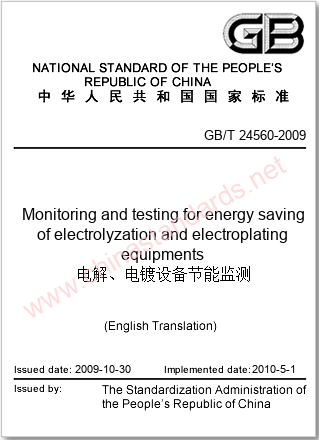
GB/T 24560-2009 in English
Monitoring and testing for energy saving of electrolyzation and electroplating equipments
2009-10-30 -

GB/T 10201-2008 in English
Regulations of proper usage of electricity in heat treatment industry
2008-06-19 -

GB/T 38692-2020 in English
Technical specification for energy online monitoring of energy consumption units
2020-03-31 -

GB 24500-2020 in English
Minimum allowable values of energy efficiency and energy efficiency grades of industrial boilers
2020-05-29 -

GB/Z 18718-2002 in English
Energy saving directives for heat treatment
2002-05-17 -

GB 20054-2015 in English
Minimum allowable values of energy efficiency and energy efficiency grades for metal-halide lamps
2015-12-10


