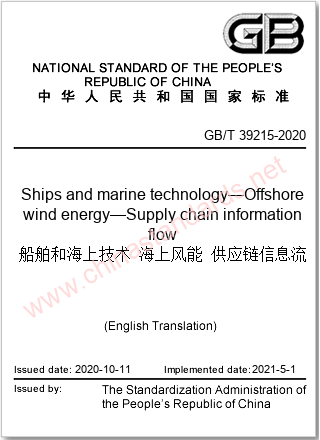
GB/T 39215-2020 in English
VALIDShips and marine technology—Offshore wind energy—Supply chain information flow
- Issued on:2020-10-11
- Implemented on:2021-05-01
- File Format:PDF
- Delivery:Via email within 5 business days
$534.00
《GB/T 39215-2020船舶和海上技术 海上风能 供应链信息流》由TC12(全国海洋船标准化技术委员会)归口,TC12SC3(全国海洋船标准化技术委员会船舶基础分会)执行,主管部门为国家标准化管理委员会。
Introduction
Standard Overview
This standard is equivalent to ISO 29404:2015, which specifies the logistics information message format of offshore wind turbine (WTG) components from suppliers to installation sites, focusing on the supply chain information flow management during the installation and maintenance stages.
Core content analysis
1. Supply chain process management
| Phase | Key information | Participants |
|---|---|---|
| Component production | Unique identifier, planned stay time | Manufacturer |
| Inland transportation | Transport carrier ID, GPS positioning | Logistics service provider |
| Offshore installation | Installation vessel IMO number, estimated arrival time | Installation company |
2. EPCIS extension mechanism
Based on the EPCIS standard, three types of data fields are extended:
- Plan data: PT field (such as PTArrivalPort)
- Instruction data: ET field (such as ETDeparturePort)
- Event data: New processing status (such as loading_completed)
Key points of technical implementation
Unique identification system
Wind turbine components are encoded with SGTIN, transport ships use IMO numbers, and port locations are identified by SGLN, forming a full-link traceability system.
Data carrier selection
RFID (ISO/IEC 18000-6) or QR code (ISO/IEC 16022) is recommended as the physical carrier to ensure AIDC technology compatibility.
Standard evolution background
With the large-scale development of offshore wind power projects, traditional paper documents can no longer meet the needs of cross-border supply chain collaboration. This standard solves the following problems by unifying EPCIS extension fields:
- Information gaps in multimodal transport
- Real-time coordination between installation vessels and ports
- Reverse logistics tracking during maintenance period
Implementation suggestions
It is recommended that enterprises implement the standard in three stages:
- Identification system construction: Standardize GLN/SGTIN encoding according to Chapter 7
- EPCIS system transformation: Refer to Appendix A to expand XMLSchema
- Process alignment: Establish event mapping rules based on Table B.1

Loading PDF document...
Error loading PDF. Please make sure the file is valid and try again.
We also recommend
-

GB/T 17843-2025 in English
Ships and marine technology—Dredgers—Vocabulary
2025-10-05 -

GB/T 7727.1-2008 in English
General terminology for ship - Part 1: Comprehension
2008-02-03 -

GB/T 47043-2026 in English
Ships and marine technology—Model tests of ice load on fixed structures
2026-01-28 -

GB/T 42057-2022 in English
Hydrostatic pressure test method for submersible and its pressure equipments
2022-10-12 -

GB/T 3894-2008 in English
Shipbuildin - Indication of details on arrangement plans of ships
2008-07-30 -

GB/T 30496-2014 in English
Shipbuilding - Active Control Units of Ships - Vocabulary
2014-02-19 -

GB/T 21475-2008 in English
Shipbuilding - Colours of indicator lights
2008-03-03


