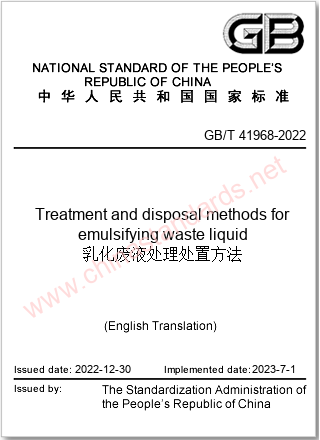
GB/T 41968-2022 in English
VALIDTreatment and disposal methods for emulsifying waste liquid
- Issued on:2022-12-30
- Implemented on:2023-07-01
- File Format:PDF
- Delivery:Via email within 1~3 business days
$156.00
《GB/T 41968-2022乳化废液处理处置方法》由TC294(全国废弃化学品处置标准化技术委员会)归口,主管部门为中国石油和化学工业联合会。
Introduction
Interpretation of Standards for Treatment and Disposal of Emulsified Wastewater
| Treatment Method | Scope of Application (COD Cr) | Main Process Steps | Treatment Results |
|---|---|---|---|
| Oil Separation - Air Floatation - Oxidation - Biochemical Method | COD Cr is less than 50000 mg/L | Separation of floating oil in grease trap → air floatation treatment → Fenton oxidation → biochemical treatment | In compliance with GB8978 or relevant emission standards |
| Oil Separation - Electrochemical Oxidation - Biochemical Method | COD Cr is less than or equal to 50000 mg/L | Separation of floating oil in grease trap→Electrochemical oxidation→Biochemical treatment | In compliance with GB8978 or relevant emission standards |
| Oil separation-evaporation concentration-oxidation-biochemical method | COD Cr is greater than 50000 mg/L | Separation of floating oil in grease trap→Evaporation concentration→Fenton oxidation→Biochemical treatment | In compliance with GB8978 or relevant emission standards |
| Membrane separation method | COD Cr is less than 50000 mg/L | Separation of floating oil in grease trap→Ultrafiltration→Nanofiltration→Reverse osmosis | Complies with GB/T19923 requirements |
Standard formulation background and technology evolution analysis
The treatment of emulsified waste liquid is an important part of environmental protection, especially in the fields of metal processing, petroleum refining and aluminum rolling, where the amount of emulsified waste liquid generated is huge and highly polluting. The formulation of GB/T41968-2022 standard aims to standardize the treatment methods of emulsified waste liquid, ensure its safe disposal and reduce harm to the environment.
Technology evolution analysis
With the improvement of environmental protection requirements and technological progress, the treatment technology of emulsified waste liquid has evolved from simple physical separation to complex multi-stage combined treatment. In the early days, oil separation and flotation were mainly used, while the application of modern technologies such as Fenton oxidation, electrochemical oxidation and membrane separation technology has significantly improved the treatment efficiency and effect.
Implementation recommendations
- Enterprises should choose appropriate treatment methods based on their own waste liquid characteristics and operate in strict accordance with standard requirements.
- It is recommended to regularly maintain and update the treatment equipment to ensure its efficient operation.
- During the treatment process, various process parameters should be strictly monitored to ensure compliance with environmental protection requirements.
- Strengthen employee training and improve awareness of the importance of emulsified waste liquid treatment.

Loading PDF document...
Error loading PDF. Please make sure the file is valid and try again.
We also recommend
-

GB/T 32124-2024 in English
Treatment and disposal specification for phosphogypsum
2024-09-29 -

GB/T 36380-2025 in English
Treatment and disposal specification for waste sulfuric acid from industrial manufacture
2025-08-01 -

GB/T 47075-2026 in English
Determination of cephalosporins in wastewater—Liquid chromatography-tandem mass spectrometry
2026-01-28


