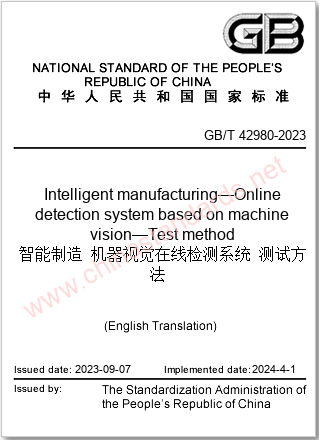
GB/T 42980-2023 in English
VALIDIntelligent manufacturing—Online detection system based on machine vision—Test method
- Issued on:2023-09-07
- Implemented on:2024-04-01
- File Format:PDF
- Delivery:Via email within 1~3 business days
$233.00
《GB/T 42980-2023智能制造 机器视觉在线检测系统 测试方法》由339-1(工业和信息化部(电子))归口,主管部门为工业和信息化部(电子)。
Introduction
In-depth interpretation of test methods for online machine vision detection systems in intelligent manufacturing
1. Standard Overview
GB/T 42980-2023 "Test Methods for Online Machine Vision Detection Systems in Intelligent Manufacturing" is an important standard formulated by China for online machine vision detection systems in the field of intelligent manufacturing. This standard is used in conjunction with GB/T 40659-2021 "General Requirements for Online Machine Vision Detection Systems in Intelligent Manufacturing" to form a series of national standards for online machine vision detection for intelligent manufacturing.
This standard specifies the test environment, system function test methods and system performance test methods, and is suitable for guiding the research and development, manufacturing, and application institutions and enterprises of machine vision online detection systems. Through standardized test processes and methods, the accuracy and reliability of the detection system are ensured, providing technical support for intelligent manufacturing.
2. Standard Framework Comparison
| Test Items | GB/T 40659—2021 | This Document | |
|---|---|---|---|
| Operation Mode | 6.2 | 6.1 | |
| System Configuration | 6.3 | 6.2 | |
| System Self-diagnosis | 6.4 | 6.3 | |
| Remote maintenance | 6.5 | 6.4 | |
| Communication protocol | 6.6 | 6.5.1 | |
| Communication interface | 6.6 | 6.5.2 | |
| Communication data quality requirements | 6.6 | 6.5.3 | |
| Accuracy | 7.4 | 7.1.1 | |
| Escape rate | 7.4 | 7.1.2 | |
| False alarm rate | 7.4 | 7.1.3 | |
| Speed | 7.2 | 7.2 | |
| Reliability | 7.1 | 7.3 | |
| Identification and detection accuracy | 7.2 | 7.4.1 | |
| Measurement and positioning accuracy | 7.2 | 7.4 | 7.6 |
| Electrical and Mechanical Safety | 7.1 | 7.7.1 | |
| Functional Safety | 7.1 | 7.7.2 | |
| Information Security | 7.1 | 7.7.3 |
3. Professional terminology explanation and practical application cases
Machine vision online inspection system: It is an automated inspection system based on computer vision technology, which is used to monitor the quality and detect defects of products in the production process in real time.
Accuracy: It refers to the degree of consistency between the inspection result and the actual result. In intelligent manufacturing, accuracy is an important indicator to measure the performance of machine vision systems.
Escape Rate: It refers to the proportion of actually defective products that are mistakenly judged as qualified products. The lower the escape rate, the stronger the quality control ability of the system.
Measurement and Positioning Precision: It refers to the accuracy of the system's measurement of object size, position and other parameters. High precision is the key to achieving precision manufacturing.
Case Study: Auto Parts Inspection
In the automotive manufacturing industry, machine vision online inspection systems are widely used to detect surface defects in engine cylinders. The test methods specified in GB/T 42980-2023 can ensure the accuracy and reliability of the system and reduce safety hazards caused by defective parts.
4. Background of Standard Formulation and Analysis of Technological Evolution
With the rapid development of intelligent manufacturing, machine vision technology is increasingly used in industrial inspection. However, due to the lack of unified testing standards, the performance of products from different manufacturers varies, resulting in unstable user experience.
The formulation of GB/T 42980-2023 fills this gap, and promotes technological progress in the industry and improves product quality through standardized testing methods and indicators. At the same time, the standard also reserves expansion space for future technological evolution, and can adapt to the development needs of new technologies such as artificial intelligence and deep learning.
5. Implementation Suggestions
Testing Process: In actual applications, systematic testing should be carried out in accordance with the testing process specified in Appendix A (requirements analysis, test planning, test design, test execution, test summary).
Staff Training: It is recommended that enterprises conduct standardized training for relevant technical personnel to ensure the correct understanding and application of test methods and indicators.
Technical Support: For complex test items (such as reliability, information security, etc.), it is recommended to seek technical support from professional organizations to ensure the authority and accuracy of the test results.

Loading PDF document...
Error loading PDF. Please make sure the file is valid and try again.


