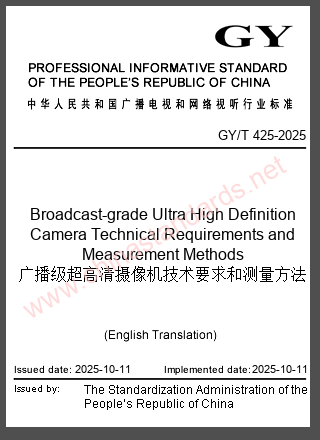
GY/T 425-2025 in English
VALIDBroadcast-grade Ultra High Definition Camera Technical Requirements and Measurement Methods
- Issued on:2025-10-11
- Implemented on:2025-10-11
- File Format:PDF
- Delivery:Via email within 1~3 business days
$248.00
| Standard No: | GY/T 425-2025 |
| Document status: | VALID |
| Title in English: | Broadcast-grade Ultra High Definition Camera Technical Requirements and Measurement Methods |
| Title in Chinese: | 广播级超高清摄像机技术要求和测量方法 |
| Language: | English |
| File Format: | Electronic (PDF) |
| Delivery: | Via email within 1~3 business days |
| Issued on: | 2025-10-11 |
| Implemented on: | 2025-10-11 |
| ICS Classification: | 33.160.01-audio, video and audiovisual systems in general |
| Chinese Classification: | M70-Broadcasting and television equipment in general |
| Professional Classification: | GY-Radio, Film and TV |
Introduction
Background and Technological Evolution of Standard Development
GY/T 425-2025 "Technical Requirements and Measurement Methods for Broadcast-Grade Ultra-High-Definition Cameras" is an important standard document for China's broadcasting, television, and online audiovisual industries against the backdrop of the rapid development of ultra-high-definition technology. Released in 2025, this standard was jointly drafted by more than 20 organizations, including the Academy of Broadcasting Science of the State Administration of Radio and Television and China Media Group, marking a new stage in the standardization of ultra-high-definition camera technology in China.
Compared with the GY/T 295-2015 high-definition camera standard, the major breakthroughs of this standard are reflected in: the resolution being upgraded from high-definition to 8K/4K ultra-high-definition, the dynamic range being expanded from SDR to HDR, and the interface standard being upgraded from 3G-SDI to 12G-SDI and IP streaming media.
This technological evolution aligns with the global trend of ultra-high-definition video industry development, providing unified technical specifications for domestic ultra-high-definition program production. The standard clearly classifies broadcast-grade ultra-high-definition cameras into two main types: ultra-high-definition studio cameras (electronic field production cameras) and ultra-high-definition electronic news gathering cameras. Both types of cameras require resolutions of 8K (7680×4320) and 4K (3840×2160), and the signal format must comply with GB/T 41808-2022.
| Functional Category | Studio Camera Requirements | News Gathering Camera Requirements | Technical Difference Analysis |
|---|---|---|---|
| Control Method | Supports camera control unit connection and control | Features standard menu reset function | Studios emphasize remote control, news gathering emphasizes ease of operation |
| Recording Function | No built-in recording requirement | Requires recording and storage function | News gathering requires independent working capability |
| Interface Configuration | SDI or IP interface (choose one) | SDI, IP, HDMI (choose one) | More flexible and diverse news acquisition interfaces |
| Alarm function | Not required | Media storage, battery capacity, and device fault alarms | News acquisition emphasizes on-site reliability |
Regarding photoelectric conversion functions, both types of cameras are required to have HLG or PQ HDR functions, while also being compatible with the SDR standard. Color gamut support must comply with the color gamut space specified in GB/T 41809-2022 to ensure the accuracy and consistency of color reproduction.
In-depth analysis of photoelectric performance indicators
The standard divides photoelectric performance into two levels, Class A and Class B, providing differentiated technical requirements for different application scenarios. The sensitivity requirement is ≥F8 for all three photoelectric conversion functions, reflecting a high degree of emphasis on shooting capabilities in low-light environments.
| Performance Indicators | Class A Requirements | Class B Requirements | Test Conditions |
|---|---|---|---|
| Dynamic Range | ≥13 stops (HDR) | ≥12 stops (HDR) | Inflection Point Enabled, Gain 0dB |
| Center Sharpness | 8K≥3600TVL 4K≥2000TVL | 8K≥3200TVL 4K≥1800TVL | Gain 0dB, Detail Enabled |
| Brightness Channel Signal-to-Noise Ratio | ≥60dB | ≥54dB | Gain 0dB, Noise Reduction Off |
| Defect Requirements | No Defects | Inspection under Different Gain Conditions | |
Dynamic range testing uses a 21-level grayscale test chart. By adjusting the inflection point position and compression ratio, the maximum number of distinguishable grayscale levels is read on an ultra-high-definition waveform analyzer. This indicator is directly related to the camera's detail performance in high-contrast scenes.
Output Interface Technical Specifications
The standard specifies detailed technical requirements for three main output interfaces: 3Gbps-SDI, 12Gbps-SDI, and IP interface.
The rise/fall time requirement of the 12Gbps-SDI interface is ≤45ps, which is a significant improvement over the 135ps of the 3Gbps-SDI interface, reflecting the strict requirements of ultra-high-definition signal transmission for timing accuracy.
| Interface Parameters | 3Gbps-SDI Requirements | 12Gbps-SDI Requirements | Technical Significance |
|---|---|---|---|
| Signal Amplitude | 800mV±80mV | 800mV±80mV | Ensuring Signal Transmission Stability |
| Rise Time | ≤135ps | ≤45ps | High Frequency Signal Integrity Guarantee |
| Jitter (100kHz) | ≤0.3UI | ≤0.3UI | Clock Synchronization Accuracy Requirements |
| Link Delay Difference | ≤400ns | ≤250ns | Key Parameters for Multi-Link Synchronization |
IP output interface requirements comply with GY/T 414-2024 (video), SMPTE ST 2110-30:2017 (audio) and SMPTE ST 2110-40:2018 (auxiliary data) standards, with a dual-channel IP output delay difference not exceeding 150μs, providing technical assurance for IP-based production and broadcasting systems.
Audio Performance Index Analysis
The standard sets forth clear requirements for the audio performance of ultra-high-definition electronic news acquisition cameras, divided into two categories: microphone signal input and line signal input. The signal-to-noise ratio requirement for line input is ≥75dB, significantly higher than the ≥60dB requirement for microphone input, reflecting the differentiated requirements for the quality of different signal sources.
Practical Application Case Analysis
In large-scale sports event broadcasts, the Ultra-HD Studio Camera transmits 8K signals to the production center via a 12Gbps-SDI interface. Its Class A optoelectronic performance ensures high-quality images even under complex lighting conditions in stadiums. Simultaneously, the requirement for a comprehensive transmission distance of at least 1km allows for flexible deployment of the camera head at any location on site.
In live news reporting, the Ultra-HD Electronic News Acquisition Camera's alarm function promptly indicates the remaining time and battery capacity of the storage medium. Its audio signal distribution function supports assigning wireless microphones and front microphones to different channels, providing greater flexibility for post-production.
Significance of Standardization of Measurement Methods
Chapter 6 of the standard details the measurement methods for various technical indicators, including measurement environmental conditions, equipment connection methods, and specific operating procedures. The measurement environment requires a temperature of 15℃~35℃, relative humidity of 10%~90%, and air pressure of 86kPa~106kPa to ensure the comparability and repeatability of test results.
Photoelectric performance measurements must be conducted in an optical darkroom, with an illuminance of 2000lx±20lx when using a reflective test card, and a white block reflectance of 89.9%. These standardized testing conditions provide a unified benchmark for comparing the performance of equipment from different manufacturers, promoting the overall improvement of the industry's technical level.
Standard Implementation Recommendations and Outlook
Based on the content of GY/T 425-2025 standard, the following recommendations are made for the development of the ultra-high-definition camera industry:
| Application Areas | Equipment Selection Recommendations | Key Performance Considerations | Testing and Acceptance Points |
|---|---|---|---|
| Broadcast and Television Production | Class A Studio Camera | Dynamic Range, Signal-to-Noise Ratio | Multi-Link Delay Synchronization |
| News Scene Acquisition | Class B News Acquisition Camera | Recording Reliability, Ease of Operation | Comprehensive Audio Performance Testing |
| Live Broadcast of Large-Scale Events | Class A Studio Camera | Sensitivity, Overall Transmission Distance | Long-Distance Transmission Stability |
| Film and Television Production | Class A News Gathering Camera | Color Reproduction, Detail Performance | HDR/SDR Compatibility |
With the continuous development of ultra-high-definition technology, future standards may further evolve towards 8K 120fps high frame rate, wider color gamut Rec.2020, and AI-based image optimization. GY/T 425-2025 lays a solid standardization foundation for this technological evolution and will strongly promote the high-quality development of China's ultra-high-definition video industry.

Loading PDF document...
Error loading PDF. Please make sure the file is valid and try again.
We also recommend
-

GY/T 410-2024 in English
Interaction protocol specification between cable TV unidirectional gateway and 4K ultra-high definition plug-in micro set-top box
2024-10-14 -

GY 63-1989 in English
broadcasting and television centers, sites, and stations Safety rules of electrical operations
1989-01-01 -

GY/T 287-2024 in English
Technical requirements for encoding and decoding of digital television signals during transmission and secondary distribution
2024-12-30 -

GY/T 319-2025 in English
Technical Requirements and Measurement Methods for Centralized Storage in Television Program Production Systems
2025-08-19


