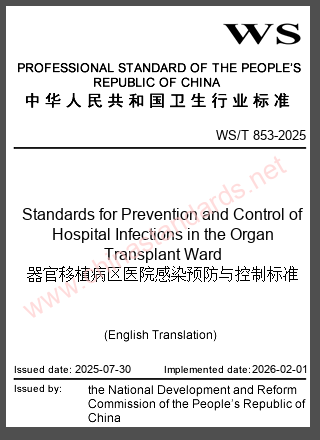
WS/T 853-2025 in English
VALIDStandards for Prevention and Control of Hospital Infections in the Organ Transplant Ward
- Issued on:2025-07-30
- Implemented on:2026-02-01
- File Format:PDF
- Delivery:Via email within 1~3 business days
$135.00
| Standard No: | WS/T 853-2025 |
| Document status: | VALID |
| Title in English: | Standards for Prevention and Control of Hospital Infections in the Organ Transplant Ward |
| Title in Chinese: | 器官移植病区医院感染预防与控制标准 |
| Language: | English |
| File Format: | Electronic (PDF) |
| Delivery: | Via email within 1~3 business days |
| Issued on: | 2025-07-30 |
| Implemented on: | 2026-02-01 |
| Chinese Classification: | C05-Medical science |
| Professional Classification: | WS-Hygiene |
| Related Keywords: | organ transplant infection prevention
organ transplant wards transplant recipient infection prevention strategythe prevention strategy hospital infection prevention organ transplant wardsws/t |
Introduction
In-Depth Analysis of the WS/T 853-2025 Standard for Infection Prevention and Control in Organ Transplant Wards
WS/T 853-2025, "Standard for Hospital Infection Prevention and Control in Organ Transplant Wards," is my country's first infection prevention and control standard specifically for organ transplant wards. It was released on July 30, 2025, and officially implemented on February 1, 2026. This standard, jointly drafted by Xiangya Hospital of Central South University and other authoritative institutions, marks a new stage of standardization and regularization in organ transplant infection prevention and control in my country.
Scope of Application and Core Definitions of the Standard
This standard applies to medical institutions with organ transplant wards, including those for liver transplantation, kidney transplantation, and heart transplantation. It does not cover institutions that provide human cell, corneal, or bone marrow transplantation. The standard clarifies the definitions of key terms such as transplant donors, transplant recipients, opportunistic infections, patients at high risk of infection and protected areas, laying the foundation for the precise implementation of infection prevention and control.
| Term categories | Definition points | Clinical application significance |
|---|---|---|
| Transplant recipients | Recipients of transplanted organs | Clear core targets of prevention and control |
| Opportunistic infections | Infections with weakly pathogenic pathogens when immune function is reduced | Identifying special infection risks |
| High-risk patients for infection | Patients in the rejection phase, those in the strongly immunosuppressed phase, etc. | Basis for tiered prevention and control |
| Protected areas | Special areas to prevent infection in immunocompromised patients | Spatial isolation standards |
Systematized management requirements
The standard requires medical institutions to establish a comprehensive hospital infection management system, establish a hospital infection management team, and clearly define eight responsibilities. Key areas include developing prevention and control measures and procedures, outbreak response plans, personnel training and assessment, and guidance on the appropriate use of antimicrobial agents.
Practical Example: After establishing a hospital infection management team and implementing standardized prevention and control procedures, the transplant center of a tertiary hospital saw its postoperative infection rate drop from 15.3% to 6.8%, and the incidence of multidrug-resistant infections decreased by 42%.
Standardized Layout and Facility Configuration
The standard sets strict requirements for the layout of organ transplant wards, emphasizing relatively independent zoning and clearly defining the functional divisions of medical areas, auxiliary areas, and waste treatment areas. The protected areas must comply with WS/T 311 isolation technical requirements and be equipped with comprehensive hand hygiene facilities.
| Area type | Configuration requirements | Infection control points |
|---|---|---|
| Protected areas | Independent isolation rooms, hand hygiene facilities | Protective isolation measures |
| General areas | Standard ward configuration | Basic infection prevention and control |
| Transition wards | Backup for public health emergencies | Emergency response capabilities |
Special emphasis is placed on the fact that floor drains should be closed or mechanically sealed, in compliance with GB/T 27710 requirements; planting and displaying flowers and plants is prohibited to reduce the risk of fungal infection; air-conditioning systems must be equipped with air disinfection devices in compliance with WS/T 368 standards.
Tiered Patient Placement Management
A three-tiered patient placement system is established: single isolation rooms for infected patients, separate rooms for pre- and post-operative patients, and protected areas for high-risk infection patients. This tiered management model effectively reduces the risk of cross-infection and improves the accuracy of prevention and control measures.
Implementation Recommendations: Medical institutions are advised to establish a patient infection risk assessment form and dynamically adjust placement plans based on factors such as the degree of immunosuppression, invasive procedures, and colonization with multidrug-resistant bacteria.
Hospital Infection Surveillance System
The surveillance system covers three dimensions: case monitoring, environmental hygiene monitoring, and air conditioning system monitoring, establishing a complete closed-loop quality control system.
Case Monitoring Timeline Requirements
| Monitoring Period | Key Pathogens | Significance of Monitoring |
|---|---|---|
| Within 1 Week After Surgery | Mainly Bacterial Infections | Early Infection Identification |
| 1-3 Months After Surgery | Fungal and Viral Infections | Opportunistic Infection Prevention and Control |
| 6-12 Months After Surgery | Chronic Infection Monitoring | Long-Term Management Effectiveness |
Frequency of Environmental Hygiene Monitoring
The standard requires quarterly environmental hygiene monitoring, and special monitoring is required before occupancy of the protected area. Wards using clean technology must comply with GB 50333 Building Technical Specifications to ensure air quality meets standards.
Transplant Recipient Infection Prevention Strategy
The prevention strategy covers two major areas: immunization and infection prevention, establishing a comprehensive protection system.
Immunization Time Requirements
| Vaccine Type | Vaccination Time | Precautions |
|---|---|---|
| Inactivated Vaccine | ≥2 Weeks Before Transplant | Ensure Immune Response |
| Live Attenuated Vaccine | ≥4 Weeks Before Transplant | Avoid Immunosuppression |
Infection Prevention Measures System
The standard requires the development of a detailed opportunistic infection prevention plan and the evaluation of indications for the prophylactic use of antimicrobial drugs. It also cites multiple professional standards: surgical site infections follow WS/T 861, catheter-associated urinary tract infections follow WS/T 862, and ventilator-associated pneumonia follows WS/T 863. Best Practices: By implementing a standardized opportunistic infection prevention program, a transplant center reduced the incidence of cytomegalovirus infection from 28% to 12% and the incidence of Aspergillus infection from 8% to 3%. Recommendations and Outlook for Standard Implementation: It is recommended that medical institutions implement this standard in phases: the first phase involves completing system development and staff training, the second phase involves optimizing facility layout, the third phase involves improving the monitoring system, and the fourth phase involves continuous quality improvement. With the continuous advancement of organ transplantation technology, infection prevention and control standards also require continuous updating. Future efforts should focus on emerging pathogen prevention and control, infection management under personalized immunosuppression regimens, and the application of intelligent monitoring technologies.
The implementation of this standard will significantly improve the quality of organ transplantation care in my country, reduce post-transplant infection-related complications and mortality, and bring hope of life to more patients with end-stage organ failure.

Loading PDF document...
Error loading PDF. Please make sure the file is valid and try again.
We also recommend
-

WS/T 863-2025 in English
Standards for the Prevention and Control of Ventilator-Associated Pneumonia
2025-07-30 -

WS/T 848-2025 in English
Guidelines for Capillary Blood Sample Collection
2025-07-30


