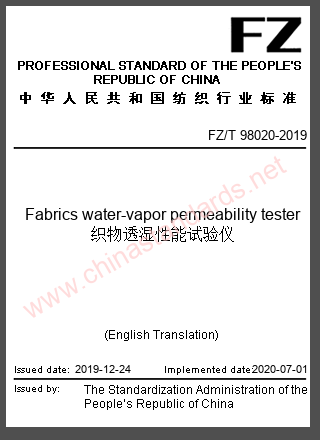
FZ/T 98020-2019 in English
VALIDFabrics water-vapor permeability tester
- Issued on:2019-12-24
- Implemented on:2020-07-01
- File Format:PDF
- Delivery:Via email within 1~3 business days
$165.00
本标准规定了织物透湿性能试验仪的基本功能和参数、要求、试验方法、检验规则及标志、包装、运输和贮存。
本标准适用于采用吸湿法或蒸发法测定织物透湿性能的试验仪。
Introduction
Analysis of the core content of the standard
| Technical parameters | FZ/T 98020 requirements | Comparison with GB/T 12704.1 | Test significance |
|---|---|---|---|
| Temperature control accuracy | ±0.1℃ | ±0.5℃ | Ensure the performance evaluation of fabrics under different climatic conditions |
| Humidity control range | 30%-98% RH | 50%-95% RH | Covering the testing needs of extreme hot and humid environments |
| Wind speed uniformity | ±0.02m/s | Unspecified | Eliminate the impact of airflow disturbance on test results |
Detailed explanation of key technical requirements
Test environment control system
Article 3.1.2 of the standard clearly requires that the Fabric Water Vapor Permeability Tester must support four standard test environments:
- High temperature and high humidity: 38℃±2℃/90%±2% RH (simulated tropical climate)
- High temperature and low humidity: 38℃±2℃/50%±2% RH (simulated desert environment)
- Normal temperature and humidity: 23℃±2℃/50%±2% RH (standard laboratory conditions)
- Special storage conditions: 20℃±2℃/65%±2% RH (textile storage environment)
In actual applications, a sportswear company compared the test data under 38℃/90%RH and 23℃/50%RH conditions and found that the moisture permeability of its quick-drying fabrics in high temperature environments increased by 27%.
Special requirements for instrument structure
Article 4.3 makes strict provisions for the test chamber:
- Test port diameter: 60±0.1mm (tolerance is only 0.17%)
- Specimen clamping distance: 22±0.2mm
- The installation position of the wind speed sensor is 10±1mm from the sample surface
This precision design can effectively avoid vapor diffusion anomalies caused by edge effects and ensure the repeatability error of the test results is <3%.
Recommendations for the implementation of the standard
Key points for laboratory construction
- It is recommended to use a dual cold trap dehumidification system to meet the requirements of rapid humidity switching (Article 4.6.3 requires a humidity change rate of ≤4%RH)
- An air curtain isolation device should be installed in the test area to prevent people from moving around and interfering with the wind speed field (Article 4.7.1 stipulates wind speed uniformity)
- Regular calibration must include three-dimensional spatial temperature field scanning (the 8-point verification method required by Article 5.7.1)
Troubleshooting
When test results fluctuate, it is recommended to follow the following process to troubleshoot:
- Check the wear of the sample sealing ring (Article 4.3.5 of the standard)
- Verify the zero drift of the wind speed sensor (Article 5.8.2 requires a sampling frequency of 1 minute)
- Calibrate the temperature and humidity sensor response time (Clause 4.4.1 requires 30 minutes of stabilization time)

Loading PDF document...
Error loading PDF. Please make sure the file is valid and try again.
We also recommend
-
FZ/T 98026-2025 in English
Fabric mace snagging tester
2025-04-10


