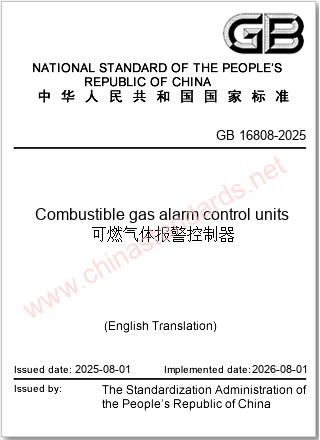
GB 16808-2025 in English
VALIDCombustible gas alarm control units
- Issued on:2025-08-01
- Implemented on:2026-08-01
- File Format:PDF
- Delivery:Via email within 5 business days
$481.00
《GB 16808-2025可燃气体报警控制器》由906(国家消防救援局)归口,委托TC113SC6(全国消防标准化技术委员会火灾探测与报警分会)执行。
Introduction
Technical Evolution and Core Changes of the GB16808-2025 Standard
GB16808-2025, "Combustible Gas Alarm Controllers," replaces the 2008 version and represents a significant improvement in technical requirements and safety performance. Jointly issued by the State Administration for Market Regulation and the Standardization Administration of China, this standard, officially implemented in 2025, marks a new phase in China's technical regulations for combustible gas detection.
Standard Framework and Technical Upgrades
The new standard features systematic structural optimizations, including the addition of a Term Definitions section, an improved controller classification system, and strengthened requirements for enclosure protection and combustion performance. Compared to the 2008 version, major technical changes encompass 20 areas, including 11 new technical requirements, 8 revisions, and 1 deletion.
| Comparison Dimensions | GB16808-2008 | GB16808-2025 | Technological Improvement |
|---|---|---|---|
| Classification System | Classification by Working Mode Only | Adding Classification by Use Environment and Application Mode | More Refined Classification, Stronger Applicability |
| Enclosure Protection | No Clear Requirements | Indoor Model IP20, Outdoor Model IP54 | Significantly Improved Environmental Adaptability |
| Record Storage | Basic Requirements | Clearly regulated quantities of various record storage types | Enhanced Data Traceability |
| Communication function | Limited requirements | Added communication requirements for graphic display device | Improved system integration |
| Electromagnetic compatibility | Basic immunity | Comprehensive electromagnetic compatibility performance requirements | Improved operation stability |
Detailed explanation of controller classification system
Chapter 4 of the standard establishes a multi-dimensional classification system to provide precise technical specifications for different application scenarios:
Classification by working mode
Bus controller adopts digital communication technology, with simple wiring and strong scalability; Multi-line controller adopts analog signal transmission, with high reliability, and is suitable for small systems.
Classification by Usage Environment
Indoor Use controllers require an enclosure protection rating of at least IP20; Outdoor Use controllers have an increased protection rating of IP54, ensuring dust and water resistance.
Classification by Application
From standalone to centralized, regionally compatible models, a complete system architecture is formed: standalone is suitable for small locations; regional models offer information transmission capabilities; centralized models enable multi-area monitoring; and centralized, regionally compatible models combine the advantages of both.
In-Depth Analysis of Core Technical Requirements
Overall System Performance Requirements
The controller must have a low-limit alarm or a two-stage low-limit and high-limit alarm function, with an alarm response time of no more than 10 seconds. The newly added multi-detector confirmation function requires the controller to enter the alarm state only after receiving two or more alarm signals, effectively reducing the false alarm rate.
Power System Specifications
The main power supply uses 220V 50Hz AC. Lithium cobalt oxide and ternary lithium batteries are expressly prohibited for backup power. The power conversion device must ensure that switching between the main and backup power sources does not affect the normal operation of the controller. The backup power supply must provide power for 1 hour + 30 minutes of alarm when in monitoring mode.
Environmental adaptability requirements
| Environmental type | Temperature range | Humidity requirement | Duration |
|---|---|---|---|
| Low-temperature operation | -10℃(indoor)/-25℃(outdoor) | Normal humidity | 16 hours |
| High-temperature operation | 55℃(indoor)/70℃(outdoor) | Normal humidity | 16 hours |
| Constant damp heat operation | 40±2℃ | 93±3% | 4 days |
| Constant Humidity and Heat Resistance | 40±2℃ | 93±3% | 21 days |
Safety Performance and Electromagnetic Compatibility
Electrical Safety Indicators
Insulation resistance must be no less than 100MΩ, leakage current must be limited to 0.5mA, and electrical strength must withstand 1250V AC voltage for 60 seconds without breakdown.
Electromagnetic Compatibility Performance
The controller must pass multiple electromagnetic compatibility tests, including RF electromagnetic field immunity, electrostatic discharge immunity, and surge immunity, to ensure stable operation in complex electromagnetic environments.
Operation Authority and Security Management
The standard divides controller operations into three levels to ensure system security:
| Operation Item | Level I Authority | Level II Authority | Level III Authority |
|---|---|---|---|
| Query Information | - | M | M |
| Reset Operation | P | M | M |
| Shield Operation | P | O | M |
| System Programming | P | P | M |
| Data Export | P | P | M |
Note: P-Prohibited; O-Optional; M-Operable by personnel at this level
Inspection Rules and Quality Assurance
Factory Inspection Requirements
Before leaving the factory, products must undergo 10 inspections, including inspection of major components, alarm function test, insulation resistance test, etc., to ensure that each controller meets standard requirements.
Type Inspection Conditions
Type inspection must be conducted in 6 situations: new product finalization, production process changes, changes to standard technical requirements, and resumption of production after one year of suspension, etc., to fully verify product performance.
Implementation Recommendations and Industry Impact
Design and Manufacturing Recommendations
Manufacturers should focus on key aspects such as casing material selection, backup power supply configuration, and communication interface design. Non-metallic casings must pass the combustion performance test in Appendix A to ensure the material's flame retardancy.
Engineering Application Guidance
In industrial and civil building applications, controllers with appropriate protection levels should be selected based on the operating environment, and system capacity should be reasonably configured to ensure that the backup power supply meets actual needs.
Maintenance and Management Requirements
Establish a comprehensive maintenance and management system, regularly check the controller's operating status, and promptly update software versions to ensure long-term stable operation of the system.
Technology Development Trend Outlook
With the development of Internet of Things technology, combustible gas alarm controllers will develop towards intelligence and networking in the future. Their integration with fire control systems will be further improved, providing more comprehensive protection for building safety.
The implementation of GB16808-2025 will promote industry technology upgrades, improve the overall level of combustible gas detection equipment in China, and provide solid technical support for industrial production safety and civil building safety.

Loading PDF document...
Error loading PDF. Please make sure the file is valid and try again.
We also recommend
-

GB 4716-2024 in English
Point type heat fire detectors
2024-11-28 -

GB/Z 24978-2010 in English
Performance assessment of fire detection and alarm system
2010-08-09 -

GB 22134-2008 in English
Compatibility Requirements of Automatic Fire Alarm System Components
- -

GB/T 26875.3-2011 in English
Remote-monitoring system of urban fire protection - Part 3: Communication protocol for alarm transmission network
2011-07-29 -

GB 28184-2011 in English
Power supply monitoring system for fire protection equipments
2011-12-30 -

GB/T 38315-2019 in English
Guidelines for preparation and implementation of fire fighting and emergency evacuation plans for workplaces
2019-12-10


