
GB/T 21563-2008 in English
SUPERSEDEDRailway applications - Rolling stock equipment - Shock and vibration tests
- Issued on:2008-03-24
- Implemented on:2008-11-01
- File Format:PDF
- Delivery:Via email within 1~3 business days
$117.00
《GB/T 21563-2008轨道交通 机车车辆设备 冲击和振动试验》由TC278(全国轨道交通电气设备与系统标准化技术委员会)归口,TC278SC1(全国轨道交通电气设备与系统标准化技术委员会机车车辆电气分会)执行,主管部门为国家铁路局。
本标准规定了对要安装在轨道机车车辆上的设备进行随机振动和冲击试验的要求。本标准主要用于固定式轨道系统上的机车车辆,也可用于其他场合。本标准包括了安装在轨道机车车辆上的机械、气动、电气和电子设备或部件的随机振动和冲击试验要求。本标准不适用于特殊应用场合下因自感应产生的振动。
1 Scope
This Standard specifies the requirements for testing items of equipment intended for use on railway vehicles which are subsequently subjected to vibrations and shock owing to the nature of railway operational environment. To gain assurance that the quality of the item is acceptable, it has to withstand tests of reasonable duration that simulate the service conditions seen throughout its expected life.
Simulated long-life testing can be achieved in a number of ways each having their associated advantages and disadvantages, the following being the most common:
a) Amplification: where the amplitudes are increased and the time base decreased;
b) Time compression: where the amplitude history is retained and the time base is decreased;
c) Decimation: where time slices of the historical data are removed when the amplitudes are below a specified threshold value.
The amplification method as stated in a) above, is used in this Standard and together with the publications referred to in Chapter 2; it defines the default test procedure to be followed when vibration testing items for use on railway vehicles. However, other standards do exist and may be used with prior agreement between the manufacturer and the customer. In such cases attestation of testing against this Standard will not apply. Where service information is available comparison with the standard can be performed using the method outlined in Appendix A.
Whilst this Standard is primarily concerned with railway vehicles on fixed rail systems, its wider use is not precluded. For systems operating on pneumatic tyres, or other transportation systems such as trolleybuses, where the level of shock and vibration clearly differ from those obtained on fixed rail systems, the supplier and customer can agree at the tender stage, the test levels. It is recommended that the frequency spectra and the shock duration/amplitude be determined using the guidelines set out in Appendix A. Items tested at levels outside those quoted in this Standard can not be certified against the requirements of this Standard.
An example of this is trolleybuses, whereby body-mounted trolleybus equipment could be tested in accordance with category 1 equipment referred to in the standard.
This Standard applies to single axis testing. Multi-axis testing is outside the scope of this Standard.
The test values quoted in this Standard have been divided into three categories dependent only upon the equipment’s location within the vehicle.
Category 1 Body mounted
Class A Cubicles, subassemblies, equipment and components mounted directly on or under the car body.
Class B Anything mounted inside an equipment case which is in turn mounted directly on or under the car body.
Note: Class B should be used when it is not clear where the equipment is to be located.
Category 2 Bogie mounted
Cubicles, subassemblies, equipment and components which are to be mounted on the bogie of a railway vehicle.
Category 3 Axle mounted
Subassemblies, equipment and components or assemblies which are to be mounted on the wheelset assembly of a railway vehicle.
Note: In the case of equipment mounted on vehicles with one level of suspension such as wagons and trucks, unless otherwise agreed at the tender stage, axle mounted equipment will be tested as category 3, and all other equipment will be tested as category 2.
The cost of testing is influenced by the weight, shape and complexity of the item under test. Consequently at the tender stage the supplier may propose a more cost effective method of demonstrating compliance with the requirements of this Standard. Where alternative methods are agreed it will be the responsibility of the supplier to demonstrate to his customer or his representative that the objective of this Standard has been met. If an alternative method of evaluation is agreed, then the item tested cannot be certified against the requirement of this Standard.
This Standard is intended to evaluate equipment which is attached to the main structure of the vehicle (and/or components mounted thereon). It is not intended to test equipment which forms part of the main structure. There are a number of cases where additional or special vibration tests may be requested by the customer, for example:
a) Equipment mounted on, or linked to, items which are known to produce fixed frequency excitation;
b) Equipment such as traction motors, pantographs, shoegear, suspension components and mechanical parts designed to transmit forces and/or torque, which may be subjected to tests in accordance with their special requirements, applicable to their use on railway vehicles. In all such cases the tests carried out should be dealt with by separate agreement at the tender stage;
c) Equipment intended for use in special operational environments as specified by the customer.
2 Normative References
Contents
Foreword II
Introduction III
1 Scope
2 Normative References
3 Terms and Definitions
4 General
5 Order of Testing
6 Reference Information Required by the Test House
7 Initial Measurements and Preconditioning
8 Random vibration test conditions
9 Simulated Long Life Testing at Increased Random Vibration Levels
10 Shock Testing Conditions
11 Transportation and Handling
12 Final Measurements
13 Acceptance Criteria
14 Report
15 Attestation of Testing
16 Disposal
Appendix A (Informative) Explanation of Service Measurements, Measuring Positions, Methods of Recording Service Data, Summary of Service Data, and Method Used to Obtain Random Test Levels from Acquired Service Data
Appendix B (Informative) Guidance for Deriving Design Levels from Random Vibration Test Data
Appendix C (Informative) Figure Identifying General Location of Equipment on Railway Vehicles and Their Resulting Test Category
Appendix D (Informative) Example of a Type Test Attestation

Loading PDF document...
Error loading PDF. Please make sure the file is valid and try again.
We also recommend
-

GB/T 28028-2011 in English
Criteria for assessing and coding of the commutation of rotation electrical machines for traction
2011-10-31 -

GB/T 32589-2025 in English
Railway applications—Conductor rail current collector
2025-12-31 -

GB/T 42005.1-2022 in English
Railway applications—Onboard energy storage tram—Part 1: Capacitance-type energy storage cubicle
2022-10-12 -

GB/T 34571-2024 in English
Railway applications—Rules for installation of cabling on rolling stock
2024-12-31 -

GB/T 34575-2023 in English
Railway applications—Converter equipment on board rolling stock—Auxiliary converter for locomotive and multiple unit
2023-11-27 -

GB/T 43790-2024 in English
Railway applications—Current collection systems—Technical criteria for the interaction between pantograph and overhead contact line
2024-03-15 -

GB/T 25890.7-2010 in English
Railway applications—Fixed installations—DC switchgear—Part 7-1:Measurement control and protection devices for specific use in d.c.traction systems—Application guide
2011-01-10 -
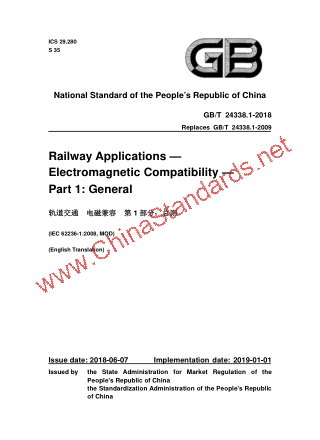
GB/T 24338.1-2018 in English
Railway applications—Electromagnetic compatibility—Part 1:General
2018-06-07 -

GB/T 32592-2023 in English
Railway applications—Current collection systems—Requirements for and validation of measurements of the dynamic interaction between pantograph and overhead contact line
2023-11-27 -

GB/T 6770-2020 in English
Special safety regulations for driver's cabs of locomotives
2020-06-02


