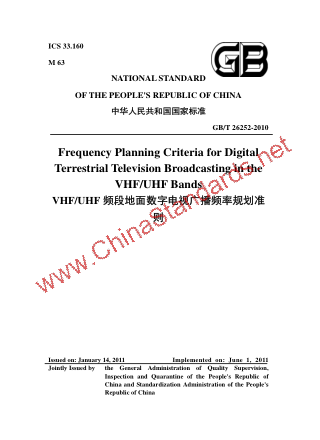
GB/T 26252-2010 in English
VALIDFrequency planning criteria for digital terrestrial television broadcasting in the VHF/UHF bands
- Issued on:2011-01-14
- Implemented on:2011-06-01
- File Format:PDF
- Delivery:Via email within 1~3 business days
$165.00
《GB/T 26252-2010VHF/UHF频段地面数字电视广播频率规划准则》由TC239(全国广播电影电视标准化技术委员会)归口,主管部门为国家广播电视总局。
1 Scope
This standard specifies the parameters and methods for frequency planning for digital terrestrial television in conformity with GB 20600-2006.
This standard is applicable to the coverage network planning of digital terrestrial television broadcasting system in the VHF/UHF bands.
2 Normative References
The following normative documents contain provisions which, through reference in this text, constitute provisions of this standard. For dated references, subsequent amendments to (excluding corrections to), or revisions of, any of these publications do not apply. However, all parties coming to an agreement according to this standard are encouraged to study whether the latest editions of these documents are applicable. For undated references, the latest edition of the normative documents referred to applies.GB 3174-1995 "Specifications of PAL-D Television System"GB/T 14433-1993 "Technical Specifications for Coverage Networks of Colour TV Broadcasting"GB 20600-2006 "Framing Structure, Channel Coding, and Modulation for Digital Television Terrestrial Broadcasting System (DTMB)"
3 Terms, Definitions and Abbreviations
3.1 Terms and DefinitionFor the purposes of this standard, the following term and definition applies.3.1.1
Wanted signal
The RF signal with information to be received.3.1.2
Unwanted signal
Other RF signal irrelevant to the information to be received.3.1.3
RF protection ratio
The minimum power ratio of wanted signal to unwanted signal at the normal receiving conditions, generally measured at the receiver inlet and represented by dB.
3.1.4
Time probability
The percentage of time when the signal field strength reaches or exceeds a certain given value to the observation time, at any measuring position if the signal varies with the time.
3.1.5
Location probability
The percentage of the location where a given value is reached or exceeded to the small measured area (typical value is 100m×100m) when the signal field strength varies with the locations to be measured.3.1.6
Minimum equivalent field strength
The minimum field strength to ensure the receiver on the digital terrestrial television can receive the signal normally without other signal interference.
Note: The power spectrum density of broadband signal is varied throughout the signal bandwidth, so the "equivalent field strength" is usually adopted instead of "field strength". The equivalent field strength is the irradiation field strength of the non-modulating signal, having the equal power with the broadband signal.
3.1.7
Minimum median equivalent field strength
The minimum median field strength to ensure the receiver on the digital terrestrial television can receive the signal normally considering that the statistical factors of wanted signal field strength will vary with the time and location.3.2 Abbreviations
For the purpose of this standard, the following abbreviations apply.
BER Bit Error Rate
C/N Carrier-noise ratio
MFN Multiple Frequency Network
PR Protection Ratio
QAM Quadrature Amplitude Modulation
SFN Single Frequency Network
TS Transport Stream
4 Terrestrial Television System
Foreword I
1 Scope
2 Normative References
3 Terms, Definitions and Abbreviations
4 Terrestrial Television System
4.1 Digital Terrestrial Television System
4.2 Terrestrial Analog Television System
5 Protection Ratio of Digital Terrestrial Television Signal
5.1 Protection Ratio of Digital Terrestrial Television Signal for Interference of Digital Terrestrial Television Signal
5.2 Protection Ratio of Digital Terrestrial Television Signal against Interference of Terrestrial Analog Television Signal
6 Protection Ratio of Terrestrial Analog Television Signal against Interference by Digital Terrestrial Television Signal
6.1 Protection Ratio of Picture Signal of Terrestrial Analog Television against Interference of Digital Terrestrial Television Signal
6.2 Protection Ratio of Terrestrial Analog Television Audio Signal against Interference by Digital Terrestrial Television Signal
7 Minimum Equivalent Field Strength and Minimum Median Equivalent Field Strength Received by Digital Terrestrial Television Signal
7.1 Minimum Equivalent Field Strength Received by Digital Terrestrial Television Signal at the Fixed Outdoors
7.2 Minimum Median Equivalent Field Strength Received Randomly by Digital Terrestrial Television Signal
Appendix A (Normative) Calculation of Minimum Equivalent Field Strength and Minimum Median Equivalent Field Strength
Appendix B (Normative) Other Planning Factors
Appendix C (Normative) Comparison Method to Assess Analog Television Protection Ratio by Reference Interference Source (SCM)
Appendix D (Normative) Tested Methods on Protection Ratio of Wanted Digital Terrestrial Signal
Appendix E (Normative) Troposphere Interference and Continuous Interference
Appendix F (Normative) Measured Power and Field Strength Conversion of Digital Television
Appendix G (Normative) Combined Method on Interference Field Strength
Appendix H (Informative) Channel Model Parameters
Bibliography

Loading PDF document...
Error loading PDF. Please make sure the file is valid and try again.
We also recommend
-

GB/T 17438-1998 in English
Technical requirements for the transmission through contribution and primary distribution networks of digital television signals defined according to the 4:2:2 STANDARD
1998-07-24 -

GB/T 34993-2017 in English
Technical requirements and measurement methods for ASI/DS3 adapter and de-adapter used in program distribution network
2017-11-01 -

GB/T 37001-2018 in English
Material exchange formats for high definition TV programmes
2018-12-28 -

GB/T 17700-1999 in English
Channel coding and modulation STANDARD for Digital Video Broadcasting-Satellite(DVB-S)
1999-03-02 -

GB/T 19263-2003 in English
Technical specification of transport of MPEG-2 signals in SDH network
2003-12-18 -

GB/T 26666-2011 in English
Implementation guidelines for transmission system of digital terrestrial television broadcasting
2011-06-16 -

GB/T 28160-2011 in English
Specification of electronic programme guide for digital television broadcasting
2011-12-30


