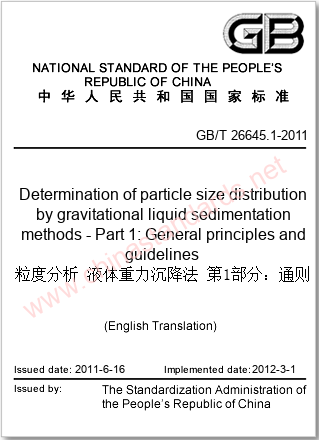
GB/T 26645.1-2011 in English
VALIDDetermination of particle size distribution by gravitational liquid sedimentation methods - Part 1: General principles and guidelines
- Issued on:2011-06-16
- Implemented on:2012-03-01
- File Format:PDF
- Delivery:Via email within 1~3 business days
$214.00
《GB/T 26645.1-2011粒度分析 液体重力沉降法 第1部分:通则》由TC168(全国颗粒表征与分检及筛网标准化技术委员会)归口,主管部门为国家标准化管理委员会。
Scope
This part of GB/T 26645 specifies the method for analyzing the particle size distribution of particulate materials by liquid gravity sedimentation method. The typical particle size measurement range is 0.5 μm to 100 μm. This section applies to the measurement of particle size distribution of slurries or particulate materials that can be dispersed in liquids. Normally the density difference between the dispersed and continuous phases is positive, but it can also be used to measure the size distribution of emulsion droplets which are less dense than the dispersed phase. Particles cannot undergo physical or chemical changes in suspension. Basic protective measures are required for hazardous materials, especially when volatile liquids with low boiling points are used as the continuous phase, the analyst must first conduct an explosion-proof test. NOTE: This section may contain hazardous materials, procedures, and equipment. This section does not indicate all the safety issues involved in the use process. For users, safety should be fully considered before use, understanding of operating rules, and training on operating skills.

Loading PDF document...
Error loading PDF. Please make sure the file is valid and try again.
We also recommend
-

GB/T 26645.4-2018 in English
Particle size analysis—Gravitational liquid sedimentation methods—Part 4:Balance method
2018-07-13 -

GB/T 42351.2-2024 in English
Preparation of particulate reference materials—Part 2: Polydisperse spherical particles
2024-09-29 -

GB/T 47069.1-2026 in English
Determination of particle density—Sedimentation methods—Part 1:Isopycnic interpolation approach
2026-01-28 -

GB/T 16418-2008 in English
Particle system - Vocabulary
2008-07-18 -

GB/Z 42353-2023 in English
Guidelines for good practices in zeta-potential measurement
2023-03-17 -

GB/T 19627-2005 in English
Particle size analysis--Photon correlation spectroscopy
2005-01-13 -

GB/T 37167-2018 in English
Particle—Separation and measurement of trace magnetic materials(elements)in inorganic powder
2018-12-28 -

GB/T 21649.1-2024 in English
Particle size analysis—Image analysis methods—Part 1: Static image analysis methods
2024-09-29 -

GB/T 31057.1-2014 in English
Granular materials―The physical properties―Part 1:Determination of apparent density
2014-12-22 -

GB/T 15445.1-2008 in English
Representation of results of particle size analysis - Part 1: Graphical representation
2008-07-18


