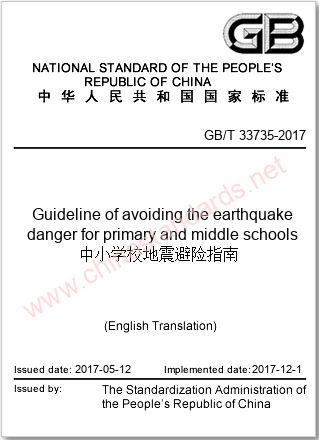
GB/T 33735-2017 in English
VALIDGuideline of avoiding the earthquake danger for primary and middle schools
- Issued on:2017-05-12
- Implemented on:2017-12-01
- File Format:PDF
- Delivery:Via email within 1~3 business days
$156.00
| Standard No: | GB/T 33735-2017 |
| Document status: | VALID |
| Title in English: | Guideline of avoiding the earthquake danger for primary and middle schools |
| Title in Chinese: | 中小学校地震避险指南 |
| Language: | English |
| File Format: | Electronic (PDF) |
| Delivery: | Via email within 1~3 business days |
| Issued on: | 2017-05-12 |
| Implemented on: | 2017-12-01 |
| ICS Classification: | 91.120.25-Seismic and vibration protection |
| Chinese Classification: | P15-Engineering seismic resistance |
| Professional Classification: | GB-National Standard |
| Related Keywords: | requirements comparative analysis earthquake avoidance preparation including plan formulation
earthquake danger earthquake risk avoidance plans earthquake risk avoidance drills systematic earthquake risk avoidance framework |
| Related Topics: | School
primary school iec+ earthquake Medium earthquake detection SMIC School school standards GBT33735 GB/T 33735-2017 primary and secondary school Zhang Yaoxue, Central South University |
《GB/T 33735-2017中小学校地震避险指南》由TC307(全国应急管理与减灾救灾标准化技术委员会)归口,主管部门为应急管理部。
Introduction
Interpretation of the Guide to Earthquake Avoidance in Primary and Secondary Schools
| Standard Dimensions | GB/T 33735—2017 Requirements | Comparative Analysis |
|---|---|---|
| Earthquake Avoidance Preparation | Including plan formulation, knowledge education, drill arrangement and facility preparation. | Compared with the old standard, the requirements for regular revision (≤5 years) and the specification of evacuation sign setting have been added. |
| Principles of Avoidance during Earthquake | According to local conditions, decisive and orderly. | Combined with the earthquake resistance of buildings, the indoor and outdoor avoidance methods are refined. |
| Post-earthquake evacuation requirements | Staggered evacuation by grade and guarding of key areas. | Added psychological counseling and parent notification mechanisms to improve emergency response capabilities. |
Professional term analysis and actual cases
Earthquake intensity:An indicator used to measure the degree of damage to ground buildings caused by an earthquake, which directly affects the choice of risk avoidance strategies. For example, intensity III and IV are mild tremors, and indoor shelter is acceptable; while intensity VII and above require rapid evacuation.
Taking the Wenchuan earthquake as an example, the method of "running if you can, hiding if you can't" was summarized after the earthquake, which reflects the principle of risk avoidance based on local conditions. Specifically for school scenarios, differentiated strategies need to be formulated based on the earthquake resistance of buildings (see Appendix B).
Background of Standard Formulation and Technological Evolution
my country is a country prone to frequent earthquake disasters. Historical experience shows that scientific risk avoidance methods can significantly reduce casualties. GB/T 33735-2017, based on the experience of major earthquakes such as Tangshan and Wenchuan, combined with current building codes (such as GB 50016 "Code for Fire Protection Design of Buildings"), has formed a systematic earthquake risk avoidance framework.
Implementation Suggestions
- Plan Revision:Schools should revise earthquake risk avoidance plans at least once a year based on actual conditions, with special attention paid to the seismic performance assessment of old buildings.
- Drill Frequency:Earthquake risk avoidance drills should be conducted monthly, focusing on simulating emergency response processes under different earthquake situations.
- Improvement of Facilities:Regularly check evacuation routes and emergency lighting equipment to ensure that signs are clearly visible.

Loading PDF document...
Error loading PDF. Please make sure the file is valid and try again.
We also recommend
-

GB 17741-2025 in English
Evaluation of seismic safety for engineering sites
2025-02-28 -

GB 50223-2008 in English
Standard for Classification of Seismic Protection of Building Cons
2008-07-30 -

GB/T 19531.2-2026 in English
Technical requirements for the observation environment of seismic stations—Part 2:Electromagnetic observation
2026-01-28 -

GB/T 18207.1-2008 in English
Terminology of protecting against and mitigating earthquake disasters - Part 1:Basic terms
2008-06-06 -

GB/T 22568-2008 in English
Public earthquake-related information release
2008-11-13 -

GB/T 50452-2008 in English
Technical specifications for protection of historic buildings against man-made vibration
2008-09-24 -
GB/T 36072-2018 in English
Surveying and prospecting of active fault
2018-03-15 -

GB/T 30352-2013 in English
Assessment of Earthquake Disaster Situation in Emergency Period
2013-12-31


