
GB/T 33949-2017 in English
VALIDCopper alloy ring material for bearing cage
- Issued on:2017-07-12
- Implemented on:2018-02-01
- File Format:PDF
- Delivery:Via email within 1~3 business days
$156.00
| Standard No: | GB/T 33949-2017 |
| Document status: | VALID |
| Title in English: | Copper alloy ring material for bearing cage |
| Title in Chinese: | 轴承保持架用铜合金环材 |
| Language: | English |
| File Format: | Electronic (PDF) |
| Delivery: | Via email within 1~3 business days |
| Issued on: | 2017-07-12 |
| Implemented on: | 2018-02-01 |
| ICS Classification: | 77.150.30-Copper products |
| Chinese Classification: | H62-Heavy metals and their alloys |
| Professional Classification: | GB-National Standard |
| Related Keywords: | copper alloy ring materials
copper alloy materials copper alloy bearing cage bearing industry |
| Related Topics: | Copper Alloy Standard
Copper Alloy Standard maintain adhesion Keep GBT33949 GB/T 33949-2017 copper alloy GB/T 33949-2017 Copper alloy rings for bearing cages. Bearing cage cleanliness |
《GB/T 33949-2017轴承保持架用铜合金环材》由TC243(全国有色金属标准化技术委员会)归口,TC243SC2(全国有色金属标准化技术委员会重金属分会)执行,主管部门为中国有色金属工业协会。
Introduction
Interpretation of the National Standard of the People's Republic of China GB/T 33949—2017
1. Background and significance of the formulation of the standard
GB/T 33949—2017 "Copper alloy ring materials for bearing cages" is to standardize the technical requirements of copper alloy ring materials used in the bearing industry and ensure their performance and quality in bearing manufacturing. With the continuous development of bearing technology, the requirements for materials are getting higher and higher. The formulation of this standard fills the gap in related fields in China and provides an important basis for the quality control of copper alloy ring materials for bearing cages.
2. Comparative analysis of standard frameworks
| Standard dimensions | GB/T 33949—2017 | International standard (reference) | Main differences |
|---|---|---|---|
| Chemical composition requirements | Clearly stipulates the chemical composition ranges of various grades, such as HPb59-1, HMn64-8-5-1.5, etc. | Similar ISO standards have similar requirements for alloy proportions, but are not detailed to specific grades. | Domestic standards pay more attention to the process adaptability of materials. |
| Mechanical performance indicators | According to different states and specifications, the specific values of tensile strength, elongation after fracture and Brinell hardness are clarified. | International standards focus on universality and do not distinguish specific application scenarios. | Domestic standards are more targeted and practical. |
| Test methods | Detailed provisions are made for chemical composition analysis, tensile test, Brinell hardness test and other methods, citing a number of national and industry standards. | International standards usually adopt general test procedures. | Domestic standards are more specific in test details. |
3. Interpretation of the core content of the standard
3.1 Brand and state management
The standard specifies a variety of brands of copper alloy materials, including HPb59-1, HMn64-8-5-1.5, etc., and clarifies their corresponding states (such as centrifugal casting, hot extrusion, etc.). The selection of these brands directly affects the performance and service life of the bearing cage.
3.2 Chemical composition requirements
Case analysis: Taking HPb59-1 as an example, the copper content in its chemical composition is 57.0~60.0%, and the lead content is 0.80~1.9%. This ratio makes the material have both good wear resistance and sufficient strength.
3.3 Mechanical properties and process requirements
The standard sets strict requirements for the mechanical properties of ring materials, including tensile strength, elongation after fracture and Brinell hardness. These indicators are determined based on the needs in actual applications to ensure the reliability of bearing cages under various working conditions.
4. Implementation suggestions and precautions
4.1 Precautions when selecting materials
- Select the appropriate grade and state according to the specific application scenario.
- Pay attention to the fluctuation range of chemical composition to ensure that it meets the requirements of the standard.
- Give priority to products from certified suppliers.
4.2 Implementation suggestions for test methods
When conducting chemical composition analysis and mechanical property tests, the test methods specified in the standard should be strictly followed to ensure the accuracy and comparability of the data. For arbitration inspection, the methods specified in the national standard should be used first.
5. Conclusion
GB/T 33949-2017 standard provides scientific basis and technical support for the production and application of copper alloy ring materials for bearing cages. With the development of the bearing industry, new materials and processes may appear in the future, and the standard will be continuously revised and improved to adapt to new technical requirements.

Loading PDF document...
Error loading PDF. Please make sure the file is valid and try again.
We also recommend
-
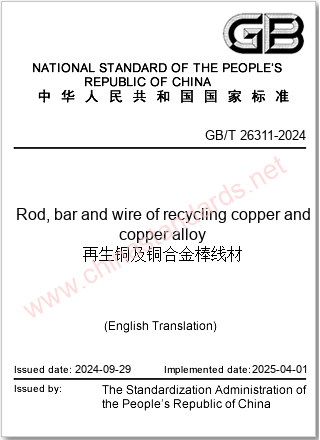
GB/T 26311-2024 in English
Rod, bar and wire of recycling copper and copper alloy
2024-09-29 -

GB/T 17791-2017 in English
Seamless copper and copper alloys tube forair conditioner and refrigeration equipment
2017-07-12 -

GB/T 5187-2021 in English
Liquid chlorine for industrial use
2021-08-20 -
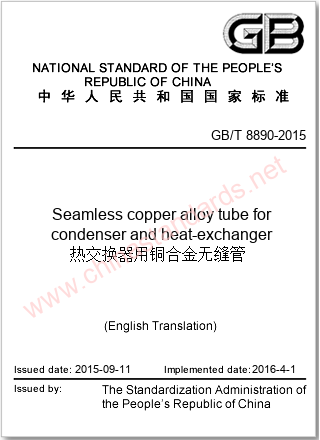
GB/T 8890-2015 in English
Seamless copper alloy tube for condenser and heat-exchanger
2015-09-11 -

GB/T 23609-2023 in English
Seamless copper alloy tube for water desalting applications
2023-08-06 -

GB/T 4423-2020 in English
Copper and copper alloy cold-drawn rod and bar
2020-09-29 -

GB/T 14594-2014 in English
Oxygen-free copper sheets and strips for vacuum electron devices
2014-12-05 -

GB/T 32468-2025 in English
Copper clad aluminum plates, sheets, strips and foils
2025-03-28 -

GB/T 20509-2023 in English
Copper and copper alloys drawing for contacting materials of electric locomotives
2023-05-23


