
GB/T 35987-2018 in English
VALIDSpecification for offshore engineering structure weighing
- Issued on:2018-02-06
- Implemented on:2018-09-01
- File Format:PDF
- Delivery:Via email within 1~3 business days
$214.00
《GB/T 35987-2018海洋工程结构物称重作业规范》由TC355(全国石油天然气标准化技术委员会)归口,主管部门为国家标准化管理委员会。
Introduction
Professional interpretation of GB/T 35987—2018 "Specifications for Weighing Operations of Offshore Engineering Structures"
| Standard dimensions | Specific requirements | Implementation points |
|---|---|---|
| Weighing grade classification | Grades A, B, and C, corresponding to accuracy ≤1%, ≤2%, and ≤3% | Select the appropriate grade according to the importance of the structure |
| Weighing device requirements | The uncertainty must meet the standard and have automatic and manual control functions | Choose certified weighing equipment |
| Environmental conditions restrictions | Wind speed, temperature, humidity, etc. must meet the requirements of the specification | Real-time monitoring and recording of environmental data |
Standard formulation background and technology evolution analysis
With the rapid development of marine engineering, the importance of structure weighing operations has become increasingly prominent. The formulation of GB/T 35987-2018 fills the gap in this field in China, mainly based on the following backgrounds:
- The increase in marine engineering projects under the background of globalization
- The impact of accurate weighing on structural safety and economy
- The need to align with international standardization trends
Interpretation of core clauses and implementation suggestions
3.1 General requirements
Weighing level selection (Table 1):Different levels correspond to different accuracy requirements, and the appropriate level needs to be selected according to the importance of the structure. For example, Class A is suitable for offshore platforms with high precision requirements, and Class C can be used for auxiliary facilities.
Explanation of professional terms
- Weighing device uncertainty: refers to the maximum error range that may be introduced by the measurement system
- Weighing points: multiple measurement positions determined according to the weight distribution of the structure
3.2 Technical requirements
Structural strength verification:The number and position of the symmetrical points need to be verified for rationality to ensure that the local and overall structural strength meets the requirements of the specification. For example, the bearing capacity of different schemes can be evaluated by finite element analysis.
3.3 Environmental requirements
Wind speed limit (Table 2): Set the maximum allowable wind speed according to different levels, A level ≤8m/s, C level can be relaxed to ≤11m/s. In actual operation, wind speed data must be monitored and recorded in real time.
Implementation suggestions
- Establish a standardized weighing operation process and clarify the responsibilities of each link
- Equip with professional weighing devices and calibrate them regularly
- Strengthen the monitoring and control of environmental factors
- Develop emergency plans to ensure safe operations

Loading PDF document...
Error loading PDF. Please make sure the file is valid and try again.
We also recommend
-

GB/T 44310-2024 in English
General design specifications for offshore fixed platform
2024-08-23 -
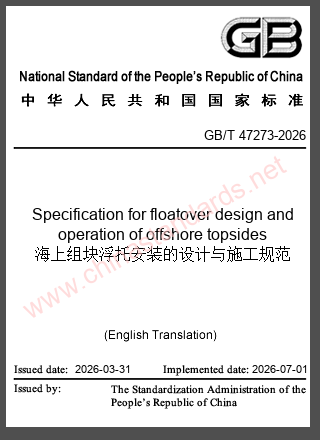
GB/T 47273-2026 in English
Specification for floatover design and operation of offshore topsides
2026-03-31 -

GB/T 35989.1-2018 in English
Petroleum and natural gas industries—Floating offshore structures—Part 1: Monohulls, semi-submersibles and spars
2018-02-06 -

GB/T 42034-2022 in English
Technical specification for floating production storage offloading unit
2022-10-12


