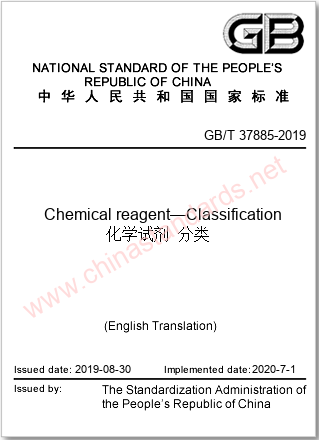
GB/T 37885-2019 in English
VALIDChemical reagent—Classification
- Issued on:2019-08-30
- Implemented on:2020-07-01
- File Format:PDF
- Delivery:Via email within 1~3 business days
$243.00
《GB/T 37885-2019化学试剂 分类》由TC63(全国化学标准化技术委员会)归口,TC63SC3(全国化学标准化技术委员会化学试剂分会)执行,主管部门为中国石油和化学工业联合会。
Introduction
Analysis of the Standard Core Framework
| Classification Dimensions | Hierarchical Structure | Coding Rules | Typical Applications |
|---|---|---|---|
| Major Categories (10 Categories) | Classification by Purpose | 1 Latin Letter (AQ) | Industry Statistics, Warehousing Planning |
| Middle Categories | Structure/Use Segmentation | 2 Digits (01-99) | R&D Direction Positioning |
| Minor Categories | Specific Compound Types | 2 digits (00-99) | Experimental design |
Key technical features
Coding system example:
B0302 means:
B (basic organic chemical reagents) → 03 (alcohols) → 02 (monohydric alcohols containing substituents) → such as 2-chloroethanol
Special classification instructions:
- High purity reagents: purity grade marking (3N-5N)
- Standard substances: exclude biochemistry
- Life science reagents: include biological standards
Implementation suggestions
Construction of laboratory management system:
- Establish an electronic ledger based on five-digit coding
- Hazardous reagents are marked with corresponding medium-class codes (such as potassium cyanide is classified as A05)
- Separate files for isotope reagents (Class H)
Optimization of procurement management:
| Scenario | Classification application |
|---|---|
| Teaching experiment | Give priority to I08 teaching-specific reagents |
| HPLC analysis | Select F05 eluent + F06 stationary phase combination |
Standard evolution analysis
Compared with the traditional classification method by purity, this standard innovatively adopts a two-dimensional system of purpose + structure:
- 2008 version: only distinguishes between analytical purity and chemical purity
- 2019 version: newly added classifications for modern scientific research needs such as instrumental analysis reagents (Class F) and life science reagents (Class G)
- The first establishment of an isotope reagent (Class H) management system

Loading PDF document...
Error loading PDF. Please make sure the file is valid and try again.
We also recommend
-

GB/T 23942-2009 in English
Chemical reagent—General rules for inductively coupled plasma atomic emission spectrometry
2009-06-02 -

GB 6851-2008 in English
pH primary reagent - General rules for certification
2008-06-18 -

GB/T 605-2006 in English
Chemical reagent - General method for the measurement of colour
2006-11-03 -

GB/T 6682-2008 in English
Water for analytical laboratory use - Specification and test methods
2008-05-15 -

GB/T 33087-2016 in English
Ultra pure water for instrumental analysis specification and test methods
2016-10-13 -

GB/T 35507-2017 in English
General rule for biochemical reagents
2017-12-29 -

GB/T 9721-2006 in English
Chemical reagent - General rules for the molecular absorption spectrophotometry (ultraviolet and visible)
2006-09-01 -

GB/T 3914-2008 in English
Chemical reagent - The general rules of anodic stripping voltammetry
2008-05-15


