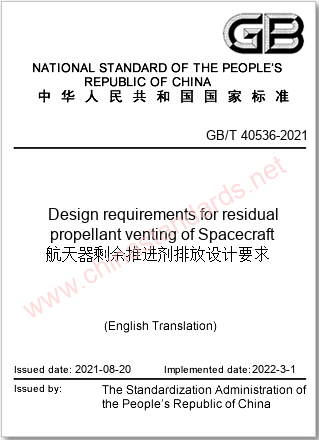
GB/T 40536-2021 in English
VALIDDesign requirements for residual propellant venting of Spacecraft
- Issued on:2021-08-20
- Implemented on:2022-03-01
- File Format:PDF
- Delivery:Within 1 day
$125.00
| Standard No: | GB/T 40536-2021 |
| Document status: | VALID |
| Title in English: | Design requirements for residual propellant venting of Spacecraft |
| Title in Chinese: | 航天器剩余推进剂排放设计要求 |
| Language: | English |
| File Format: | Electronic (PDF) |
| Delivery: | Within 1 day |
| Issued on: | 2021-08-20 |
| Implemented on: | 2022-03-01 |
| ICS Classification: | 49.050-Aerospace engines and propulsion systems |
| Professional Classification: | GB-National Standard |
| Related Keywords: | design requirements
emission path design six-property design specifications reliability requirements core terms termsdefinitionapplication scenarios active emission propellant emission spacecraft propellant emissions |
| Related Topics: | advance
propellant gel remaining Spacecraft Xinyu agent Discharge purpose remaining standard Emission method The remainder of the prescribing Emission method emission plan GBT40536 GB/T 40536-2021 remaining solid phase remaining aerospace propellant water Light up sky lanterns to discharge total spacecraft dose |
《GB/T 40536-2021航天器剩余推进剂排放设计要求》由TC425(全国宇航技术及其应用标准化技术委员会)归口,主管部门为国家标准化管理委员会。
Introduction
Standard Background and Significance
As the problem of space debris becomes increasingly serious, the international community has put forward strict requirements for the disposal of spacecraft at the end of their life. GB/T40536-2021, as my country's first national standard specifically for spacecraft propellant emissions, fills the standard gap in the field of active space debris mitigation technology. The standard was formulated with reference to international standards such as ISO 24113, combined with my country's Long March series rockets, Beidou satellites and other engineering practice experiences, to form a systematic technical specification.
Analysis of core terms
| Terms | Definition | Application scenarios |
|---|---|---|
| Active emission | Propellant emission controlled by ground commands | Planned disposal at the end of satellite life |
| Passive emission | Emergency emission triggered autonomously by the system | Failure conditions such as loss of spacecraft contact |
Key technical requirements
1. Emission path design
The standard defines two emission paths:
- Engine emission: Thrust disturbance compensation needs to be considered, and cross-mixing must be prevented in the two-component system
- Specialized emission device: Double isolation design is required, and the emission speed ≤ the maximum allowable flow rate of the tank
2. Six-property design specifications
Reliability requirements for emission devices:
- Protection against mis-emission: At least 2 independent prohibition functions
- Extreme operating condition verification: Including -40℃~120℃ temperature cycle test
- Radiation resistance design: Cumulative dose over the entire life cycle ≥100krad
Implementation suggestions
Typical application case
When implementing the standard on a geosynchronous orbit satellite:
- Active discharge is started at an altitude of 300km after the deorbit maneuver
- Dual redundant discharge valves are used, and the discharge rate is controlled at 0.5kg/s
- Emptying is determined by the tank pressure change rate (ΔP/Δt>5kPa/s)
Solutions to common problems
| Problem type | Standard clause | Countermeasures |
|---|---|---|
| Propellant freezing | 5.2.2.2c | Install an electric heater to maintain the valve body temperature>10℃ |
| Attitude disturbance | 5.2.1.2b | Use a symmetrical layout of discharge ports, torque deviation<0.1N·m |

Loading PDF document...
Error loading PDF. Please make sure the file is valid and try again.


