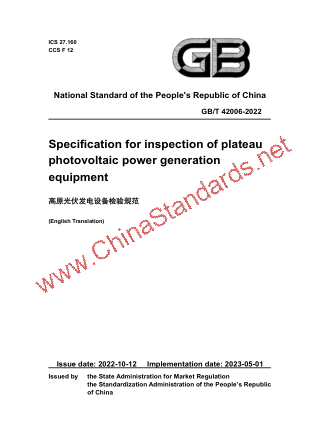
GB/T 42006-2022 in English
VALIDSpecification for inspection of plateau photovoltaic power generation equipment
- Issued on:2022-10-12
- Implemented on:2023-05-01
- File Format:PDF
- Delivery:Via email within 1~3 business days
$301.00
《GB/T 42006-2022高原光伏发电设备检验规范》由TC330(全国高原电工产品环境技术标准化技术委员会)归口,主管部门为中国电器工业协会。
Specification for inspection of plateau photovoltaic power generation equipment
1 Scope
This document specifies the inspection classification, requirements for inspection environment conditions, inspection contents and methods of plateau photovoltaic power generation equipment.
This document is applicable to photovoltaic power generation equipment used in areas with an altitude of 1,000m to 5,000m (including 5,000m), mainly including photovoltaic modules, inverters, combiner boxes and module brackets.
2 Normative references
The following normative documents contain provisions which, through reference in this text, constitute indispensable provisions of this document. For dated references, only the edition cited applies. For undated references, the latest edition of the referenced document (including any amendments) applies.
GB/T 2297 Terminology for solar photovoltaic energy system
GB/T 2423.1-2008 Environmental testing—Part 2: Test methods—Tests A: Cold
GB/T 2423.2-2008 Environmental testing—Part 2: Test methods—Tests B: Dry heat
GB/T 2423.3 Environmental testing—Part 2: Testing method—Test Cab: Damp heat, steady state
GB/T 2423.4-2008 Environmental testing for electric and electronic products—Part 2: Test method—Test Db: Damp heat, cyclic (12h+12h cycle)
GB/T 2423.10 Environmental testing—Part 2: Test methods—Test Fc: Vibration (sinusoidal)
GB/T 2423.22 Environmental testing—Part 2: Tests methods—Test N: Change of temperature
GB/T 2900.33 Electrotechnical terminology—Power electronics
GB/T 4208-2017 Degrees of protection provided by enclosure (IP code)
GB/T 5237.2 Wrought aluminium alloy extruded profiles for architecture—Part 2: Anodized profiles
GB/T 5237.3 Wrought aluminium alloy extruded profiles for architecture—Part 3: Electrodeposition coating profiles
GB/T 5237.5 Wrought aluminium alloy extruded profiles for architecture—Part 5: Paint coating profiles
GB/T 7251.1-2013 Low-voltage switchgear and controlgear assemblies―Part 1: General rules
GB/T 11804 Environmental conditions for electric and electronic products—Terminologies
GB/T 13912 Metallic coatings—Hot dip galvanized coatings on fabricated iron and steel articles—Specifications and test methods
GB/T 14597 Environmental climatic conditions appearing in different altitudes for electrical products
GB/T 16422.3-2014 Plastics―Methods of exposure to laboratory light sources―Part 3: Fluorescent UV lamps
GB/T 20626.1-2017 Specific environmental condition—Electric and electronic products for plateau—Part 1: General technical requirements
GB/T 30427 Technical requirements and test methods for grid-connected PV inverters
GB/T 34936 Technical requirement of combiner box for photovoltaic power station
GB 50794 Code for construction of PV power station
IEC 61215-2: 2021 Terrestrial photovoltaic (PV) modules-design qualification and type approval—Part 2: Test procedures
IEC 61730-2: 2016 Photovoltaic (PV) module safety qualification—Part 2: Requirements for testing
IEC 62109-1: 2010 Safety of power converters for use in photovoltaic power systems—Part 1: General requirements
3 Terms and definitions
For the purposes of this document, the terms and definitions given in GB/T 2297, GB/T 2900.33, GB/T 30427 and GB/T 11804 apply.
4 Inspection classification
4.1 Inspection includes type inspection, end-of-manufacturing inspection and handover acceptance inspection.
4.2 The type inspection aims to verify the performance of photovoltaic modules, inverters, combiner boxes and module brackets used in plateau.
4.3 The end-of-manufacturing inspection aims to check the performance of the delivered photovoltaic modules, inverters, combiner boxes and module brackets used in plateau.
4.4 The handover acceptance inspection is the site acceptance inspection, including:
a) Take samples from the photovoltaic modules, inverters, combiner boxes and module brackets used in plateau and delivered in batches according to the corresponding sampling standards, and inspect their performance according to the user’s requirements;
b) Conduct acceptance according to site acceptance specifications.
5 Inspection environment conditions
The inspection environment conditions shall meet the requirements of GB/T 14597 and see Table 1 for details.
Table 1 Environment condition parameters
S.N. Environment parameters Altitude/m
0 1,000 2,000 3,000 4,000 5,000
1 Pressure/kPa Annual average 101.3 90.0 79.5 70.1 61.7 54.0
Minimum 97.0 87.2 77.5 68.0 60.0 52.5
2 Air temperature/°C Maximum 45, 40 45, 40 35 30 25 20
Maximum daily average 35, 30 35, 30 25 20 15 10
Annual average 20 20 15 10 5 0
Minimum +5, –5, –15, –25, –40, –45
Maximum daily temperature difference/K 15, 25, 30
3 Relative humidity/% Monthly average maximum (average minimum temperature/°C) in the wettest month 95, 90
(25) 95, 90
(25) 90
(20) 90
(15) 90
(10) 90
(5)
Monthly average minimum (average maximum temperature/°C) in the driest month 20
(15) 20
(15) 15
(15) 15
(10) 15
(5) 15
(0)
4 Absolute humidity/(g/m3) Annual average 11.0 7.6 5.3 3.7 2.7 1.7
Minimum annual average 3.7 3.2 2.7 2.2 1.7 1.3
5 Maximum direct solar radiation intensity/(W/m2) 1,000 1,000 1,060 1,120 1,180 1,250
6 Maximum wind speed/(m/s) 25, 30, 35, 40
7 Maximum precipitation in 10 min/mm 15, 30
8 Maximum soil temperature at 1m deep/°C 30 25 20 20 15 15
Note 1: See GB/T 14597 for the data in the table.
Note 2: For convenience of comparison, the standard atmospheric condition parameter of 0m altitude is included in the table.
Note 3: For the selection of maximum air temperature, minimum air temperature, maximum daily average air temperature, maximum daily temperature difference, maximum wind speed, and maximum precipitation in 10 min, the actual values of these parameters shall be determined according to the environment conditions in relevant regions.
6 Inspection contents and methods
6.1 General requirements
6.1.1 The inspection of plateau photovoltaic power generation equipment shall meet the relevant requirements of routine inspection and the requirements of this document.
6.1.2 The inspection items of plateau photovoltaic power generation equipment shall be carried out according to the requirements of Annex A, unless otherwise specified.
6.1.3 The end-of-manufacturing inspection shall meet the following requirements:
a) When the altitude of the inspection site is the same as that of the site of use, the test voltage shall be in accordance with the requirements of the corresponding standard for conventional products;
b) When the altitude of the inspection site is different from that of the site of use, the test voltage shall be corrected according to the requirements of GB/T 20626.1-2017.
6.2 Photovoltaic module
6.2.1 Appearance and structure inspection
6.2.1.1 Inspection contents and requirements
The inspection contents and requirements of the appearance and structure of photovoltaic modules are as follows:
a) The outer surface shall be free from breakage and cracking;
b) The outer surface (including front and rear surfaces, frame and junction box) shall not be bent or misaligned, and shall not affect the safety performance of the modules;
c) The edges of the cell and the module shall be free from bubbles or delamination which can form the continuous channel;
d) If the module adopts lamination or other adhesion methods, the total area of all bubbles shall not exceed 1% of the total module area;
e) The packaging material, backplane, front panel, diode or live parts of the module shall be free from melting or burning marks;
f) The modules shall be complete;
g) The broken and cracked area of the cell shall not exceed 10% of its effective area;
h) The gap or visible corrosion extension area of any layer in the effective (active) circuit of the module shall not exceed 10% of the cell;
i) The connector, joint or lead end shall not be broken;
j) There shall be no short circuit or exposed live electrical components in the module;
k) The additional information of module marking (label) shall not be missing or invisible due to wear.
6.2.1.2 Inspection method
Place the photovoltaic module on the visual inspection table and test it under the illumination of an illuminometer with an illuminance of not less than 1,000 lx.
6.2.2 Maximum power determination
6.2.2.1 Inspection contents and requirements
The constant temperature time shall not be less than 3h, and the module temperature shall be controlled at 25°C ± 1°C. Determine the maximum power of the module after stabilization, that is, the maximum power of the photovoltaic module before and after various environmental tests. The power loss of the photovoltaic module during the environmental test shall be less than 5%.
6.2.2.2 Inspection method
Inspection shall be conducted according to method of MQT 02 specified in IEC 61215-2: 2021.
6.2.3 Insulation resistance
6.2.3.1 Inspection contents and requirements
The insulation resistance shall be greater than or equal to 40 MΩ.
6.2.3.2 Inspection method
The following steps shall be applied:
a) Use the insulation resistance tester to apply 2,000V DC voltage for 2 min to detect the insulation resistance;
b) The photovoltaic module is connected with the positive pole of the insulation resistance tester after the positive and negative poles are short-circuited, and the metal part of the photovoltaic module enclosure is connected with the negative pole of the insulation resistance tester.
6.2.4 Grounding continuity
6.2.4.1 Inspection contents and requirements
The test current is 2.5 times the maximum fuse rated current, the test time is 120s and the grounding resistance shall be less than 0.1Ω.
6.2.4.2 Inspection method
Inspection shall be conducted according to MST 13 specified in IEC 61730-2: 2016.
6.2.5 Outdoor exposure test
6.2.5.1 Inspection contents and requirements
Under the irradiance specified in 6.2.5.2, the photovoltaic module has no deformation and meets the requirements of design functional parameters.
6.2.5.2 Inspection method
The installation inclination angle can be in accordance with the local latitude, with a deviation of ±5°C. The sample is connected in series with a suitable load (slider type rheostat) near the maximum power point. Adjust the resistance (R) of the slider type rheostat to be equal to peak voltage (Vmp)/peak current (Imp), with the total radiation reaching 60 kW·h/m2, and observe the photovoltaic module.
6.2.6 Ultraviolet pretreatment test
6.2.6.1 Inspection contents and requirements
After testing according to 6.2.6.2, there shall be free from serious appearance defects.
6.2.6.2 Inspection method
Place the photovoltaic module in the ultraviolet environment chamber. The temperature range shall be controlled at 60°C ± 5°C, the irradiance at the wavelength of 280 nm to 400 nm shall not exceed 250 W/m2, the total irradiance shall be at least 60 kW·h/m2, and the irradiation of UVB (280 nm to 320 nm) shall account for 3% to 10% of the total irradiation. Record the temperature of the module and the irradiation of UVA and UVB.
6.2.7 Ultraviolet aging
6.2.7.1 Inspection contents and requirements
The appearance shall be free from yellowing, cracking and deformation after ultraviolet irradiation.
6.2.7.2 Inspection method
For the photovoltaic module backplane, UVB-313 fluorescent ultraviolet lamp and irradiance specified in GB/T 16422.3-2014 shall be adopted, and the test temperature is 60°C ± 5°C. See Table 2 for the corresponding irradiation time at different altitudes.
Table 2 Corresponding irradiation time at different altitudes
Foreword
1 Scope
2 Normative References
3 Terms and definitions
4 Inspection classification
5 Environmental conditions for inspection
6 Inspection contents and methods
Appendix A (Normative) Inspection Items of Plateau Photovoltaic Power Generation Equipment
Appendix B (Normative) Temperature Limits for Temperature Rise Test of Plateau PV Power Generation Inverter and Its Modules
Appendix C (Normative) Corresponding requirements for sectional area of test copper conductor and test current

Loading PDF document...
Error loading PDF. Please make sure the file is valid and try again.
We also recommend
-

GB/T 30152-2013 in English
Testing Code for Photovoltaic Generation System Connected to Distribution Network
2013-12-17 -

GB/T 44232-2024 in English
Technical specification for battery charge discharge controller of stand-alone photovoltaic system
2024-08-23 -

GB/T 29158-2012 in English
Technical code for solar-plus-supplementary water heating system(tank capacity more than 0.6m3)
2012-12-31 -

GB/T 35694-2025 in English
Safety code of photovoltaic power station
2025-12-31 -

GB/T 34931-2017 in English
Testing code for reactive power compensation device of photovoltaic power station
2017-11-01 -

GB/T 45310-2025 in English
Specification for main control system of solar power tower plant
2025-02-28 -

GB/T 26970-2011 in English
Specification for remote-storage double-loop domestic solar water heating systems
2011-09-29 -

GB/T 6424-2021 in English
Flat plate solar collectors
2021-12-31 -

GB/Z 40104.103-2023 in English
Solar thermal electric plants—Part 1-3: General—Data format for meteorological data sets
2023-11-27 -

GB/T 17581-2021 in English
Evacuated tube solar collectors
2021-12-31


