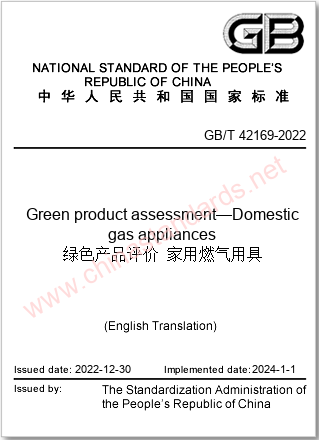
GB/T 42169-2022 in English
VALIDGreen product assessment—Domestic gas appliances
- Issued on:2022-12-30
- Implemented on:2024-01-01
- File Format:PDF
- Delivery:Via email within 5 business days
$291.00
| Standard No: | GB/T 42169-2022 |
| Document status: | VALID |
| Title in English: | Green product assessment—Domestic gas appliances |
| Title in Chinese: | 绿色产品评价 家用燃气用具 |
| Language: | English |
| File Format: | Electronic (PDF) |
| Delivery: | Via email within 5 business days |
| Issued on: | 2022-12-30 |
| Implemented on: | 2024-01-01 |
| ICS Classification: | 97.040.20-Cooking ranges, working tables, ovens and similar appliances |
| Chinese Classification: | Q82-Air supply instrument and equipment |
| Professional Classification: | GB-National Standard |
| Related Keywords: | green product assessment domestic gas appliances introduction in-depth interpretation
household gas appliances gas appliances green product evaluation green environmental protection performance |
| Related Topics: | product evaluation
green product Product Evaluation Criteria product evaluation Whose product is gcms green product Green Product Evaluation gas appliance utensils Green Product Evaluation Household Gas Appliances Furniture odor evaluation and classification gb/t 42169-2022 |
《GB/T 42169-2022绿色产品评价 家用燃气用具》由TC174(全国五金制品标准化技术委员会)归口,主管部门为中国轻工业联合会。
Introduction
In-depth interpretation of GB/T42169-2022 "Green Product Evaluation of Household Gas Appliances"
Background and significance of standard formulation
With the improvement of global environmental awareness, household gas appliances, as important equipment widely used in residents' lives, have received extensive attention for their green environmental protection performance. GB/T42169-2022 "Green Product Evaluation of Household Gas Appliances" came into being, aiming to standardize the green evaluation requirements and methods of household gas appliances and promote the sustainable development of the industry.
The standard was proposed by the China Light Industry Federation and managed by the National Technical Committee for Standardization of Hardware Products, which embodies the wisdom and practical experience of many leading companies. By establishing a unified evaluation system, it provides consumers, enterprises and society with a clear basis for identifying green products, helping to achieve the "dual carbon" goal.
Comparative analysis of standard frameworks
| Evaluation dimensions | GB/T42169-2022 requirements | Comparison with other relevant standards |
|---|---|---|
| Resource attributes | Renewable utilization rate ≥ 80%, focusing on the recycling value of materials. | Compared with GB/T33761, specific requirements for disassembly lists have been added, further refining green design standards. |
| Energy attributes | Thermal efficiency ≥ 58%, and the hot water efficiency of gas instantaneous water heaters ≥ 90%. | Compared with GB20665, a new requirement for heating efficiency of condensing furnaces (≥ 100%) has been added, reflecting technological progress. |
| Environmental attributes | Harmful substances are strictly controlled: the content of heavy metals such as lead, mercury, and cadmium is ≤100mg/kg. | In line with international standards, a new nitrogen oxide emission limit (≤60mg/kW·h) has been added, which is in line with the global environmental protection trend. |
Explanation of professional terms and practical application cases
Recycling Rate: refers to the mass proportion of the part of the product that is expected to be reused or recycled. Through the calculation method in Appendix A, combined with the disassembly list examples in Tables B.1 to B.4, the recycling value of various parts can be clarified.
Thermal Efficiency: an important indicator to measure the energy conversion effect of gas appliances. For example, a gas stove with a thermal efficiency of ≥58% means that its energy utilization rate has reached the industry-leading level.
Nitrogen oxide emissions (NOx Emissions): Harmful gases generated during combustion are calculated using the test methods and conversion values specified in Appendix C to ensure that emissions meet environmental protection requirements.

Loading PDF document...
Error loading PDF. Please make sure the file is valid and try again.


