
GB/T 44407-2024 in English
VALIDIntelligent service—Predictive maintenance—Requirement of virtual maintenance system
- Issued on:2024-08-23
- Implemented on:2025-03-01
- File Format:PDF
- Delivery:Via email within 5 business days
$301.00
《GB/T 44407-2024智能服务 预测性维护 虚拟维护系统技术要求》由TC124(全国工业过程测量控制和自动化标准化技术委员会)归口,主管部门为中国机械工业联合会。
Introduction
1. Standard Overview
GB/T 44407-2024 "Technical Requirements for Intelligent Service Predictive Maintenance Virtual Maintenance System" was issued on August 23, 2024 and will be implemented on March 1, 2025. This standard is managed by the National Technical Committee for Industrial Process Measurement, Control and Automation Standardization and is applicable to the design, development, use and maintenance of virtual maintenance systems.
2. Comparison of standard frameworks
| Standard dimensions | GB/T 44407—2024 requirements | Comparison with international advanced levels |
|---|---|---|
| System framework | Infrastructure layer, data layer, model layer and function layer | In line with international standards, in line with MES and IIoT requirements |
| Modeling requirements | Three-dimensional model accuracy, physical property setting, behavior design | Meet industrial-grade simulation standards |
| Functional requirements | Maintenance management and program planning, verification optimization, and capability training | Support AR/VR collaboration and remote maintenance |
3. Background of standard formulation and technological evolution
Background analysis:With the advancement of Industry 4.0 and intelligent manufacturing, predictive maintenance has become a key technology to improve equipment reliability and production efficiency. Virtual maintenance systems use augmented reality (AR) and virtual reality (VR) technologies to achieve digital mapping of physical systems, supporting remote diagnosis, real-time monitoring, and intelligent decision-making.
Technological evolution:From early discrete maintenance to model-based predictive maintenance, and then to the current digital twin application, the technological development of virtual maintenance systems reflects the trend of industrial intelligence. The formulation of standards aims to standardize industry practices, lower technical barriers and promote technological innovation.
4. Implementation recommendations and best practices
Case study: Application practice of an automobile manufacturer
The company achieved the following goals by deploying a virtual maintenance system:
- Maintenance efficiency increased by 40%
- Maintenance costs reduced by 25%
- Training time reduced by 60%
Implementation recommendations: 1. Ensure that hardware facilities meet the requirements of high-performance computing and real-time interaction; 2. Establish standardized model data interfaces to promote system integration; 3. Strengthen security management to prevent cyber attacks and data leaks.

Loading PDF document...
Error loading PDF. Please make sure the file is valid and try again.
We also recommend
-
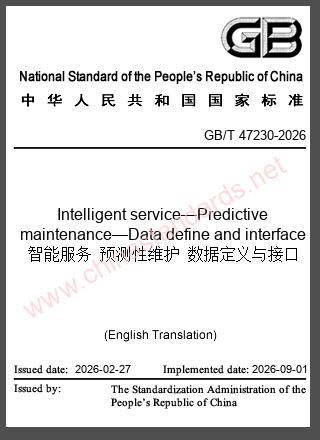
GB/T 47230-2026 in English
Intelligent service—Predictive maintenance—Data define and interface
2026-02-27 -

GB/T 44406-2024 in English
Production process quality data acquisition system—Performance assessment and calibration
2024-08-23 -

GB/Z 42023.2-2022 in English
Reliability of industrial automation devices and systems—Part 2: System reliability
2022-10-12 -

GB/T 41273-2022 in English
Production process quality control—System model and architecture—Machining
2022-03-09 -

GB/T 37942-2019 in English
Quality control of production process—Condition monitoring of equipment
2019-08-30 -

GB/T 43555-2023 in English
Intelligent service—Predictive maintenance—Algorithm evaluation method
2023-12-28


