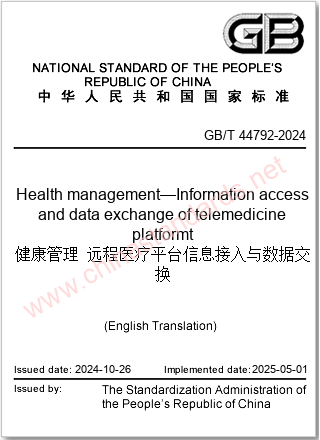
GB/T 44792-2024 in English
VALIDHealth management—Information access and data exchange of telemedicine platformt
- Issued on:2024-10-26
- Implemented on:2025-05-01
- File Format:PDF
- Delivery:Via email within 5 business days
$359.00
| Standard No: | GB/T 44792-2024 |
| Document status: | VALID |
| Title in English: | Health management—Information access and data exchange of telemedicine platformt |
| Title in Chinese: | 健康管理 远程医疗平台信息接入与数据交换 |
| Language: | English |
| File Format: | Electronic (PDF) |
| Delivery: | Via email within 5 business days |
| Issued on: | 2024-10-26 |
| Implemented on: | 2025-05-01 |
| ICS Classification: | 35.240.80-IT applications in health care technology |
| Chinese Classification: | C07-Computer application |
| Professional Classification: | GB-National Standard |
| Related Keywords: | health management information access
data exchange interface data exchange data exchange process information exchange |
| Related Topics: | telemedicine
health management iso remote access Health Insurance and the Medical System Medical health instrument usb data remote |
《GB/T 44792-2024健康管理 远程医疗平台信息接入与数据交换》由TC242(全国音频、视频及多媒体系统与设备标准化技术委员会)归口,主管部门为工业和信息化部(电子)。
Introduction
1. Background and significance of standard formulation
GB/T 44792—2024 is formulated to standardize the information access and data exchange process of telemedicine platforms and improve the quality and efficiency of health management services. With the rapid development of digital medicine, ensuring information exchange and data security between medical institutions has become a pain point in the industry. This standard provides standardized guidance for telemedicine services through unified interfaces and technical requirements.
2. Comparison of standard frameworks
| Dimensions | Existing standards | Improvements of new standards |
|---|---|---|
| Data interface specifications | Diverse and non-uniform | Unified interface and format requirements |
| Security requirements | Basic security measures | Strengthen TLS/SSL encryption and multi-factor authentication |
| Data quality control | Partially missing | Introduce business data verification and audit mechanism |
3. Interpretation of core technical requirements
3.1 Technical requirements for front-end exchange
As a bridge between the telemedicine platform and the access system, the front-end undertakes the key tasks of data conversion and routing. The new standard emphasizes the front-end's:
- Functional adaptability: Supports conversion between multiple communication protocols and development languages.
- Network independence: The front-end needs to be connected to an independent network to ensure the security and stability of data exchange.
- Enhanced security: Comply with the national information security level 3 standard to ensure that sensitive information in data transmission is not leaked.
3.2 Data exchange interface mode
The new standard defines two main data exchange modes:
a) Front-end database exchange interface mode:- Applicable to batch data processing, supporting scheduled upload and sharing.
- Data conversion and verification are realized through XML files or database table records.
- Based on web services, HL7 CDA format is used for document registration and query.
- Supports primary index service and document exchange service to achieve efficient data management and sharing.
4. Implementation suggestions
4.1 Phased implementation strategy
In view of the complexity of the telemedicine platform, it is recommended to advance in stages:
- Pilot test: Select some medical institutions to conduct standard trials and collect feedback.
- System transformation: Adapt and optimize the existing system based on the pilot results.
- Full deployment: Promote implementation across the industry to ensure that all links meet the standard requirements.
4.2 Security Strategy Recommendations
- Adopt a multi-level access control mechanism to ensure the security of patient data.
- Strengthen the application of TLS/SSL encryption protocols to prevent potential threats in data transmission.
- Perform security audits and vulnerability scans regularly to fix risk points in a timely manner.
4.3 Training and Support
Organize industry training to enhance the understanding and application capabilities of medical institution technicians on the new standards. At the same time, establish a technical support team to provide timely solutions to problems encountered during implementation.

Loading PDF document...
Error loading PDF. Please make sure the file is valid and try again.
We also recommend
-

GB/T 40419-2021 in English
Health informatics—Genomic Sequence Variation Markup Language (GSVML)
2021-10-11 -

GB/T 21716.2-2025 in English
Health informatics—Public key infrastructure—Part 2: Certificate profile
2025-10-05 -

GB/Z 24464-2009 in English
Health informatics—Electronic health record—Definition,scope and context
2009-10-15 -

GB/T 46940-2025 in English
Traditional Chinese medicine—Categories of traditional Chinese medicine (TCM) clinical terminological systems
2025-12-31 -
GB/T 44662-2024 in English
Health management—Data collection and transmission protocol of terminal equipment
2024-09-29 -

GB/T 25513-2010 in English
Health informatics - Directory services for security communications and identification of professionals and patients
2010-12-01


