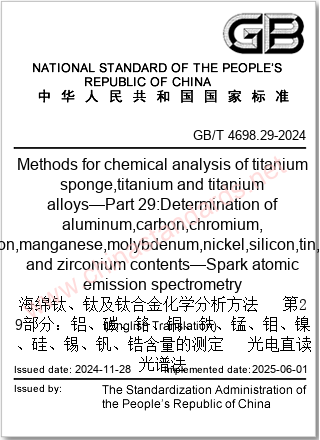
GB/T 4698.29-2024 in English
VALIDMethods for chemical analysis of titanium sponge,titanium and titanium alloys—Part 29:Determination of aluminum,carbon,chromium, copper,iron,manganese,molybdenum,nickel,silicon,tin,vanadium and zirconium contents—Spark atomic emission spectrometry
- Issued on:2024-11-28
- Implemented on:2025-06-01
- File Format:PDF
- Delivery:Via email within 5 business days
$364.00
| Standard No: | GB/T 4698.29-2024 |
| Document status: | VALID |
| Title in English: | Methods for chemical analysis of titanium sponge,titanium and titanium alloys—Part 29:Determination of aluminum,carbon,chromium, copper,iron,manganese,molybdenum,nickel,silicon,tin,vanadium and zirconium contents—Spark atomic emission spectrometry |
| Title in Chinese: | 海绵钛、钛及钛合金化学分析方法 第29部分:铝、碳、铬、铜、铁、锰、钼、镍、硅、锡、钒、锆含量的测定 光电直读光谱法 |
| Language: | English |
| File Format: | Electronic (PDF) |
| Delivery: | Via email within 5 business days |
| Issued on: | 2024-11-28 |
| Implemented on: | 2025-06-01 |
| ICS Classification: | 77.120.50-Titanium and titanium alloys |
| Chinese Classification: | H14-Rare metals and their alloys analysis method |
| Professional Classification: | GB-National Standard |
| Related Keywords: | titanium alloys part
complete titanium alloy analysis system titanium sponge atomic emission spectrometry introduction analysis chemical analysis |
| Related Topics: | Titanium Silicon Molecule
Aluminum manganese titanium alloy composition Titanium peak splitting Titanium Alloy Spectral Analysis Nitinol Analysis Method Titanium Spectrum Titanium and titanium alloys (chemical analysis method) Titanium alloy direct reading spectroscopy method Direct reading spectrum titanium alloy |
《GB/T 4698.29-2024海绵钛、钛及钛合金化学分析方法 第29部分:铝、碳、铬、铜、铁、锰、钼、镍、硅、锡、钒、锆含量的测定 光电直读光谱法》由TC243(全国有色金属标准化技术委员会)归口,TC243SC3(全国有色金属标准化技术委员会稀有金属分会)执行,主管部门为中国有色金属工业协会。
Introduction
Analysis of the core content of the standard
| Technical elements | Specific requirements | Innovation points |
|---|---|---|
| Determination of elements | aluminum, carbon, etc. 12 kinds | Synchronous detection of multiple elements |
| Detection range | 0.003%~14.9% | Wide range coverage |
| Precision | r≤0.1%(Al) | Verified by 18 laboratories |
Method principle and technical characteristics
The standard adopts spark source atomic emission spectroscopy technology to achieve quantification by analyzing the intensity of element characteristic spectral lines under argon protection. Key technical indicators include:
- Environmental control: temperature 18-30℃±5℃, humidity 20-80%
- Argon purity: ≥99.995%
- Surface roughness: Ra≤3.2μm
Key implementation points
| Element | Analysis line (nm) | Interference element |
|---|---|---|
| Al | 396.152 | Ni 199.025 |
| C | 193.027 | Al 193.041 |
Standard Evolution and Industry Value
As the 29th part of the GB/T 4698 series, this standard, together with the 28 previously released method standards, constitutes a complete titanium alloy analysis system. Compared with traditional chemical methods, photoelectric direct reading spectroscopy has the following advantages:
- Efficiency is improved by 5-10 times
- Detection limit is reduced by 1 order of magnitude
- Accurate analysis of hard-to-measure elements such as Al and C is achieved
Quality control requirements
Use two-point standardization correction and control sample method to ensure data accuracy:
- Standardized sample: content near the upper and lower limits of the working curve
- Control sample: consistent with the metallurgical process of the sample to be tested
- Repeatability limit r calculation formula: lgr=0.7914lgw-1.5741(Al)

Loading PDF document...
Error loading PDF. Please make sure the file is valid and try again.
We also recommend
-

GB/T 4698.26-2024 in English
Methods for chemical analysis of titanium sponge,titanium and titanium alloys—Part 26: Determination of tantalum and tungsten content—Inductively coupled plasma atomic emission spectrometry
2024-10-26


