
GB/T 6378-2002 in English
SUPERSEDEDSampling procedures and charts for inspection by variables for percent nonconforming (Applied to inspection of successive lots or batches)
- Issued on:2002-06-13
- Implemented on:2003-01-01
- File Format:PDF
- Delivery:Via email within 10 business days
$1,058.00
《GB/T 6378-2002不合格品率的计量抽样检验程序及图表(适用于连续批的检验)》由TC21(全国统计方法应用标准化技术委员会)归口,主管部门为国家标准化管理委员会。
本标准设计的计量抽样检验方案和程序,是对GB/T 2828(ISO 2859-1)的补充。在产品规格、合同、检验说明书或其他文件中可参考本标准和GB/T 2828。使用本标准时,要在上述文件中规定“负责部门”。本标准的抽样检验方法,可以保证可接收质量的批有高接收概率,并且使劣质批的拒收概率尽可能的高。与GB/T 2828(ISO 2859-1)相同,用不合格品率表示批质量和相应的生产过程质量。本标准主要是在下述条件下使用:A) 检验程序适用于分立产品的连续批,即这些产品全部由同一生产方用同一生产过程提供。如果这些产品来自于不同的生产方,应分别使用本标准。B) 仅考虑产品的单个质量特性X,该质量特性必须能用连续尺度度量;如果有几个同样重要的质量特征,应分别使用本标准。C) 生产过程稳定(处于受控状态),且质量特性X服从或近似服从正态分布。D) 若合同或标准中规定了上规格限U,下规格限L,或同时规定了上、下规格线;当产品被测量的质量特性X满足下列不等式之一时为不合格品:1)对于上规格限,X>U时为不合格;2)对于下规格限,X<L时为不合格;3)对于双侧规格限,X>U或X<L时为不合格。对于在后一种情况,根据上、下规格限是否指定了一个总AQL值进一步区分为综合双侧规格限和分立双侧规格限。
Scope
The measurement sampling inspection plan and procedures designed in this standard are supplements to GB/T 2828 (IS0 2859-1). This standard and GB/T 2828 may be referred to in product specifications, contracts, inspection instructions or other documents. When using this standard, the "responsible department" shall be specified in the above-mentioned document. The sampling inspection method of this standard can ensure that batches of acceptable quality have a high probability of acceptance, and make the probability of rejection of inferior batches as high as possible. Same as GB/T 2828 (IS0 2859-1), the batch quality and the corresponding production process quality are expressed by the defective product rate. This standard is mainly used under the following conditions: a) The inspection procedure is applicable to continuous batches of discrete products, that is, these products are all supplied by the same manufacturer using the same production process. If these products come from different producers, this standard should be used separately. B) Consider only a single quality characteristic X of the product, which must be measurable on a continuous scale; if there are several equally important quality characteristics, this standard should be used separately. C) The production process is stable (under control), and the quality characteristic X obeys or approximately obeys a normal distribution. D) If the upper specification limit U, the lower specification limit L, or both are specified in the contract or standard; when the measured quality characteristic x of the product satisfies one of the following inequalities, it is a non-conforming product: 1) For For the upper specification limit, it is unqualified when x>u; 2) For the lower specification limit, it is unqualified when X%L; 3) For the two-sided specification limit, it is unqualified when X>U or X%L. In the latter case, a further distinction is made between composite two-sided specification limits and discrete two-sided specification limits, depending on whether an overall AQL value is specified for the upper and lower specification limits.

Loading PDF document...
Error loading PDF. Please make sure the file is valid and try again.
We also recommend
-
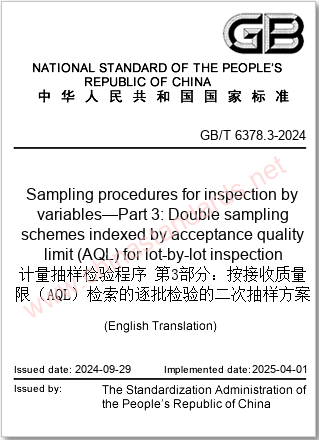
GB/T 6378.3-2024 in English
Sampling procedures for inspection by variables—Part 3: Double sampling schemes indexed by acceptance quality limit (AQL) for lot-by-lot inspection
2024-09-29 -
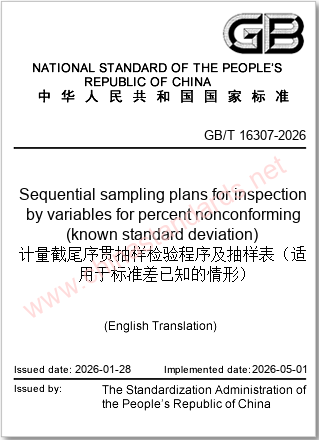
GB/T 16307-2026 in English
Sequential sampling plans for inspection by variables for percent nonconforming (known standard deviation)
2026-01-28 -

GB/T 33260.2-2018 in English
Capability of detection—Part 2:Methodology in the linear calibration case
2018-06-07 -

GB/T 17560-1998 in English
Interpretation of statistical data - Estimation of a median
1998-01-01 -

GB/T 10092-2009 in English
Statistical interpretation of data - Multiple comparison for test results
2009-10-15 -

GB/T 13262-2008 in English
Single sampling procedures and tables for inspection having desired operating characteristics by attributes for percent nonconforming
2008-07-16 -

GB/T 22553-2023 in English
Guidance for the use of repeatability, reproducibility and trueness estimates in measurement uncertainty evaluation
2023-11-27


