
GB/T 6730.77-2019 in English
VALIDIron ores—Determination of arsenic content—Hydride generation-atomic fluorescence spectrometric method
- Issued on:2019-08-30
- Implemented on:2020-07-01
- File Format:PDF
- Delivery:Via email within 1~3 business days
$214.00
《GB/T 6730.77-2019铁矿石 砷含量的测定 氢化物发生-原子荧光光谱法》由TC317(全国铁矿石与直接还原铁标准化技术委员会)归口,主管部门为中国钢铁工业协会。
Introduction
Introduction
GB/T 6730.77-2019 specifies in detail the method for determining the arsenic content in iron ore using hydride generation-atomic fluorescence spectrometry, which is applicable to natural iron ore, iron concentrate and lump ore, including sintered products. The method reduces pentavalent arsenic to trivalent arsenic by chemical reaction in hydrochloric acid medium and detects it on an atomic fluorescence spectrometer.
Overview of standard content
Scope of application
- Determination range: 0.001% to 0.50%
- Applicable to iron ore and its products, including sintered products
Reagents and materials
A variety of reagents are used in the analysis, including hydrochloric acid, nitric acid, hydrofluoric acid, etc. Key reagents such as thiourea-ascorbic acid mixed solution are used for pre-reduction of the test solution, and potassium borohydride solution is used as a reducing agent.
Instruments and Equipment
The main instrument is a hydride generation-atomic fluorescence spectrometer (in accordance with GB/T 21191), equipped with an arsenic hollow cathode lamp, and the detection limit is not less than 0.07μg/L.
Analysis Steps
Sample Decomposition
| Method | Detailed Steps | Applicable Situations |
|---|---|---|
| Microwave Digestion Method | The sample is digested in a polytetrafluoroethylene digestion tank by adding hydrochloric acid, nitric acid, etc. in sequence. | Applicable to conventional samples |
| Conventional Acid Dissolution Method | The sample is heated and digested in a polytetrafluoroethylene beaker using a variety of strong acids. | For samples with high silicon content |
Test solution aliquoting and calibration
Different volumes of test solution were aliquoted according to the arsenic content range (Table 1) and the fluorescence intensity was measured after dilution.
Table 1: Comparison of sample quantity and aliquot volumeResult calculation and quality control
Precision analysis
| Arsenic content range (%) | Repeatability limit r | Reproducibility limit R |
|---|---|---|
| 0.001-0.50% | r=0.0532X+0.00028 | R=0.120X+0.00160 |
Result presentation and report
Analysis results according to GB/T 8170 was rounded off, retaining four decimal places when less than 0.1%, and retaining three decimal places when greater than or equal to 0.1%.
Implementation suggestions
Method advantages
- High sensitivity: detection limit of 0.07μg/L
- Good accuracy: linear correlation coefficient of standard curve ≥0.996
- Strong applicability: applicable to a variety of iron ore samples
Precautions
Pay attention to the protection of strong acid solution during the experiment. Blank test and standard sample verification are important steps to ensure data reliability.
Future improvement direction
- Explore the application of automated digestion technology
- Optimize reagent ratio to improve determination efficiency

Loading PDF document...
Error loading PDF. Please make sure the file is valid and try again.
We also recommend
-

GB/T 6730.88-2024 in English
Iron ores—Determination of chlorine content—X-ray fluorescence spectrometric method
2024-06-29 -

GB/T 6730.1-2016 in English
Iron ores―Preparation of predried test samples for chemical analysis
2016-02-24 -
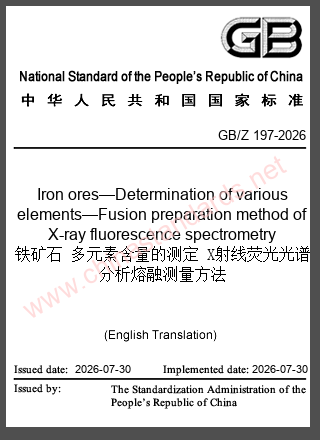
GB/Z 197-2026 in English
Iron ores—Determination of various elements—Fusion preparation method of X-ray fluorescence spectrometry
2026-07-30 -

GB/Z 42358-2023 in English
Iron ores—Wavelength dispersive X-ray fluorescence spectrometers—Determination of precision
2023-03-17 -

GB/T 32545-2016 in English
Division of production grade for iron ores
2016-02-24 -

GB/T 8454-2020 in English
Reduced ilmenite powder for welding rob-Determination of ferrous iron content- Potassi um dichromate titrimetric method
2020-06-02 -

GB/T 24190-2009 in English
Iron ores—Determination of combined water—Karl Fischer method
2009-07-08


