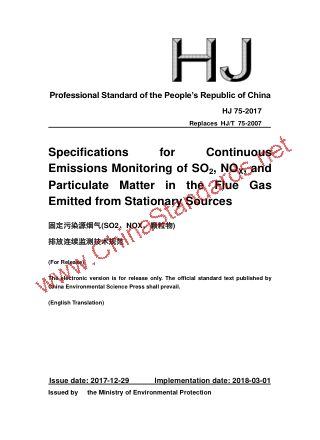
HJ 75-2017 in English
VALIDSpecifications for continuous emissions monitoring of SO2, NOx, and particulate matter in the flue gas emitted from stationary sources
- Issued on:2017-12-29
- Implemented on:2018-03-01
- File Format:PDF
- Delivery:Via email within 1~3 business days
$476.00
ChinaStandards.net is in charge of this English translation. In case of any doubt about the English translation, the Chinese original shall be considered authoritative.
This standard is formulated with a view to implementing the Environmental Protection Law of the People's Republic of China and the Law of the People's Republic of China on the Prevention and Control of Atmospheric Pollution, strengthening the monitoring, supervision and control over the flue gas emitted from stationary sources, and improving the level of continuous monitoring management of flue gas emitted from stationary sources.
This standard specifies the requirements on the composition and functions, technical performance, monitoring station building and installation, performance testing of technical indexes, technical acceptance, daily operation management, daily operation quality assurance and data review and processing in relation to the continuous monitoring system for flue gas (SO2, NOX and particulate matters) emitted from stationary sources.
This standard is a revision with respect to HJ/T 75-2007 Specifications for Continuous Emissions Monitoring of Flue Gas Emitted from Stationary Sources (on trial). This standard was firstly issued in 2001 and revised in 2007 for the first time. Its original drafting organization is Shanghai Environmental Monitoring Center. It is the second revision with the main revised contents as follows:
——Flue gas humidity testing and quality control requirements are added;
——The introduction to the method and the structure of the monitoring instrument is simplified;
——CEMS installation requirements are refined;
——Supplements are made for the performance testing and technical acceptance methods, technical requirements and relevant record forms;
——Requirements are refined as to the operation management and quality assurance as well as data review and processing.
Annex A, Annex C and Annex H of this standard are normative. Annex B, Annex D, Annex E, Annex F and Annex G are informative.
As of the implementation date of this standard, HJ/T 75-2007 Specifications for Continuous Emissions Monitoring of Flue Gas Emitted from Stationary Sources (on trial) is abolished.
This standard is formulated under the organization of the Department of Environment Monitoring and Department of Science, Technology and Standards under the Ministry of Environmental Protection.
This standard was approved by the Ministry of Environmental Protection on December 29, 2017.
This standard shall be implemented as of March 1, 2018.
The Ministry of Environmental Protection is in charge of the interpretation of this standard.
Specifications for Continuous Emissions Monitoring of SO2, NOX, and Particulate Matter in the Flue Gas Emitted from Stationary Sources
1 Scope of Application
This standard specifies the requirements on the composition and functions, technical performance, monitoring station building and installation, performance testing of technical indexes, technical acceptance, daily operation management, daily operation quality assurance and data review and processing in relation to the continuous monitoring system for the gaseous pollutants (SO2 and NOX) emission, particulate matter emission and relevant flue gas parameters among the continuous monitoring systems for flue gas emitted from stationary sources.
This standard is applicable to continuous monitoring systems for flue gas (SO2, NOX and particulate matter) emitted from stationary sources such as thermal power plant boilers, industrial/civilian boilers and industrial furnaces and kilns with solid and liquid as fuel or raw material.
This standard may serve as a reference for the continuous monitoring system for flue gas (SO2, NOX and particulate matter) emitted from domestic waste incinerators, hazardous waste incinerators, and stationary sources with gas as fuel or raw materials.
Prior to the formal promulgation and implementation of the standards for other continuous monitoring systems for flue gas pollutant emission, this standard may be implemented as a reference.
2 Normative References
The following documents or provisions therein are referred to in this standard. For undated references, the latest edition of the normative document applies.
GB 4208 Degrees of Protection Provided by Enclosure ( IP Code)
GB 50057 Design Code for Protection of Structures against Lightning
GB 50093 Code for Construction and Quality Acceptance of Automation Instrumentation Engineering
GB 50168 Code for Construction and Acceptance of Cable System Electric Equipment Installation Engineering
GB/T 16157 Determination of Particulates and Sampling Methods of Gaseous Pollutants Emitted from Exhaust Gas of Stationary Source
HJ 76 Specifications and test procedures for Continuous Emission Monitoring System for SO2, NOX and Particulate Matter in Flue Gas emitted from Stationary Sources
HJ/T 212 Standard for Data Communication of Pollution Emission Auto Monitoring System
HJ/T 397 Technical Specifications for Emission Monitoring of Stationary Source
3 Terms and Definitions
3.1
continuous emission monitoring, CEM
continuous real time automatic monitoring over emission concentration and emission amount of particulate matter and (or) gaseous pollutants emitted by stationary sources, abbreviated as CEM
3.2
continuous monitoring system, CMS
all the equipment necessary for continuous monitoring of flue gas parameters for the stationary sources, abbreviated as CEMS
3.3
continuous emission monitoring system, CEMS
all the equipment necessary for continuous monitoring over emission concentration and emission amount of particulate matter and (or) gaseous pollutants emitted by stationary sources, abbreviated as CEMS
3.4
valid operation of CEMS
operation within the specified validity period which meet the technical index requirements given in this standard, excluding, however, the operation periods with detector contamination, instrument failure, system calibration or system without regular calibration or regular verification
3.5
valid data
The data measured under the condition that the stationary source emits flue gas during valid operation of the CEMS which meets the technical index requirements in this standard and passes the acceptance
3.6
valid hourly average
arithmetic average of valid data for no less than 45 min within 1h on the hour
3.7
reference method
standard method released by the State or profession for comparison with CEMS measurement result
3.8
checkout/verification
the testing process to compare the testing results of CEMS (including sampling system and analysis system) with the reference method in terms of relative accuracy, correlation coefficient, confidence interval, allowable interval, relative error, absolute error, etc.
3.9
performance testing
calibration and checkout/verification carried out for the CEMS prior to the technical acceptance and after CEMS installation, initial adjustment and continuous normal operation for at least 168 hours
3.10
comparison testing
random inspection on the accuracy of CEMS in valid operation with the reference method
3.11
response time
response time refers to the interval from the time when standard gas is introduced into the CEMS system sampling probe to the time when the analyzer indication value reaches 90% of the nominal value of standard gas, including pipeline transmission time and instrument response time
3.12
zero drift
percentage of deviation between instrument reading and initial measurement value of zero gas relative to the full span when zero gas is introduced into the CEMS after operating for a specified time under the premise that the instrument is not subjected to repair, maintenance or adjustment
3.13
span drift
percentage of deviation between instrument reading and initial measurement value of span calibration gas relative to the full span when zero gas is introduced into the CEMS after operating for a specified time under the premise that the instrument is not subjected to repair, maintenance or adjustment
3.14
relative accuracy
ratio of the sum of the absolute value of average for the difference between data pairs and the confidence coefficient to the average of determination data with reference method where the measurement results in the same time interval and in the same status compose several data pairs when the reference method is adopted to measure the gas pollutant concentration in the flue gas synchronously with the CEMS
3.15
correlation calibration
the process to calibrate CEMS for particulate matter with reference method via the establishment of a correlation curve between data pairs where the measurement results in the same time interval and in the same status compose several data pairs when the reference method is adopted to measure the gas pollutant concentration in the flue gas synchronously with the CEMS
3.16
velocity field coefficient
ratio of average flue gas flow velocity measured with reference method and that measured with CEMS in the same time interval and same status when reference method and CEMS are adopted synchronously to measure the average flue gas flow velocity
4 Composition and Function Requirements on CEMS for Stationary Sources
CEMS is composed of particulate matter monitoring unit and (or) gaseous pollutants monitoring unit, flue gas parameter monitoring unit and data acquisition and processing unit.
CEMS shall realize such functions as measurement of the particulate matter concentration and concentration of gaseous pollutants SO2 and/or NOX in the flue gas, the flue gas parameters (temperature, pressure, flow velocity or flow capacity, humidity, oxygen content, etc.), as well as calculation of pollutant emission rate and emission amount in the flue gas, display (supporting printing) and record of a variety of data and parameters, the formation of related charts, which may be transmitted to the management department through data, teletext and other means. The output parameter calculation shall meet the requirements of Annex C.
As for the nitrogen oxide monitoring unit, NO2 can be measured directly, or measured after it is converted to NO after passing through the reformer, but it is not allowed to monitor the NO in the flue gas only. The efficiency of converting NO2 to NO shall meet the requirements specified in HJ 76.
5 Technical Performance Requirements on CEMS for Stationary Sources
The relevant requirements in HJ 76 shall be complied with.
6 Requirements on Monitoring Station Building of CEMS for Stationary Sources
6.1 An independent station building shall be provided for the outdoor CEMS. The distance between the monitoring station building and the sampling site shall be as close as possible, and it should not exceed 70m in principle.
6.2 The load intensity of the foundation for monitoring station building shall be ≥ 2,000kg/m2. If only a single cabinet is placed in the station building, its area shall be ≥ 2.5 × 2.5m2. If more than one set of analysis instruments are placed in the same station building, the area of the station building shall be increased by at least 3m2 for each additional cabinet to facilitate operation and maintenance. The spatial height of the station building shall be ≥ 2.8m, and building shall be built at an elevation ≥ 0m.
6.3 Air conditioner and heating equipment shall be installed in the monitoring station building. The indoor temperature shall be maintained at (15~30) °C and the relative humidity shall be ≤ 60%. The air conditioner shall have an automatic restart function in case of power recovery. Exhaust fans or other ventilation facilities shall be installed in the station building.
Foreword i
1 Scope of Application
2 Normative References
3 Terms and Definitions
4 Composition and Function Requirements on CEMS for Stationary Sources
5 Technical Performance Requirements on CEMS for Stationary Sources
6 Requirements on Monitoring Station Building of CEMS for Stationary Sources
7 Requirements on Installation of CEMS for Stationary Sources
8 Performance Testing for the Technical Indexes of CEMS for Stationary Sources
9 Technical Acceptance of CEMS for Stationary Sources
10 Daily Operation and Management Requirements for CEMS for Stationary Sources
11 Quality Assurance Requirements for Daily Operation of CEMS for Stationary Sources
12 Data Review and Processing for CEMS for Stationary Sources
Annex A (Normative) Performance Testing Methods for Key Technical Indexes of CEMS for Stationary Sources
Annex B (Informative) Analysis and Processing Methods for the Result of Performance Testing of Technology Index of CEMS for Stationary Sources
Annex C (Normative) Calculation Method for Output Parameters of CEMS for Stationary Sources
Annex D (Informative) Original Data Sheet for System Installation Performance Test of CEMS for Stationary Sources
Annex E (Informative) Performance Testing Report for CEM System of Flue Gas Emitted from Stationary Sources
Annex F (Informative) Acceptance Report of Technical Indexes for CEMS for Stationary Sources
Annex G (Informative) Original Routine Inspection, Calibration and Maintenance Record for CEMS for Stationary Sources
Annex H (Normative) Requirements for Data Acquisition Processing and Transmission System of CEMS for Stationary Sources

Loading PDF document...
Error loading PDF. Please make sure the file is valid and try again.
We also recommend
-

HJ 53-2000 in English
Interim regulation for acceptable levels of residual radionuclides in soil of site considered for release
2000-05-22 -

HJ/T 2.4-1995 in English
Technical guidelines for noise impact assessment
1995-11-28


