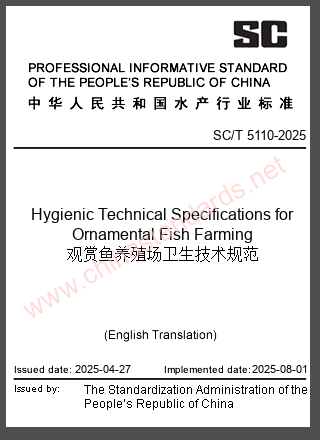
SC/T 5110-2025 in English
VALIDHygienic Technical Specifications for Ornamental Fish Farming
- Issued on:2025-04-27
- Implemented on:2025-08-01
- File Format:PDF
- Delivery:Via email within 1~3 business days
$131.00
| Standard No: | SC/T 5110-2025 |
| Document status: | VALID |
| Title in English: | Hygienic Technical Specifications for Ornamental Fish Farming |
| Title in Chinese: | 观赏鱼养殖场卫生技术规范 |
| Language: | English |
| File Format: | Electronic (PDF) |
| Delivery: | Via email within 1~3 business days |
| Issued on: | 2025-04-27 |
| Implemented on: | 2025-08-01 |
| ICS Classification: | 65.150-Fishing and fish breeding |
| Chinese Classification: | B50-Aquatic product and fishery in general |
| Professional Classification: | SC-Aquaculture |
| Related Keywords: | ornamental fish farming
ornamental fish farming industry ornamental fish industry ornamental fish ornamental fish farming introductionin-depth interpretation |
Introduction
In-Depth Interpretation of SC/T 5110-2025 Hygienic Technical Specifications for Ornamental Fish Farms
With the rapid development of the ornamental fish industry, standardized farm hygiene management has become a crucial foundation for ensuring its healthy development. The release and implementation of SC/T 5110-2025, "Hygienic Technical Specifications for Ornamental Fish Farms," marks a new stage of standardized and regular development for my country's ornamental fish farming industry.
Background of Standardization and Technological Evolution
This standard was proposed by the Fisheries Administration of the Ministry of Agriculture and Rural Affairs, under the jurisdiction of the Ornamental Fish Subcommittee of the National Technical Committee for Aquatic Products Standardization, and drafted in conjunction with the Pearl River Fisheries Research Institute of the Chinese Academy of Fishery Sciences. The standard was developed based on the current state of my country's ornamental fish farming industry, fully considering the integration of advanced international experience and actual domestic needs.
In terms of technological evolution, this standard inherits traditional aquaculture hygiene requirements while incorporating innovative provisions tailored to the unique characteristics of ornamental fish farming. In particular, it puts forward clear requirements for key technical links such as isolation area setting, circulation purification system and tail water treatment, reflecting the deep integration of modern breeding concepts and environmental protection requirements.
Functional area setting and plane layout requirements
Chapter 4 of the standard stipulates the functional area division and layout principles of ornamental fish farms. According to the differences in breeding models, the farm should have three main functional areas: breeding area, isolation area, office and living area, and can optionally set up auxiliary functional areas such as packaging area, loading and unloading area, display and sales area.
| Functional area type | Core requirements | Layout location | Special facilities |
|---|---|---|---|
| Farming area | Independent water supply and drainage system | Center or rear | Circulating purification system |
| Isolation area | Strict physical isolation | Center or rear | Tailwater Collection Facilities |
| Packaging Area | Anti-slip and Anti-water Accumulation | Peripheral or Front | Dual Entrances and Exits |
| Office and Living Area | Daily Cleaning | Peripheral Area | Regular Disinfection |
The floor plan adopts a center-peripheral or front-rear division principle to ensure effective protection of the core breeding area. This layout design considers both operational convenience and fully embodies the principles of biosafety control.
Detailed Explanation of Facility Technical Requirements
Partition Facility Requirements
Physical barriers must be established between the breeding area and isolation area and other functional areas to prevent cross-contamination. Partition facilities must be stable and tight, effectively preventing the abnormal flow of people, animals, and objects.
Farming Area Facilities
The water inlet and outlet systems must be independent, and each aquaculture water body should have independent control over both inlet and outlet. This design facilitates isolation and treatment of problems in individual water bodies, preventing the spread of disease.
The circulating purification system can be either independent or shared across multiple water bodies, as needed. For shared systems, sterilization and disinfection equipment must be installed at the outlet of the filter tank to ensure the safety of the circulating water.
Special Requirements for Isolation Areas
The establishment of isolation areas is a core component of hygienic management in ornamental fish farms. Each farm must have at least one isolation area, which can be divided into multiple isolation units as needed. The isolation area should be sturdy and weatherproof, with partitions to prevent splashing, and a drainage ditch to collect tailwater.
Entrances and exits to the isolation area must be separate and clearly marked, and equipped with comprehensive disinfection facilities. Relevant regulations must be posted at the entrance, and a handwashing sink, shoe disinfection pool, and rat screens must be provided. Exits also require comprehensive disinfection facilities and waste collection bins.
Typical Case Study: After implementing this standard, a large ornamental fish farm successfully blocked the introduction of foreign pathogens by improving its isolation area facilities. The farm established independent water supply and drainage systems in the isolation area, equipped each isolation unit with specialized tools, and strictly implemented disinfection procedures, significantly reducing the incidence of disease.
Analysis of Hygiene Management Standards
Ornamental Fish Entry Management
Chapter 6 of the standard details the hygienic management requirements for the entry and exit of ornamental fish. All incoming ornamental fish must undergo disinfection and be quarantined for observation for at least seven days. Ornamental fish imported domestically may be temporarily held for observation in the isolation area or directly in the aquaculture water body.
Ornamental fish imported from abroad are subject to stricter management. Farms approved as temporary quarantine sites must follow quarantine procedures as specified in SN/T 3537. Those entering the farm after completing quarantine off-site still need to follow the requirements for domestic imports.
Water quality management requirements
The water quality of the source water must meet the requirements of GB 11607. If surface water or natural seawater is used as the water source, it must be disinfected and sterilized before being put into use to ensure that no pathogens are detected in the disinfected water.
| Water quality indicators | Test frequency | Control range | Abnormal handling |
|---|---|---|---|
| pH value | Regular testing | Suitable range for aquaculture objects | Timely adjustment |
| Ammonia nitrogen (NH₃-N) | Regular testing | Suitable range for aquaculture objects Scope | Enhanced Filtration |
| Nitrite Nitrogen (NO₂-N) | Regular Testing | Suitable Range of Aquaculture Items | Water Quality Improvement |
| Dissolved Oxygen (DO) | Continuous Monitoring | Suitable Range of Aquaculture Items | Oxygen Enhancement Measures |
Isolation Management Implementation Details
Isolation management is a core component of hygiene management. Personnel entering and exiting the isolation area must use dedicated passages and are prohibited from entering against the flow. Strict hand and shoe disinfection procedures must be followed.
Isolation observation requires at least one observation per day, morning and evening, with a focus on observing fish for symptoms, abnormal behavior, color changes, and abnormal feeding and excretion. Observation results must be recorded in detail using the observation record form provided in Appendix A of the standard.
For special circumstances, the standard allows for on-site isolation. When a large number of ornamental fish are brought in at a time, or when a fish outbreak requires collective treatment, a temporary isolation area may be designated within the aquaculture area and implemented in accordance with the requirements for isolation area management. Chapter 7 of the standard specifies the requirements for the harmless disposal of diseased and dead fish, which must be implemented in accordance with SC/T 7015. Appendix A also provides detailed observation record form and medication record form templates, providing tools to support standardized farm management. The observation record form includes basic information such as pond number, fish species, origin, and stocking rate, as well as water quality indicators such as water temperature, pH, ammonia nitrogen, and nitrite. It also includes observations on physical symptoms and feeding activity. The medication record form details key information such as the name, dosage, and duration of action of the medication. Recommendations for Standard Implementation New Farm Planning For new ornamental fish farms, it is recommended that the requirements of this standard be fully considered during the planning and design phase. Focus on functional zoning, isolation area design, and circulation system design to ensure compliance with hygienic technical standards from the source.
Recommendations for Existing Farms
Existing farms should develop a step-by-step renovation plan based on their actual conditions. Prioritize improving isolation area facilities and water supply and drainage systems, gradually achieving physical isolation between functional areas and ultimately meeting standard requirements.
Recommendations for Daily Operations
Establish a comprehensive sanitation management system, appoint dedicated sanitation managers, and conduct regular employee training. Strictly implement observation and medication record systems to establish a traceable management system.
Recommendations for Emergency Response
Develop an epidemic emergency plan, clarifying epidemic reporting procedures and treatment measures. Stockpile necessary disinfectants and equipment to ensure timely and effective response in the event of an epidemic.
Technological Development Trends
With advancements in aquaculture technology and increasing environmental protection requirements, sanitation technology in ornamental fish farms will develop towards intelligent and sophisticated technologies. In the future, advanced technologies and equipment such as IoT-based real-time water quality monitoring systems and automated disinfection equipment may emerge, further improving farm hygiene management.
At the same time, as consumers' expectations for the quality of ornamental fish increase, hygiene management standards will continue to improve and enhance. Farming companies should closely monitor technological developments and promptly update their facilities and management methods to maintain a competitive advantage.
The implementation of SC/T 5110-2025 will provide strong support for the healthy development of my country's ornamental fish farming industry, driving the industry towards standardization, scale, and modernization.

Loading PDF document...
Error loading PDF. Please make sure the file is valid and try again.
We also recommend
-

SC/T 9455-2025 in English
Standards for the Survey of Freshwater Fisheries Resources: Lakes
2025-04-27 -

SC/T 3043-2014 in English
Guideline of aquaculture products traceability label
2014-03-24


