
SN/T 5228.1-2019 in English
VALIDRapid detection of pathogens in export food-MALDI-TOF MS method- Part 1: Vibrio alginolyticus
- Issued on:2019-12-27
- Implemented on:2020-07-01
- File Format:PDF
- Delivery:Via email within 1~3 business days
$97.00
Introduction
Technical background of the standard
This standard, as the first part of a series of detection methods issued by the General Administration of Customs, establishes a rapid screening system for Vibrio alginolyticus based on MALDI-TOF MS technology. This technology shortens the traditional culture and identification time from 3-5 days to 20 minutes through the analysis of microbial characteristic protein fingerprints.
Analysis of core methods
| Technical links | Key parameters | Quality control points |
|---|---|---|
| Sample pretreatment | 70% formic acid protein extraction | Colony count ≥5mg |
| Mass spectrometry detection | Laser frequency 60Hz | Mass-to-charge ratio error <0.03% |
| Result judgment | Biotyper score | ≥1.700 valid |
Implementation points
Typical application scenario
During the inspection of a seafood export company, 3 samples were found to have Biotyper scores ≥2.300. After review, they were confirmed to be contaminated by Vibrio alginolyticus. The whole detection time was shortened by 92% compared with traditional methods.
Key control measures
- The matrix solution must be prepared and used immediately, and discarded after precipitation
- The calibration standard (BTS) is stored in aliquots at -20°C
- The waste must be sterilized at 121°C for 30 minutes
Technology evolution analysis
Compared with traditional PCR methods, MALDI-TOF MS technology has the following advantages:
- No specific primer design is required
- Multiple microorganisms can be detected simultaneously
- Operation costs are reduced by about 60%
Currently, this technology has been expanded to the detection system of 9 foodborne pathogens.

Loading PDF document...
Error loading PDF. Please make sure the file is valid and try again.
We also recommend
-

SN 0283-1994 in English
\"Method for Inspection of Dichlorodipyridinol Residues in Exported Poultry Meat\"
1994-02-18 -

SN 184-1993 in English
\"Test Methods for Listeria Monocytogenes in Exported Foods\"
1993-10-08 -
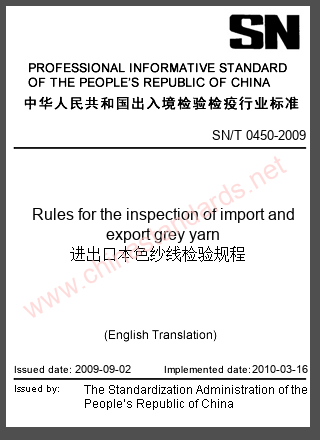
SN/T 0450-2009 in English
Rules for the inspection of import and export grey yarn
2009-09-02 -

SN/T 0453-2009 in English
Rules of inspection for import and export wool knitting goods
2009-09-02 -

SN/T 0244-1994 in English
\"General Rules for Inspection and Certification of Imported Mechanical and Electrical Instruments\"
1993-08-01 -

SN/T 1770-2006 in English
Determination of tebufenozide residues in cereals for import and export - Liquid chromatographic method
2006-04-25 -

SN/T 2978-2011 in English
PCR Method for the Detection of Chicken Components in Animal Derived Products
2011-09-09 -

SN/T 3072-2011 in English
Rules for Post-Entry Quarantine of Plant Seed and Seeding
2011-09-09 -

SN/T 2868-2011 in English
Quarantine Protocol for West Nile Fever
2011-05-31


