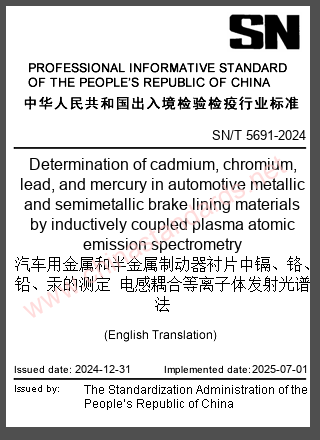
SN/T 5691-2024 in English
VALIDDetermination of cadmium, chromium, lead, and mercury in automotive metallic and semimetallic brake lining materials by inductively coupled plasma atomic emission spectrometry
- Issued on:2024-12-31
- Implemented on:2025-07-01
- File Format:PDF
- Delivery:Via email within 1~3 business days
$117.00
| Standard No: | SN/T 5691-2024 |
| Document status: | VALID |
| Title in English: | Determination of cadmium, chromium, lead, and mercury in automotive metallic and semimetallic brake lining materials by inductively coupled plasma atomic emission spectrometry |
| Title in Chinese: | 汽车用金属和半金属制动器衬片中镉、铬、铅、汞的测定 电感耦合等离子体发射光谱法 |
| Language: | English |
| File Format: | Electronic (PDF) |
| Delivery: | Via email within 1~3 business days |
| Issued on: | 2024-12-31 |
| Implemented on: | 2025-07-01 |
| ICS Classification: | 43.040.40-Braking systems |
| Chinese Classification: | T24-Braking system |
| Professional Classification: | SN-Import&Export Inspection |
| Related Keywords: | semimetallic brake lining materials
automotive metallic chromium determination plasma atomic emission spectrometry introduction technical background automotive prohibited substances requirements |
Introduction
Technical Background and Significance of the Standard
With the implementation of EU REACH regulations and China's "Automotive Prohibited Substances Requirements", the control of heavy metal content in brake linings has become a key point in the safety testing of automotive parts. This standard adopts a high-sensitivity detection method established by Inductively Coupled Plasma Optical Emission Spectrometer, filling the gap in the domestic standard for the detection of harmful elements in metal/semi-metal brake materials.
Core principles of the method
Based on the technical characteristics of ICP-OES:
| Technical links | Key parameters | Quality control points |
|---|---|---|
| Sample digestion | 175℃ microwave digestion | Nitric acid purity ≥1.42g/mL |
| Spectral analysis | Cd214.439nm and other characteristic spectral lines | Internal standard calibration (Indium for chromium determination) |
| Linear range | Cd0.5-100mg/kg | Correlation coefficient>0.999 |
Key Operation Points
Special Requirements for Sample Preparation
When crushing samples according to JC/T2268 standard, please note that uniformity of metal fiber distribution directly affects the representativeness of sampling, and liquid nitrogen freezing grinding technology is recommended.
Standard Solution Preparation Gradient
Cadmium standard solution needs to be prepared with 9 concentration gradients (0-0.2μg/mL), among which the setting of 0.001μg/mL low concentration point ensures the accurate determination of low-content samples.
Method Validation Data
| Element | Detection Limit (mg/kg) | Spike Recovery (%) | RSD Control Value |
|---|---|---|---|
| Cd | 0.15 | 92-105 | <20% |
| Cr | 1.5 | 88-102 | <15% |
Implementation Suggestions
- Laboratories need to calibrate regularlyMicrowave digestion instrument temperature control system, the 175℃/10min program provided in Appendix A needs to be optimized according to the equipment model
- When determining chromium, the timing and volume of adding indium internal standard solution (5μg/mL) need to be strictly controlled to 15mL before constant volume
- It is recommended to conduct blank test and quality control sample determination simultaneously for each batch of testing to monitor the background value of nitric acid reagent

Loading PDF document...
Error loading PDF. Please make sure the file is valid and try again.


