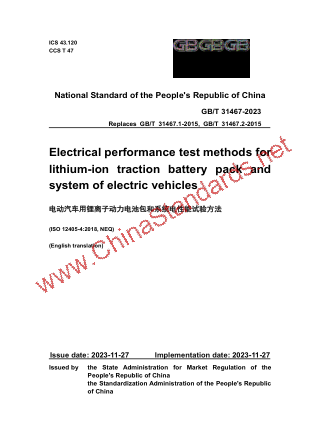
GB/T 31467-2023 in English
VALIDElectrical performance test methods for Iithium-ion traction battery pack and system of electric vehicles
- Issued on:2023-11-27
- Implemented on:2023-11-27
- File Format:PDF
- Delivery:Via email within 1~3 business days
$641.00
《GB/T 31467-2023电动汽车用锂离子动力电池包和系统电性能试验方法》由TC114(全国汽车标准化技术委员会)归口,TC114SC27(全国汽车标准化技术委员会电动车辆分会)执行,主管部门为工业和信息化部。
Electrical performance test methods for lithium-ion traction battery pack and system of electric vehicles
1 Scope
This document specifies the test methods for the electrical performance of lithium-ion traction battery pack and system of electric vehicles.
This document is applicable to the research, development, and test of lithium-ion traction battery pack and system of electric vehicles.
2 Normative references
The following documents contain requirements which, through reference in this text, constitute provisions of this document. For dated references, only the edition cited applies. For undated references, the latest edition of the referenced document (including any amendments) applies.
GB/T 19596 Terminology of electric vehicles
GB 38031 Electric vehicles traction battery safety requirements
3 Terms and definitions
For the purposes of this document, the terms and definitions given in GB/T 19596 and GB 38031 and the following apply.
3.1
high energy application
characteristic of device or application, for which the numerical ratio between maximum allowed continuous electric power output (W) and electric energy output (W·h) at a 1 C discharge rate at room temperature for a battery pack or system is lower than 10
Note: High-energy batteries are typically used in battery electric vehicle (BEV) and plug-in hybrid electric vehicle (PHEV).
3.2
high power application
characteristic of device or application, for which the numerical ratio between maximum allowed continuous electric power output (W) and electric energy output (W·h) at a 1 C discharge rate at room temperature for a battery pack or system is equal to or higher than 10
Note: High-power batteries are typically used in hybrid electric vehicles (HEV).
3.3
energy density
electrical energy released by the average unit mass of the battery pack or system
Note: The energy density is expressed in watt hours per kilogram (W·h/kg).
3.4
energy round trip efficiency
ratio of the total energy discharged from the battery pack or system to the total energy charged to it during the test process
Note: The total energy charged to and discharged from the battery pack or system is expressed in watt hours (W·h).
4 Symbols and abbreviations
For the purposes of this document, the following symbols and abbreviations apply.
BCU: Battery Control Unit
FS: Full Scale
RT: Room Temperature
SOC: State-of-Charge
Imax(T): maximum allowed continuous discharge current at a test ambient temperature T
I'max(SOC, T, t): maximum allowed discharge current at a given SOC, test ambient temperature T, and pulse duration t;
n C: current rate equal to n times the one hour discharge capacity
η: efficiency
5 General test conditions
5.1 General conditions
5.1.1 Unless otherwise specified, the tests shall be conducted in an environment with a room temperature (RT) of 25°C ± 2°C, relative humidity of 10%–90%, and an atmospheric pressure of 86 kPa – 106 kPa.
5.1.2 The necessary documentation for operation and needed interface parts for connection to the test equipment (i.e. connectors, plugs, including cooling interface) shall be delivered together with the test sample. See Annex A for the typical structures of battery packs and systems. Manufacturers shall provide the safe operating limits of the battery pack or system to ensure the safety of the test.
Foreword i
1 Scope
2 Normative references
3 Terms and definitions
4 Symbols and abbreviations
5 General test conditions
5.1 General conditions
5.2 Requirements for accuracy of test instrument
5.3 Data recording and its interval
5.4 Test preparation
6 General tests
6.1 Preconditioning cycles
6.2 Standard cycles
6.3 Method of adjusting SOC to test target value n%
7 Basic performance tests
7.1 Appearance
7.2 Polarity
7.3 Mass and overall dimensions
7.4 Capacity and energy
7.5 Power and internal resistance
7.6 No-load capacity loss
7.7 Capacity loss at storage
7.8 Cranking power at high and low temperatures
7.9 Energy round trip efficiency
7.10 Energy density
7.11 Charge performance
7.12 Discharge at operating conditions
Annex A (Informative) Typical configurations of battery pack and system
A.1 Battery pack
A.2 Battery system
Annex B (Informative) Test items of battery pack or system

Loading PDF document...
Error loading PDF. Please make sure the file is valid and try again.
We also recommend
-

GB/T 1968-1980 in English
Test method for air permeability ceramics
- -

GB 8689-1988 in English
Method for determination of the cover factor of wool knitted fabrics
1988-02-13 -

GB/T 40096.6-2024 in English
Technical specification for on-site relay protection equipment—Part 6: Busbar protection
2024-04-25 -

GB/T 12772-2016 in English
Flexible cast iron pipes, fittings and accessories for drainage
2016-04-25 -

GB/T 25408-2010 in English
Hanging type long-range sprinkling irrigation machines
2010-11-10 -

GB/T 6920-1986 in English
Water Quality - Determination of pH Value - Glass Electrode Method
1986-10-10 -

GB/T 30559.2-2017 in English
Energy performance of lifts,escalators and moving walks- Part 2:Energy calculation and classification for lifts(elevators)
2017-10-14 -

GB/T 42259-2022 in English
Metallic and other inorganic coatings—Test methods for measuring thermal cycle resistance and thermal shock resistance for thermal barrier coatings
2022-12-30 -

GB/T 63-1988 in English
Lifting nuts
1988-06-24 -

GB 19082-2023 in English
Disposable protective clothing for medical use
2023-11-27


