
GB/T 32027-2015 in English
VALIDFootwear―Resistance to crack initiation and growth―Belt flex method
- Issued on:2015-09-11
- Implemented on:2016-04-01
- File Format:PDF
- Delivery:Via email within 1~3 business days
$78.00
《GB/T 32027-2015鞋类 抗弯曲性能 传送带耐折试验方法》由TC305(全国制鞋标准化技术委员会)归口,主管部门为中国轻工业联合会。
本标准规定了测定鞋类部件或材料抗反复弯折性能的试验方法。本标准适用于鞋类外底,也适用于可弯折的部件。
Introduction
1. Background and significance of the standard
GB/T 32027—2015/ISO 16177:2012 "Test method for bending resistance of conveyor belts for footwear" is an important national standard, which mainly tests the bending resistance of footwear outsoles and bendable parts. This standard adopts the translation method to be equivalent to the international standard ISO 16177:2012, aiming to provide a scientific and unified basis for quality assessment of footwear products.
With the rapid development of the footwear industry, consumers' demands for footwear products are becoming increasingly diversified, especially for the durability of soles. The formulation of this standard not only helps to standardize industry testing methods, but also effectively improves product quality and guarantees consumers' experience.
2. Comparison of standard technical frameworks
| Dimensions | GB/T 32027—2015 | ISO 16177:2012 | Difference analysis |
|---|---|---|---|
| Test equipment | Bending machine, conveyor belt, polyurethane bonding system, etc. | Same | No difference |
| Sample preparation | Cut off the upper part and polish the outsole | Cut off the upper part and polish the outsole | No difference |
| Data Recording and Analysis | Record the crack location, length and depth | Record the crack location, length and depth | No difference |
3. Key points in the implementation of the standard
3.1 Selection and calibration of test equipment
In actual testing, the roller diameter and conveyor belt parameters of the bending machine are important factors affecting the test results. For example, for the soles with high bending resistance requirements, the diameter at the center of the driven wheel is (60.0±0.5) mm and the diameter at both ends is (57±1) mm. These parameters need to be strictly calibrated to ensure the accuracy of the test results.
3.2 Precautions for specimen preparation
In the process of specimen preparation, the control of the outsole thickness is crucial. If the thickness of the outsole is greater than 15 mm, it needs to be thinned to 15 mm to ensure the bending effect. At the same time, for soles equipped with metal inserts, a driven wheel with a diameter of 120 mm should be used for testing.
4. Implementation Suggestions
- Equipment calibration:Regularly calibrate the bending machine and conveyor belt parameters to ensure compliance with standard requirements.
- Staff training:Provide professional training for testers and familiarize them with standard operating procedures.
- Data recording:Establish a complete test record system to ensure data traceability.
- Result analysis:Combined with the crack depth and location, comprehensively evaluate the anti-bending performance of the sole.

Loading PDF document...
Error loading PDF. Please make sure the file is valid and try again.
We also recommend
-

GB 30585-2024 in English
Safety technical specifications for infants' and children's footwear
2024-05-28 -

GB/T 16641-2019 in English
Footwear—Test methods for whole shoe—Dynamic waterproofness
2019-08-30 -

GB/T 44939-2024 in English
Guidelines for quality grading of consumer products—Footwear
2024-11-28 -

GB/T 6677-2008 in English
Classification of cloth shoes
2008-12-30 -

GB/T 33313-2016 in English
Children's rain boots(shoes)
2016-12-13 -
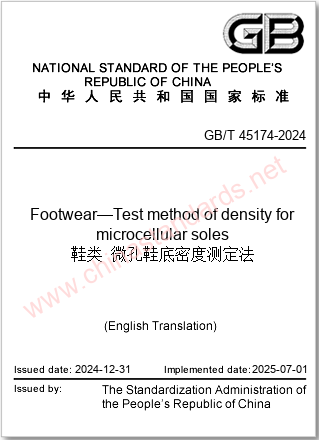
GB/T 45174-2024 in English
Footwear—Test method of density for microcellular soles
2024-12-31


