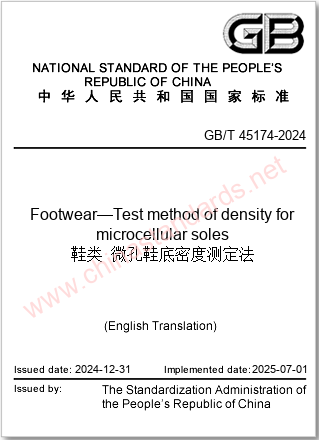
GB/T 45174-2024 in English
VALIDFootwear—Test method of density for microcellular soles
- Issued on:2024-12-31
- Implemented on:2025-07-01
- File Format:PDF
- Delivery:Via email within 1~3 business days
$131.00
| Standard No: | GB/T 45174-2024 |
| Document status: | VALID |
| Title in English: | Footwear—Test method of density for microcellular soles |
| Title in Chinese: | 鞋类 微孔鞋底密度测定法 |
| Language: | English |
| File Format: | Electronic (PDF) |
| Delivery: | Via email within 1~3 business days |
| Issued on: | 2024-12-31 |
| Implemented on: | 2025-07-01 |
| ICS Classification: | 61.060-Footwear |
| Chinese Classification: | Y78-Footgear |
| Professional Classification: | GB-National Standard |
| Related Keywords: | technology evolution analysis footwear microporous sole density determination method
footwear test method microcellular soles introduction gb/t45174-2024 standard background microporous soles microporous sole density |
| Related Topics: | footwear
Density measurement standard Density measurement standard Drainage method for density determination Medium Pore Low Porosity Classification |
《GB/T 45174-2024鞋类 微孔鞋底密度测定法》由TC305(全国制鞋标准化技术委员会)归口,主管部门为中国轻工业联合会。
Introduction
GB/T45174-2024 Standard Background and Technology Evolution Analysis
Footwear Microporous Sole Density Determination Method (GB/T45174-2024) is one of the important standards in my country's footwear industry, mainly for the determination of the apparent density of microporous materials and the whole soles of microporous materials and other materials. The formulation of this standard fills the gap in the field of microporous sole density testing in China, which is of great significance to improving product quality and process control.
Comparison of standard frameworks
| Standard dimensions | GB/T45174-2024 | Comparison with old standards | Differences in international standards |
|---|---|---|---|
| Scope of application | Determination of apparent density of microporous soles | Only applicable to soles made of single materials | In line with ISO methods, adapt to global needs |
| Test principle | Archimedes' principle | Traditional volume measurement method | Consistent with international general methods |
| Equipment requirements | High-precision weighing device + fixture combination | Simple balance and fixture | Technical specifications are improved and in line with international standards |
Explanation of professional terms and practical application cases
Apparent density: refers to the mass of microporous soles per unit volume. This indicator directly reflects the density and structural characteristics of the material and has important reference value in product design and quality control.
Practical application case
A sports brand used this standard to test the density of the soles of new running shoes and found that its apparent density was 0.75 kg/m³, which is much lower than traditional foam materials. By optimizing the foaming process and material ratio, the density was finally reduced to 0.68 kg/m³, significantly improving the lightweight performance of the product.
Recommendations for the implementation of the standard
- Equipment calibration: Calibrate the weighing device regularly to ensure that the measurement accuracy meets the requirement of 0.01g.
- Operation training: Conduct systematic training for test personnel, focusing on mastering the use of fixtures and bubble handling techniques.
- Environmental control: Strictly adjust the specimen in accordance with the requirements of GB/T22049 and complete the test under a standard environment.
- Data recording and analysis: It is recommended to use professional software for data processing to ensure the accuracy of the calculation results and keep a complete test report.
Summary
The GB/T45174-2024 standard provides a scientific and standardized method for the determination of the density of microporous soles of footwear. As the industry's requirements for product quality increase, this standard will play a greater role in production practice.

Loading PDF document...
Error loading PDF. Please make sure the file is valid and try again.
We also recommend
-

GB 30585-2024 in English
Safety technical specifications for infants' and children's footwear
2024-05-28 -

GB/T 25036-2021 in English
Children’s canvas rubber footwear
2021-08-20 -

GB/T 34842-2017 in English
Footwear-Chemical tests-Determination of formamide
2017-11-01 -

GB/T 38011-2019 in English
Footwear—Test methods for whole shoe—Pull-out force of upper bands
2019-08-30 -

GB/T 46468.1-2025 in English
Footwear—In-shoe measurement—Part 1:Shoe length
2025-10-31 -

GB/T 21536-2024 in English
Track & field sport shoes
2024-11-28 -

GB/T 42170-2022 in English
Footwear—Test methods for hollow and compact heels with top pieces—Top piece attachment strength
2022-12-30 -

GB/T 22756-2017 in English
Leather sandals
2017-05-12 -

GB/T 6677-2008 in English
Classification of cloth shoes
2008-12-30 -

GB/T 43293-2022 in English
Shoe size
2022-10-12


