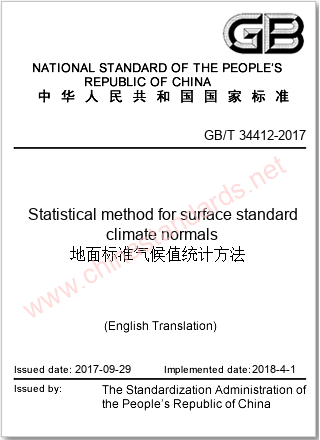
GB/T 34412-2017 in English
VALIDStatistical method for surface standard climate normals
- Issued on:2017-09-29
- Implemented on:2018-04-01
- File Format:PDF
- Delivery:Via email within 1~3 business days
$214.00
《GB/T 34412-2017地面标准气候值统计方法》由TC346(全国气象基本信息标准化技术委员会)归口,主管部门为中国气象局。
Introduction
GB/T 34412—2017 Professional Interpretation of Statistical Methods for Ground Standard Climate Values
1. Background of Standardization and Analysis of Technical Evolution
This standard is under the jurisdiction of the National Technical Committee for Basic Meteorological Information Standardization and was proposed and drafted by the China Meteorological Administration. The background of its formulation is mainly to meet the needs of modern climate change research and meteorological services and to ensure the accuracy and consistency of climate data. Technically, it refers to the relevant specifications of the World Meteorological Organization (WMO) and is optimized in combination with the actual experience of China's meteorological observation.
2. Comparison of standard frameworks
| Standard dimensions | GB/T 34412—2017 | Internationally accepted specifications | Comparison of local standards |
|---|---|---|---|
| Data quality control | Complies with QX/T118 requirements, including uniformity inspection and processing | Follows WMO recommendations (Calculation of monthly and annual 30-year standard normals) | Compatible with local standards such as JGJ134-2001 |
| Statistical period division | Uses the Gregorian calendar, subdivided into days, seasons, ten-day periods, months and years | The internationally accepted 30-year climate normal value calculation cycle | Combined with the actual needs of China's meteorological observations |
| Statistical item accuracy | Table 1 clearly lists the units and accuracy requirements of each element | Consistent with international meteorological observation standards | Some indicators (such as snow depth) are adjusted according to regional characteristics |
3. Data quality control and homogenization processing
Case study: Analysis of the impact of observation station relocation
The relocation of a meteorological station resulted in a change in altitude of more than 100 meters, and segmented statistics were required according to QX/T64. Specific processing methods include:
- Source data quality control: interpolation of missing values and assessment of data reliability
- Homogeneity test: analysis of sequence changes through Mann-Kendall test
- Analysis of causes of non-uniformity: environmental changes vs. changes in observation methods
4. Implementation Suggestions
4.1 Data Collection and Processing
It is recommended to use automated meteorological observation stations for data collection and to perform quality control through the QX/T118 standard. Special attention:
- 20:00 every day is the solar boundary to avoid time confusion
- Sunshine uses true solar time, with midnight as the solar boundary
- Record relocation or equipment replacement in a timely manner and process them in sections
4.2 Statistical analysis and application
In actual applications, it is recommended to combine the climate data analysis platform for statistics, and focus on:
- Calculation accuracy of standard climate values (30-year average)
- Applicable scenarios and restrictions of temporary climate values
- The impact of homogeneity test results on long-term trend analysis
4.3 Report writing specifications
It is recommended to include the following in the report:
- Data source and processing method: Detailed description of observation station information and data preprocessing steps
- Statistical results presentation: Use tables and charts to clearly present the main climate indicators
- Uncertainty analysis: Assess the impact of missing data and outliers on the results
5. Summary and Outlook
GB/T 34412—2017 provides comprehensive methodological support for the standardized statistics of ground climate values. With the deepening of climate change research, it is recommended to optimize the following aspects in the future:
- Introduce machine learning algorithms to improve the accuracy of homogenization processing
- Establish a mechanism for sharing climate data among regions
- Develop more intelligent climate statistical analysis tools

Loading PDF document...
Error loading PDF. Please make sure the file is valid and try again.
We also recommend
-

GB/T 38950-2020 in English
Cooling summer grades
2020-07-21 -

GB/T 44395-2024 in English
Technical specification for reliability evaluation of wind data from lidar
2024-08-23 -

GB/T 32135-2015 in English
Classification of regional drought severity
2015-10-13 -

GB/T 27956-2011 in English
Medium-range weather forecast
2011-12-30 -

GB/T 42072-2022 in English
Climate livability index
2022-10-12 -

GB/T 33679-2026 in English
Storage conditions for combustion agents and cooling agents used in weather modification
2026-02-27


