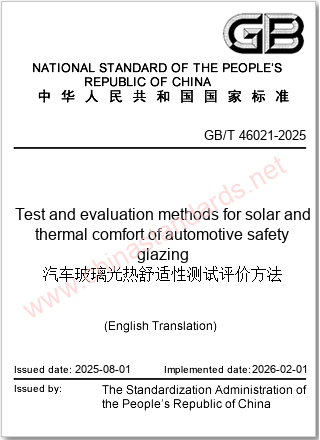
GB/T 46021-2025 in English
VALIDTest and evaluation methods for solar and thermal comfort of automotive safety glazing
- Issued on:2025-08-01
- Implemented on:2026-02-01
- File Format:PDF
- Delivery:Via email within 1~3 business days
$248.00
| Standard No: | GB/T 46021-2025 |
| Document status: | VALID |
| Title in English: | Test and evaluation methods for solar and thermal comfort of automotive safety glazing |
| Title in Chinese: | 汽车玻璃光热舒适性测试评价方法 |
| Language: | English |
| File Format: | Electronic (PDF) |
| Delivery: | Via email within 1~3 business days |
| Issued on: | 2025-08-01 |
| Implemented on: | 2026-02-01 |
| ICS Classification: | 43.040.60-Bodies and body components |
| Chinese Classification: | T26-Vehicle body (cab) and accessories |
| Professional Classification: | GB-National Standard |
《GB/T 46021-2025汽车玻璃光热舒适性测试评价方法》由TC114(全国汽车标准化技术委员会)归口,TC114SC9(全国汽车标准化技术委员会安全玻璃分会)执行,主管部门为工业和信息化部。
Introduction
Background of Standard Development and Technological Evolution
With the rapid development of the automotive industry and consumers' increasing demands for driving comfort, the optical and thermal comfort of automotive glass has become an important indicator for measuring vehicle quality. The release of GB/T 46021-2025 fills the gap in domestic standards for the evaluation of optical and thermal comfort of automotive glass, providing the industry with unified technical specifications and testing methods.
During the development of this standard, reference was made to multiple international standards and relevant domestic specifications, including ISO 9050:2003 Test methods for optical properties of architectural glass and GB/T 5137 series test methods for automotive safety glass, reflecting the international perspective and technological advancement of the standard's development.
Analysis of Core Terminology Definitions
The standard clearly defines key terms such as smart glass, tinted state, and faded state:
Smart glass refers to glass products whose optical properties undergo reversible changes under the influence of an external energy field (such as electricity, light, or heat). This definition covers various smart glass types, including electrochromic, thermochromic, and photochromic.
Color temperature conversion capability is a key innovative indicator introduced in this standard. It is used to quantify the glass's ability to adjust the color temperature of the light source. The unit is Myrd (MRD), and this indicator is directly related to driving visual comfort.
Comparative Analysis of Evaluation Index Systems
| Evaluation Items | Test Methods | Smart Glass Requirements | Traditional Glass Requirements | Weight Distribution (Windshield) |
|---|---|---|---|---|
| Visible Light Transmittance | GB/T 5137.2-2020 | State Test | Single State | 10% |
| Color Transmittance Index | ISO 9050:2003 | Ra≥95, 5 points | Same as left | 10% |
| Color temperature conversion capability | Appendix A | |ν|≤20mrd gets 5 points | Same as left | 10% |
| Ultraviolet transmittance | GB/T 5137.4-2020 | Tuv≤1% gets 5 points | Same as left | 10% |
| Total solar transmittance | GB/T 5137.4-2020 | Trs≤20% gets 5 points | Same as left | 20% |
Key Technical Points of the Test Method
The standard specifies detailed test environment conditions: temperature 20±5°C, humidity 40%-80%, specimen size uniformly 300mm×300mm, and exposure to standard conditions for at least 24 hours prior to testing.
For smart glass testing, the standard requires dimming capability to be evaluated in both the tinted and faded states. Other parameters are tested in a stable state agreed upon by both the supplier and the buyer. This demonstrates the standard's careful consideration of the unique characteristics of smart materials.
Differentiated Weighting Strategy
The standard establishes differentiated weighting schemes based on the usage requirements of different glass installation locations:
windshield places greater emphasis on optical performance, with visible light transmittance and color transmittance index each accounting for 10%;skylight places greater emphasis on thermal insulation, with the glass's inner surface temperature weighted at 15%;side and rear windows balance optical and thermal performance.
Implementation Recommendations and Application Guidance
Manufacturers should establish comprehensive light and thermal comfort testing laboratories equipped with qualified equipment such as spectrophotometers, solar simulators, and color temperature illuminance meters, and perform regular calibration and maintenance.
It is recommended to introduce the concept of light and thermal comfort design during the product development stage, and to comprehensively improve product performance through material selection, film system design, structural optimization and other means. For smart glass products, special attention should be paid to performance indicators such as state stability and response time.
Testing institutions should strictly follow the test conditions and methods required by the standard, especially the special test methods specified in Appendices A, B, and C, to ensure the accuracy and comparability of test results.
Impact and Prospect of Standard Implementation
The implementation of GB/T 46021-2025 will promote technological upgrading and product quality improvement in the automotive glass industry, and provide consumers with a more scientific basis for product selection. With the continuous development of smart glass technology, future standards will need to be continuously updated and improved to adapt to the application needs of new technologies and new materials.
The standard also provides automobile manufacturers with a unified supplier evaluation standard, which will help promote technological progress and quality improvement of the entire industry chain and provide technical support for the high-quality development of China's automobile industry.

Loading PDF document...
Error loading PDF. Please make sure the file is valid and try again.
We also recommend
-

GB 7063-2011 in English
The wheel guards of motor vehicles
2011-05-12 -

GB 11566-2024 in English
External projections for passenger cars
2024-08-23 -

GB/T 19463-2004 in English
Blade length series and its connection dimensions of wiper for passenger cars
2004-03-10 -
GB/T 30037-2013 in English
The Assembly of Electrical Operation Sunroof about Motor Vehicle
2013-11-27 -

GB 26511-2011 in English
Front underrun protective requirements for commercial vehicle
2011-05-12 -

GB/T 32085.1-2015 in English
Automobiles―Cabin air filter―Part 1:Test for particulate filtration
2015-10-09 -

GB/T 36120-2018 in English
Production label for child restraint system of power-driven vehicles
2018-05-14 -

GB/T 24927-2010 in English
Safety-belt and safety-belt anchorages for all-terrain vehicle
2010-08-09


