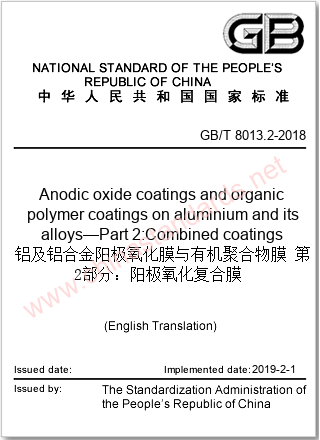
GB/T 8013.2-2018 in English
VALIDAnodic oxide coatings and organic polymer coatings on aluminium and its alloys—Part 2:Combined coatings
- Issued on:-
- Implemented on:2019-02-01
- File Format:PDF
- Delivery:Via email within 1~3 business days
$253.00
《GB/T 8013.2-2018铝及铝合金阳极氧化膜与有机聚合物膜 第2部分:阳极氧化复合膜》由TC243(全国有色金属标准化技术委员会)归口,TC243SC1(全国有色金属标准化技术委员会轻金属分会)执行,主管部门为中国有色金属工业协会。
ChinaStandards.net is in charge of this English translation. In case of any doubt about the English translation, the Chinese original shall be considered authoritative.ICS 25.220.01
GB/T 8013 consists of three parts under the general title of Anodic oxide coatings and organic polymer coatings on aluminium and its alloys:
——Part 1: Anodic oxide coatings;
——Part 2: Combined coatings;
——Part 3: Organic polymer coatings.
It is Part 2 of GB/T 8013.
This part is developed in accordance with the rules given in GB/T 1.1-2009.
This part replaces GB/T 8013.2-2007 Anodic oxide coatings and organic polymer coatings on aluminium and its alloys—Part 2: Combined anodic oxide coating.
In addition to editorial changes, the following main technical changes have been made with respect to GB/T 8013.2-2007.
——The applicable “scope” of this part is modified (see Clause 1; Clause 1 of 2007 Edition);
——The “normative references” are modified (see Clause 2; Clause 2 of 2007 Edition);
——The “term and definition” is deleted (see Clause 3 of 2007 Edition);
——The "classification of combined coating" is modified into "classification" (see Clause 3; Clause 4 of the 2007 Edition);
——The “classification” is modified (see 3.1 and 3.2; clause 4 of 2007 Edition);
——The "standard sample" is modified to "sample plate" in “appearance” (see 4.1; 5.1 of 2007 Edition);
——The "color and color difference" is modified into "color difference" (see 4.2; 5.2 of 2007 Edition);
——The performance requirements and test methods for “color difference” are modified (see 4.2 and 5.2; 5.2 and 6.2 of 2007 Edition);
——The performance requirements for local film thickness of oxide coatings, local film thickness of paint coatings and local film thickness of combined coatings in “film thickness” are modified (see 4.4; 5.4 of 2007 Edition);
——The performance requirements for the “hardness” are modified (see 4.5; 5.5 of 2007 Edition);
——In “abrasive resistance”, the performance requirements for the abrasive blasting method and the performance requirements and test methods for the falling abrasive method are modified (see 4.6 and 5.6; 5.6 and 6.6 of 2007 Edition);
——The performance requirements and test methods for boiling water resistance are modified (see 4.8 and 5.8; 5.8 and 6.8 of 2007 Edition);
——The performance requirements and test methods for warm water resistance are modified (see 4.9 and 5.9);
——The performance requirements and test methods of "UV and salt fog resistance", "cyclic acidified seawater salt spray corrosion resistance", "resistance to saline wet-dry cycle corrosion", "resistance to saline solution" and "resistance to flowing mixed gas" are added, all of which are called “environmental corrosion resistance” together with "salt spray resistance" and "resistance to humid atmospheres containing sulfur dioxide”, whose performance requirements are modified (see 4.10 and 5.10; 5.10, 5.11, 6.10 and 6.11 of 2007 Edition);
——The performance requirements and test methods of "artificial sweat resistance", "alcohol resistance" and "salt water resistance" are added, all of which are called “chemical resistance” together with "alkali resistance", "mortar resistance", "hydrochloric acid resistance", "nitric acid resistance", "detergent resistance" and "solvent resistance"; performance requirements and test methods of "alkali resistance" are modified (see 4.11 and 5.11; 5.12, 5.13, 5.14, 5.15, 5.16 and 5.17 of 2007 Editions );
——The "resistance to heat and humidity" is incorporated into "temperature and humidity resistance"; the performance requirements and test methods of "constant temperature and humidity test", "temperature cycling test" and "temperature-humidity cycling test" are added (see 4.12 and 5.12; 5.9 of 2007 Edition);
——The test method for natural weather resistance is modified (see 5.13.1; 6.18.1 of 2007 Edition);
——The performance requirements and test methods for accelerated weather resistance of xenon lamps are modified (see 4.13.2.1 and 5.13.2.1; 5.18.2.1 and 6.18.2.1 of 2007 Edition);
——The inspection rules are modified (see Clause 6; Clause 7 of Edition 2007).
This part was proposed by the China Nonferrous Metals Industry Association.
This part is under the jurisdiction of SAC/TC 243 National Technical Committee on Nonferrous Metals of Standardization Administration of China.
The previous edition of standard replaced by this part is as follows:
——GB/T 8013.2-2007.
Anodic oxide coatings and organic polymer coatings on aluminium and its alloys—
Part 2: Combined coatings
1 Scope
This part of GB/T 8013 specifies the classification, performance requirements, test methods and inspection rules of combined coatings on aluminium and aluminium alloys.
This part is applicable to combined coatings on aluminium product used in the fields of mechanical, municipal, transportation, electrical, packaging, construction, decoration, etc.
2 Normative references
The following referenced documents are indispensable for the application of this document. For dated references, only the edition cited applies. For undated references, the latest edition of the referenced document (including any amendments) applies.
GB/T 629 Chemical reagent—Sodium hydroxide
GB/T 1733 Determination of resistance to water of films
GB/T 1740 Determination of resistance to heat and humidity of paint films
GB/T 1766 Paints and varnishes—Rating schemes of degradation of coats
GB/T 1865-2009 Paints and varnishes—Artificial weathering and exposure to artificial radiation—Exposure to filtered xenon-arc radiation
GB/T 2423.51 Environmental testing—Part 2: Test methods—Test Ke: Flowing mixed gas corrosion test
GB/T 4957 Non-conductive coatings on non-magnetic basis metals—Measurement of coating thickness—Eddy current
GB/T 6461 Methods for corrosion testing of metallic and other inorganic coatings on metallic substrates—Rating of test specimens and manufactured articles subjected to corrosion tests
GB/T 6462 Metallic and oxide coatings—Measurement of coating thickness—Microscopical method
GB/T 6682 Water for analytical laboratory use—Specification and test methods
GB/T 6739 Paints and varnishes—Determination of film hardness by pencil test
GB/T 8013.1 Anodic oxide coatings and organic polymer coatings on aluminium and its alloys—Part 1: Anodic oxide coatings
GB/T 8014.1 Anodizing of aluminium and its alloys—The measuring method of thickness of anodic oxide coatings—Part 1: The measuring principle
GB/T 9276 Methods of exposure to natural weathering of coating
GB/T 9286 Paints and varnishes—Cross cut test for films
GB/T 9754 Paints and varnishes—Determination of specular gloss of non-metallic paint films at 20° 60°and 85°
GB/T 9761 Paints and varnishes—Visual comparison of the colour of paints
GB/T 9789 Metallic and other non-organic coatings—Sulfur dioxide test with general condensation of moisture
GB/T 10125 Corrosion tests in artificial atmospheres —Salt spray tests
GB/T 11186.2 Methods for measuring the colour of paint films; Part 2: Colour measurement
GB/T 11186.3 Methods for measuring the colour of paint films; Part 3: Calculation of colour differences
GB/T 12967.1 Test Methods for anodic oxidation coatings of aluminium and aluminium alloys—Part 1: Measurement of mean specific abrasion resistance of anodic oxidation coatings with an abrasive jet test Apparatus
GB/T 12967.3 Test Methods for anodic oxidation coatings of aluminium and aluminium alloys—Part 3: Copper accelerated acetic acid salt spray test (CASS test)
GB/T 12967.6 Test Methods for anodic oxidation coatings of aluminium and aluminium alloys—Part 6: Determination of color differences and appearance of colored anodic oxide films by viewing method
GB/T 12967.7 Test methods for anodic oxidation coatings of aluminium and aluminium alloys—Part 7: Measurement of abrasion resistance of anodic oxidation coatings by sand falling test apparatus
GB/T 14684 Sand for construction
GB/T 16585 Rubber, vulcanized-Test method of resistance to artificial weathering (Fluorescent UV lamp)
GB/T 18911-2002 Thin-film terrestrial photovoltaic (PV) modules—Design qualification and type approval
GB/T 20854 Corrosion of metals and alloys—Accelerated testing involving cyclic exposure to salt mist “dry “and “wet” condition
GB/T 33230 Aluminum and aluminum alloy micro-multiport profiles
JC/T 479 Building quicklime
3 Classification
3.1 The film types and characteristics and typical applications of combined coatings are shown in Table 1.
Table 1 Film types and characteristics and typical applications of combined coatings
Film type Film characteristics Typical application
Classification according to the film luster Glossy film The film has bright surface and high specular reflectivity. Accessories, electrical equipment, furniture, interior decoration materials for vehicle and rail traffic, solar energy frame, building and decoration materials
Matt film The film has soft surface gloss and low specular reflectivity. Furniture, interior decoration materials for vehicle, solar energy frame, building and decoration materials
Classification according to the film color Transparent film The film is colorless and transparent, and painted by such electrophoretic paint without any pigment. Accessories, electrical equipment, furniture, interior decoration materials for vehicle and rail traffic, solar energy frame, building and decoration materials
Color film The film has various colors, but due to the influence of the performance of the pigment used, the weather resistance and corrosion resistance are different from those of the transparent film. Accessories, electrical equipment, interior decoration materials for vehicle and rail traffic, solar energy frame, building and decoration materials
3.2 The film code, film thickness level and film type of combined coatings are shown in Table 2.
Table 2 Film code, film thickness level and film type of combined coatings
Film code Film type Remarks
EA21 Glossy or matt transparent film In the film code:
“EA”, “EB” and “EC” are types of anodic oxide+glossy or matt transparent film;
“ES” is the type of anodic oxide+ glossy or matt color film; “EZ” is the type of anodic oxide+ glossy or matt film;
The numbers in the code indicate the minimum local thickness limit of anodic oxide coatings and combined electrophoretic coatings.
EB16
EC13
EZ8
ES21 Glossy or matt color film
3.3 It is permitted to take mechanical pretreatment (such as sand blasting, wire drawing, polishing, etc.) before anodizing in order to achieve a special decorative effect upon agreed between the supplier and the purchaser.
4 Performance requirements
4.1 Appearance
With uniform color and gloss, it is not allowed to have defects like wrinkles, cracks, bubbles, flow marks, pockmarks, inclusions, stickiness, film peeling. As for other requirements, refer to sample plate agreed between the supplier and the purchaser.
4.2 Color difference
In the determination with the visual method, the color difference shall be dependent on the color plate agreed between the supplier and the purchaser. In the instrumental determination, the color difference value shall be agreed between the supplier and the purchaser. The method for determining color difference shall be noted in the purchase order (or contract).
4.3 Luster
The request of the purchaser for luster, if any, shall be indicated in the purchase order (or contract) for the performance.
4.4 Film thickness
The thickness of the combined coatings consists of anodic oxide coatings thickness and film thickness. The film thickness shall conform to Table 3.
Table 3 Film thickness
Film code Film thickness
μm
Local thickness of anodic oxide coatings Local thickness of film Local thickness of combined coatings
EA21 ≥9 ≥12 ≥21
EB16 ≥9 ≥7 ≥16
EC13 ≥6 ≥7 ≥13
ES21 ≥6 ≥15 ≥21
EZ8 ≥3 ≥5 ≥8
4.5 Hardness
In terms of the hardness, the film shall not be less than 3 H.
4.6 Abrasive resistance
4.6.1 The result of sand falling test shall be as specified in Table 4.
4.6.2 When the purchaser requires to test abrasive resistance in abrasive blasting method, it shall indicate it in the purchase order (or contract) and its performance requirements shall conform to the provisions in Table 4.
Table 4 Performance requirements and typical applications of abrasive resistance
Test method Performance requirements Typical application
Abrasive blasting method The total time from the start to the end of the test shall not be less than 35 s. Solar energy frame, building and decoration materials, electrical equipment, furniture
Falling abrasive method The amount of sand used shall not be less than 3,300 g.
4.6.3 Special requirements from the purchaser, if any, shall be agreed between the supplier and the purchaser, and shall be indicated in the purchase order (or contract).
Foreword i
1 Scope
2 Normative references
3 Classification
4 Performance requirements
5 Test method
6 Inspection rules

Loading PDF document...
Error loading PDF. Please make sure the file is valid and try again.
We also recommend
-

GB/T 8005.2-2011 in English
Terms of aluminium and aluminium alloys—Part 2:Chemical analysis
2011-05-12


