GY/T 422-2025 in English
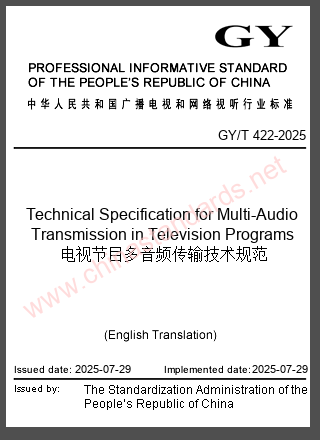
VALIDTechnical Specification for Multi-Audio Transmission in Television Programs
- Issued on:2025-07-29
- Implemented on:2025-07-29
- File Format:PDF
- Delivery:Via email within 1~3 business days
$232.00
| Standard No: | GY/T 422-2025 |
| Document status: | VALID |
| Title in English: | Technical Specification for Multi-Audio Transmission in Television Programs |
| Title in Chinese: | 电视节目多音频传输技术规范 |
| Language: | English |
| File Format: | Electronic (PDF) |
| Delivery: | Via email within 1~3 business days |
| Issued on: | 2025-07-29 |
| Implemented on: | 2025-07-29 |
| ICS Classification: | 33.160.01-audio, video and audiovisual systems in general |
| Chinese Classification: | M70-Broadcasting and television equipment in general |
| Professional Classification: | GY-Radio, Film and TV |
| Related Keywords: | multi-audio transmission
television programs multi-audio transmission technology television programs introductionbackground modern television programs |
Introduction
Background of Standardization and Technological Evolution
The release of GY/T 422-2025 "Technical Specification for Multi-Audio Transmission of Television Programs" marks a new stage of standardization in the field of multi-audio transmission technology for my country's radio, television, and online audio-visual industries. The standard, officially released and implemented on July 29, 2025, was jointly drafted by authoritative industry organizations such as China Media Group and the China Academy of Radio and Television Planning under the State Administration of Radio and Television.
With the rapid development of technologies such as ultra-high-definition television and immersive audio, the traditional single-audio transmission mode can no longer meet the production and broadcasting needs of modern television programs. This standard, based on the GB/T 17975.1 system coding specification, introduces the audio_preselection_descriptor descriptor within the elementary stream description loop of the transport stream mapping segment, providing a unified technical framework for multi-audio transmission.
Analysis of core technical requirements
audio_preselection_descriptor descriptor structure
As a core technical element of the standard, this descriptor adopts a layered structure design to ensure backward compatibility and scalability. The descriptor tag (descriptor_tag) is fixed to 0x7F, and the descriptor tag extension (descriptor_tag_extension) is 0x19, forming a complete identification system.
| Field Name | Number of Bits | Data Type | Function Description |
|---|---|---|---|
| descriptor_tag | 8 | uimsbf | Descriptor Identifier (0x7F) |
| descriptor_length | 8 | uimsbf | Subsequent Descriptor Length | < /tr>
| num_preselections | 5 | uimsbf | Number of preselected audios (≥1) |
| preselection_id | 5 | uimsbf | Preselected audio identifier |
Audio rendering indication mechanism
The audio_rendering_indication field uses 3 bits to define 6 standard audio presentation methods, providing clear playback guidance for the receiving device.
| Indicator value | Semantic description | Applicable scenarios |
|---|---|---|
| 0 | Silent channel presentation requirement | General audio stream |
| 1 | Two-channel stereo | Traditional TV programs |
| 2 | Surround sound (5.1)Receiving terminal parsing mechanismThe receiving device must fully parse each field of the descriptor and intelligently select the best audio stream or provide a user selection interface based on the audio_rendering_indication instruction and the playback device capabilities. Accurate parsing of the language code (ISO_639_language_code) ensures the correct presentation of multilingual programs. Practical application case analysisTaking 4K ultra-high-definition sports event live broadcasts as an example, the production end may simultaneously provide stereo commentary (preset ID1), 5.1 surround sound live sound effects (preset ID2), and 3D immersive audio (preset ID3). Through the audio_preselection_descriptor, the receiving device can automatically select the most suitable audio stream based on the user's device and preferences, thereby improving the viewing experience. Standard Implementation RecommendationsEquipment R&D GuidanceWhen developing encoders, multiplexers, receiving terminals, and monitoring systems, equipment manufacturers should strictly adhere to the technical requirements of Chapter 6 of the standard to ensure the accuracy of descriptor generation, transmission, and parsing. System Integration SpecificationsWhen deploying television broadcast and transmission systems, system integrators should establish a complete testing and verification process and verify the correctness of descriptor syntax and semantics according to the test methods in Appendix A. Operation and Maintenance Assurance MeasuresThe operation and maintenance team should regularly check the integrity of descriptors in the transmission link and establish a monitoring and alarm mechanism to promptly detect and address descriptor loss or errors. Technical Advantages and Industry ImpactThe implementation of GY/T 422-2025 will significantly improve the audio quality of television programs in my country and support a smooth transition from traditional stereo to immersive 3D sound. The unified standard reduces device compatibility risks and provides a solid foundation for technological innovation in the industry. With the popularization of new technologies such as 5G and 8K, this standard will play an even more important role in the era of ultra-high-definition television. Sample only — not a preview of GY/T 422-2025
 Loading PDF document... Error loading PDF. Please make sure the file is valid and try again. We also recommend
All Rights Reserved © 2026 WWW.CHINASTANDARDS.NET


|