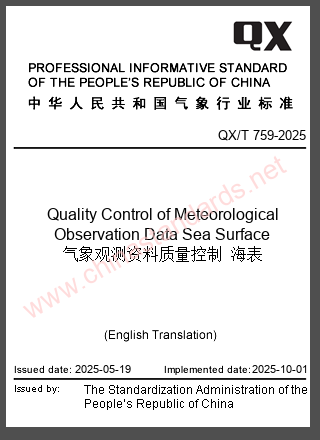
QX/T 759-2025 in English
VALIDQuality Control of Meteorological Observation Data Sea Surface
- Issued on:2025-05-19
- Implemented on:2025-10-01
- File Format:PDF
- Delivery:Via email within 1~3 business days
$248.00
| Standard No: | QX/T 759-2025 |
| Document status: | VALID |
| Title in English: | Quality Control of Meteorological Observation Data Sea Surface |
| Title in Chinese: | 气象观测资料质量控制 海表 |
| Language: | English |
| File Format: | Electronic (PDF) |
| Delivery: | Via email within 1~3 business days |
| Issued on: | 2025-05-19 |
| Implemented on: | 2025-10-01 |
| ICS Classification: | 07.060-Geology. Meteorology. Hydrology |
| Chinese Classification: | A47-Meteorology |
| Professional Classification: | QX-Meteorology |
| Related Keywords: | observation data quality control
ship observation data quality control marine meteorological observation data quality control field surface observation data observation elements quality control characteristics application scenarios ship observation data |
Introduction
Standard Overview and Technical Background
QX/T759-2025, "Quality Control of Meteorological Observation Data - Sea Surface," is an industry standard developed by the China Meteorological Administration for quality control of ocean surface observation data. It will be officially implemented in June 2025. This standard fills a gap in standardization in my country's marine meteorological observation data quality control field and provides a technical basis for ensuring data quality from observation platforms such as ships, buoys, and ocean stations.
With the rapid development of marine meteorological observation technology, my country has established a three-dimensional observation network covering both nearshore and offshore waters. However, the complexity of the marine environment, the diversity of observation platforms, and the real-time requirements for data transmission have placed higher standards on observation data quality control. QX/T759-2025 was developed based on advanced international experience and combined with the actual practice of marine meteorological observation in my country to establish a scientific and comprehensive quality control system.
Classification and Analysis of Quality Control Objects
The standard clearly divides sea surface observation data into three categories of quality control objects, each of which has unique observation characteristics and quality control requirements:
| Observation platform type | Range of observation elements | Quality control characteristics | Application scenarios |
|---|---|---|---|
| Ship observation data | Meteorological elements such as air pressure, air temperature, dew point temperature, relative humidity, wind direction, wind speed, clouds, visibility, and weather phenomena; hydrological elements such as sea water temperature, waves, and sea ice | The platform is highly mobile and requires a moving speed check; the observation environment is complex and the data fluctuates greatly | International volunteer ships, scientific research vessels, commercial ships, etc. |
| Buoy observation data | Meteorological elements such as air pressure, air temperature, relative humidity, wind direction, wind speed; hydrological elements such as sea temperature, sea salinity, waves, and currents | Relatively fixed position (anchored buoy) or moving with the current (drifting buoy), requiring differentiated processing | Internationally shared buoys, buoys deployed by domestic meteorological and oceanographic departments |
| Ocean station observation data | Meteorological elements such as air pressure, air temperature, relative humidity, wind direction, wind speed, and precipitation; hydrological elements such as sea temperature, sea salinity, waves, and currents | Completely fixed position, can be compared with metadata, high data continuity requirement | Fixed stations such as coastal meteorological stations, island stations, and offshore platforms |
In-depth Analysis of Nine Quality Control Methods
5.1 Basic Information Verification
Basic information verification is the first line of defense for quality control, covering verification of core information such as observation time, location, and platform identification:
- Observation Time Verification: Utilizes strict numerical range verification to ensure the rationality and integrity of time data
- Observation Location Verification: Enhances location data accuracy through dual verification of latitude and longitude and the Marsden ID
- Platform Identification Standardization: Format verification of various platform identifications is performed in accordance with international and domestic standards
5.2 Land and Ocean Location Verification
Utilizes global ocean and land location background data to identify unusual inland observation locations and prevent land observation data from being mistakenly included in ocean datasets.
5.3 Missing Observation Verification
The system identifies missing data and terminates the subsequent verification process, improving processing efficiency and avoiding invalid calculations.
5.4 Limit value check
Appendix A of the standard specifies in detail the limit value range of each factor, such as the air pressure range of 870-1070hPa, the temperature range of -49.1-50℃, etc. Data outside the range will be directly judged as erroneous data.
5.5 Check on the main range of changes
For elements with obvious latitudinal distribution characteristics, such as air temperature and sea surface temperature, a combination of latitude zone check and climate threshold check is adopted:
| Element | Latitude Zone | Error Judgment Condition | Suspicious Judgment Condition |
|---|---|---|---|
| Air Temperature | Mid-low latitudes (45°S-45°N) | Below -35℃ | Above 45℃ |
| Air Temperature | Mid-high latitudes (over 45°S/45°N) | Above 45℃ | Below -35℃ |
| Sea surface temperature | Mid-low latitudes (45°S-45°N) | Below -3°C | Above 37°C |
| Sea surface temperature | Mid-high latitudes (over 45°S/45°N) | Below -3°C or above 37°C | - |
5.6 Internal consistency check
The rationality of the data is verified by the physical relationship between the elements. Appendix C of the standard provides detailed criteria for 9 tables:
- Air pressure consistency: Verification of the logical relationship between the 3-hour pressure change and the air pressure tendency
- Temperature-humidity relationship: The basic physical principle that the dew point temperature shall not be higher than the air temperature
- Wind element association: Reasonable range of wind direction and speed, maximum wind speed and instantaneous wind speed
- Weather phenomenon coordination: Physical matching check of temperature and precipitation type
5.7 Temporal consistency check
Includes two dimensions: rigid value check and variability check, to ensure the rationality of data in time series:
| Check type | Check elements | Key parameters | Quality control significance |
|---|---|---|---|
| Rigid value check | Air pressure, air temperature | No change for up to 6 hours | Identify sensor failure or data transmission anomaly |
| Sea surface temperature | No change for up to 24 hours | Verification of the natural law of ocean temperature change | |
| Wave height | No change for up to 12 hours | Verification of dynamic characteristics of ocean waves | |
| Variation check | Air pressure | Maximum change of 5hPa in 1 hour | Identification of abnormal air pressure fluctuations |
| Air temperature | Maximum change of 6℃ in 1 hour | Verification of the rationality of ocean temperature change | |
| Sea surface temperature | Maximum change of 5℃ in 1 hour | Check of the physical limits of sea temperature change |
5.8 Extreme Value Time Check
Verify the rationality of the extreme value occurrence time. The 1-hour extreme value should be within 1 hour before the current time, and the 24-hour extreme value should be within 24 hours before the current time.
5.9 Data Quality Identification
Use the quality control code system of the QX/T118-2020 standard to achieve standardized identification of quality status.
Quality Control Process Architecture
Chapter 6 of the standard establishes a complete real-time quality control process, forming a progressive quality screening system:
- Data input: Receive raw observation data
- Basic information check: Verify basic information such as time and location
- Land and sea location check: Confirm that the observation location is in the ocean area
- Missing data check: Identify and process missing data
- Boundary value check: Verify that the data is within a reasonable physical range
- Main change range check: Verify the rationality of data based on latitude characteristics
- Internal consistency check: Verify the physical relationship between elements
- Temporal consistency check: Verify the rationality of the data time series
- Extreme value time check: Verify the rationality of the extreme value occurrence time
- Data Quality Identification: Outputs data with quality identification.
Technological Evolution and Standard Innovation
QX/T759-2025 achieves several key technical innovations:
Multi-dimensional Quality Control System
The standard establishes a comprehensive quality control system covering basic information, specialized elements, spatial relationships, and time series, significantly improving data quality reliability compared to traditional single-source quality control methods.
Marine Feature Coverage
For the first time, typical marine elements such as waves, currents, and sea ice are systematically included in the quality control scope, and specialized quality control criteria are established, such as verifying the logical relationships between various wave height parameters.
Platform-Specific Processing
Differentiated quality control strategies are developed based on the characteristics of different observation platforms, such as ships, buoys, and oceanographic stations, such as checking ship speed and verifying the position consistency of fixed stations.
Implementation Suggestions and Application Guidance
System Construction Suggestions
It is recommended that all marine meteorological observation data receiving and processing units establish or upgrade the quality control system in accordance with the standard requirements:
- Configure a global ocean and land position background database to support ocean and land position inspection
- Establish a climate threshold parameter library for each latitude zone to support the inspection of major change ranges
- Develop a multi-factor association analysis module to implement internal consistency inspection
- Build a time series analysis engine to support temporal consistency inspection
Quality control strategy optimization
According to different application scenarios, the quality control links can be appropriately adjusted:
| Application scenarios | Required inspection links | Optional inspection links | Quality control focus |
|---|---|---|---|
| Real-time weather forecast | Basic information check, limit value check, missing measurement check | Main change range check, time consistency check | Data timeliness, accuracy of key elements |
| Climate analysis and research | All inspection links | - | Data integrity, long-term consistency |
| Marine disaster warning | Basic information check, limit value check, internal consistency check | Extreme time check | Extreme data identification, key element verification |
Staff training and standard promotion
It is recommended to organize and carry out standard promotion training. The key training content should include:
- In-depth understanding of the technical requirements of the standard
- Key Points for Implementing Each Quality Control Method
- Correct Interpretation of Quality Control Results
- Processing Process for Abnormal Data
Typical Application Case: Ship Observation Data Quality Control
An international volunteer ship reported an air pressure of 860 hPa in the North Atlantic. This data was identified as erroneous despite passing the threshold check (the standard requires 870-1070 hPa). Further analysis revealed that the ship was located within the influence of a severe cyclone and the actual air pressure should have been 986 hPa. A bit error occurred during data transmission. The quality control system promptly identified this erroneous data and prevented it from impacting the weather forecast.
Expected Benefits of Standard Implementation
The implementation of QX/T759-2025 will produce significant technical and business benefits:
- Improve data quality: Through systematic quality control, the risk of using erroneous data will be significantly reduced
- Promote data sharing: Unified quality standards provide a technical basis for international and domestic data exchange
- Support accurate forecasts: High-quality observation data provide reliable initial fields for numerical weather forecasts
- Serve the marine economy: Reliable marine meteorological data provide decision-making support for shipping, fisheries, offshore engineering, etc.
The release and implementation of this standard marks that my country's marine meteorological observation data quality management has entered a new stage of standardization and normalization, and will provide solid technical support for the construction of a strong maritime nation.

Loading PDF document...
Error loading PDF. Please make sure the file is valid and try again.
We also recommend
-

QX/T 333-2016 in English
Ship pilotage meteorological conditions level
2016-09-29 -

QX/T 705-2023 in English
Technical Specifications for Division of Lightning-prone Areas
2023-12-30 -

QX/T 317-2023 in English
General rules for quality assessment of lightning protection device testing
2023-09-05 -

QX/T 712-2024 in English
Climate Change Impact Assessment Food Crop Yield Vulnerability
2024-06-20


