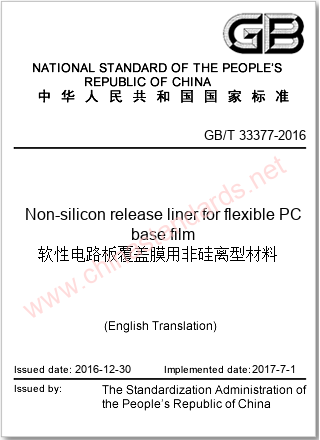
GB/T 33377-2016 in English
VALIDNon-silicon release liner for flexible PC base film
- Issued on:2016-12-30
- Implemented on:2017-07-01
- File Format:PDF
- Delivery:Via email within 1~3 business days
$243.00
| Standard No: | GB/T 33377-2016 |
| Document status: | VALID |
| Title in English: | Non-silicon release liner for flexible PC base film |
| Title in Chinese: | 软性电路板覆盖膜用非硅离型材料 |
| Language: | English |
| File Format: | Electronic (PDF) |
| Delivery: | Via email within 1~3 business days |
| Issued on: | 2016-12-30 |
| Implemented on: | 2017-07-01 |
| ICS Classification: | 83.180-Adhesives |
| Chinese Classification: | G39-Adhesives |
| Professional Classification: | GB-National Standard |
| Related Keywords: | non-silicon release liner
standard frameworks dimensions release paper release film basis weight non-silicon release materials non-silicon release material supplier flexible pc base film introduction |
| Related Topics: | circuit board
New membrane materials can efficiently non-silicon-based materials micro membrane separation new membrane material zwitterionic material Inactive silicon flexible circuit board GBT33377 GB/T 33377-2016 Copper Clad Laminate Electronic Materials College |
《GB/T 33377-2016软性电路板覆盖膜用非硅离型材料》由TC185(全国胶粘剂标准化技术委员会)归口,TC185SC1(全国胶粘剂标准化技术委员会压敏胶制品分会)执行,主管部门为中国石油和化学工业联合会。
Introduction
1. Standard Overview
GB/T 33377-2016 "Non-silicone release materials for flexible circuit board cover films" was issued on December 30, 2016 and officially implemented on July 1, 2017. The standard specifies the product classification, technical requirements, test methods, inspection rules, and marking, packaging, transportation and storage of non-silicone release materials.
2. Comparison of standard frameworks
| Dimensions | Release paper | Release film | ||
|---|---|---|---|---|
| Basis weight (g/m²) | ≤160 | - | ||
| Thickness (μm) | - | Performance indicators | Tensile strength, tear strength, delamination force, etc. | Tensile strength, elongation at break, etc. |
3. Background of Standard Formulation and Technological Evolution
With the development of the electronics industry, the demand for flexible circuit boards is growing. As a key auxiliary material, the performance of non-silicon release materials directly affects product quality. This standard was created to regulate the market and improve product quality.
Technical Features:Non-silicon formula avoids silicone pollution problems, while meeting high temperature tolerance (110℃~150℃), and adapting to the needs of electronic applications in complex environments.
4. Implementation Suggestions
4.1 Suggestions for manufacturers:
- Strictly follow the standard requirements for raw material procurement and production process control.
- Establish a complete quality inspection system to ensure that products meet the index requirements.
4.2 Suggestions for application companies:
- Choose a non-silicon release material supplier with authoritative certification.
- Choose products with appropriate specifications according to specific application scenarios.
4.3 Recommendations from testing agencies:
- Periodically conduct sampling tests on market products to ensure product quality.
- Provide standard interpretation and technical consulting services.

Loading PDF document...
Error loading PDF. Please make sure the file is valid and try again.
We also recommend
-

GB/T 44543-2024 in English
Epoxy adhesive for precast concrete segmental construction
2024-09-29 -

GB/T 27561-2011 in English
Styrene-butadiene-styrene block copolymers(SBS) adhesives
2011-12-05 -

GB 33372-2020 in English
Limit of volatile organic compounds content in adhesive
2020-03-04 -

GB/T 36797-2018 in English
Epoxy resin joint sealant for anti-cracking in refurbishment
2018-09-17 -

GB/T 37882-2019 in English
Silicone adhesive for back rail bonding in terrestrial photovoltaic(PV) modules
2019-08-30 -

GB/T 42909-2023 in English
Electrically conductive adhesive tape for wireless terminal equipment application
2023-08-06 -
GB/T 14732-2017 in English
Wood adhesives: urea-formaldehyde, phenol-formaldehyde and melamine-formaldehyde resins
2017-12-29


