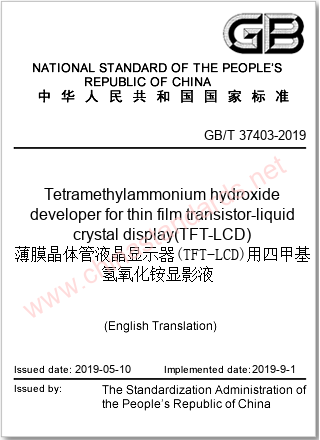
GB/T 37403-2019 in English
VALIDTetramethylammonium hydroxide developer for thin film transistor-liquid crystal display(TFT-LCD)
- Issued on:2019-05-10
- Implemented on:2019-09-01
- File Format:PDF
- Delivery:Via email within 5 business days
$359.00
《GB/T 37403-2019薄膜晶体管液晶显示器(TFT-LCD)用四甲基氢氧化铵显影液》由TC203(全国半导体设备和材料标准化技术委员会)归口,主管部门为国家标准化管理委员会。
Introduction
Interpretation of the core content of the standard
This standard specifies the technical requirements for the three concentration systems (25%, 20%, 2.38%) and their classification (Class I/II/III) of tetramethylammonium hydroxide (TMAH) developer for TFT-LCD manufacturing. The following indicators are focused on:
| Key indicators | Class I requirements | Class II requirements | Class III requirements |
|---|---|---|---|
| Metal ions (such as Na/K/Fe) | ≤0.5μg/kg | ≤1μg/kg | ≤10μg/kg |
| Number of particles (≥0.5μm) | 10-30 pieces/mL | 30-50 pieces/mL | 50-100 pieces/mL |
| Concentration deviation | ±0.003-0.032% | ±0.005-0.05% | ±0.01-0.1% |
Innovation of detection method
1. Automatic potentiometric titration technology
For the first time, the standard uses automatic potentiometric titration as the arbitration method for TMAH content determination. Compared with traditional acid-base titration:
- The resolution is up to 0.001pH, and the error is less than 0.2%
- The three-jump point is used to determine carbonate (EP1→EP2→EP3)
- Equipped with aqueous composite pH electrode, the external reference solution is 3mol/L KCl
2. Trace metal detection
Through class=instrument>ICP-MS detects 23 kinds of metal impurities, critical control points:
Key points for implementation
- Packaging specifications:HDPE barrels or PTFE-lined tank trucks must be used and marked with corrosive material signs (GB190)
- Sampling requirements:800mL of sample must be placed in a Class 2 clean environment (GB50073) for 30 minutes before packaging
- Storage conditions:Store below 25°C in the dark, with a shelf life of 12 months. It is strictly forbidden to store it with acidic substances
Technology evolution analysis
Compared with the earlier version, this standard has the following major upgrades:
- Added a new 2.38% low-concentration specification detection method
- The metal ion detection limit has been increased from ppm to ppb
- The lower limit of particle detection size has been extended to 0.1μm (GB/T11446.9)

Loading PDF document...
Error loading PDF. Please make sure the file is valid and try again.
We also recommend
-

GB/T 40096.6-2024 in English
Technical specification for on-site relay protection equipment—Part 6: Busbar protection
2024-04-25 -

GB/T 41475-2022 in English
Specifications for color and legend of soil nutrient maps at the scale of 1:25 000~1:500 000
2022-04-15 -

GB/T 9966.1-2020 in English
Test methods for natural stone—Part 1:Determination of dry,wet and after freezing compressive strength
2020-03-06 -

GB/T 42238-2022 in English
Surface active agents—Determination of free propylene oxide content in propylene oxide adduct surfactants—GC method
2022-12-30 -
GB/T 14563-2020 in English
Specification and test method of kaolin clay
2020-06-02 -

GB/T 33174-2022 in English
Asset management—Management systems—Guidelines for the application of GB/T 33173
2022-12-30 -

GB/T 26676-2011 in English
Electrical, electronic and programmable electronic control systems of machine tools - Specification of withstanding voltage test
2011-06-16 -

GB/T 10095.1-2022 in English
Cylindrical gears—ISO system of flank tolerance classification—Part 1:Definitions and allowable values of deviations relevant to flanks of gear teeth
2022-10-12 -

GB/T 24421.2-2023 in English
Guidelines for standardization of organizations in service sector—Part 2:Standard system construction
2023-03-17 -

GB/T 38133-2019 in English
Genetically modified alfalfa detection method by real-time PCR
2019-10-18


