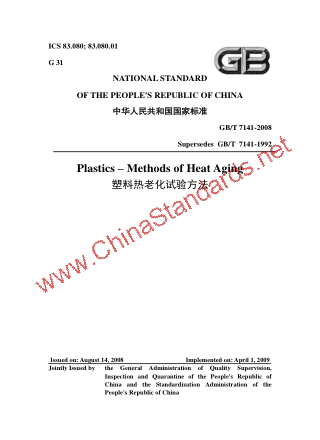
GB/T 7141-2008 in English
VALIDPlastics - Methods of heat aging
- Issued on:2008-08-14
- Implemented on:2009-04-01
- File Format:PDF
- Delivery:Via email within 1~3 business days
$107.00
《GB/T 7141-2008塑料热老化试验方法》由TC15(全国塑料标准化技术委员会)归口,TC15SC5(全国塑料标准化技术委员会老化方法分会)执行,主管部门为中国石油和化学工业联合会。
本标准修改采用ASTM D5510:1994《可氧化降解塑料热老化标准规范》(英文版)
本标准代替v《塑料热空气暴露试验方法》。
本标准规定了塑料仅在不同温度的热空气中暴露较长时间的暴露条件。本标准仅规定了热暴露的方法,而未对试验方法或试样进行规定。
本标准给出了比较材料热老化性能的导则,这些性能通过某相关性能的变化来测定(也就是说,脆化性能通过伸长率的减少来测定)。本标准适用于评价使用时易氧化的塑料。
本标准与GB/T 7141-1992的主要差异如下:
―――GB/T 7141-1992中只有一种热老化试验箱方法即强制通风的空气热老化试验箱。而本标准提供了两种热老化试验箱方法,即重力对流式热老化试验箱和强制通风式热老化试验箱。这两种热老化试验箱分别适用于不同标称厚度的试样;
―――本标准对塑料热老化试验提出了更多试验周期选择的要求;
―――本标准除了提供单一温度下每种材料在每个暴露周期的试验方法和结果比较方法外,还提供了在一系列温度下每种材料进行暴露试验时的试验方法和结果比较方法。试验结果可用于材料温度稳定性的基本评定或在设定温度下的最大预期使用寿命的评估。
1 Scope
1.1 This standard specifies the exposure conditions for plastics only exposed in temperature-varying hot air for relatively long time. This standard specifies only the heat exposure method, excluding the test method or specimen. The influence on any performance of plastics from the heat can be tested by selecting proper test methods and specimen. This standard recommends to adopt ASTM D 3826 to test the embrittlement endpoint which is reached while the elongation at break of 75% of tested specimen is 5% or smaller under the initial strain rate of 0.1mm/min.
1.2 This standard gives the guideline for comparing the heat aging performances of materials, and these performances are tested by changing certain relative performance (which is to say that the embrittlement performance is tested by reducing the elongation). This standard is applicable to evaluating plastics easy to oxidize in application.
1.3 Results obtained from this standard are influenced by the type of adopted heat aging test boxes. The user can select one of the two methods to expose the heat aging test boxes. Results based on these two methods shall not confuse mutually.
1.3.1 Method A: gravitational-convection heat aging test box--recommended to be used for the thin specimen with the nominal thickness not greater than 0.25mm.
1.3.2 Method B: forced-draft heat aging test box--recommended to be used for the specimen with the nominal thickness greater than 0.25mm.
1.4 This standard introduces the method to compare the heat aging performances of materials under single temperature. This standard also describes the methods to test the heat aging performances of materials under series of temperatures so as to estimate the duration required by materials in specified characteristic change under certain lower temperature. This standard doesn't estimate the heat aging performance under the interaction of factors like stress, environment, temperature and time control failure.
1.5 This standard doesn't involve the explanation on safety, if any, the explanation is only relative to the application of this standard. The user of this standard is obligated to, prior to use, establish applicable safety and health codes and determine the application rule limits.
Note: No ISO standard identical to this standard is available.
2 Normative References
The following standards contain provisions which, through reference in this standard, constitute provisions of this standard. For dated references, subsequent amendments to (excluding correction to), or revisions of, any of these publications do not apply. However, the parties entering into agreement according to this standard are encouraged to research whether the latest editions of these references apply. For undated references, their latest editions are applicable to this standard.
GB/T 2035 "Terms and Definitions for Plastics" (GB/T 2035-2008; ISO 472: 1999, IDT)
GB/T 2918 "Plastics -- Standard Atmospheres for Conditioning and Testing" (GB/T 2918-1998; idt ISO 291: 1997)
GB/T 7142 "Determination of Time-temperature Limits for Plastics after Prolonged Exposure to Heat" (GB/T 7142-2002; ISO 2578: 1993, MOD)
GB/T 11026.4-1999 "Guide for the Determination of Thermal Endurance Properties of Electrical Insulating Materials -- Part 4: Ageing Ovens -- Single-chamber Ovens" (idt IEC 60216-4-1: 1990)
Foreword I
1 Scope
2 Normative References
3 Terms and Definitions
4 Significance and Use
5 Equipment
6 Specimen
7 Conditioning
8 Test Procedure
9 Result Calculation
10 Test Report
11 Precision and Bias
Appendix A (Informative) Technical Differences between This Standard and ASTM D 5510: 1994(2001) and Their Reasons

Loading PDF document...
Error loading PDF. Please make sure the file is valid and try again.
We also recommend
-

GB/T 13525-1992 in English
Test method for tensile-impact property of plastics
1992-06-23 -

GB/T 44995-2024 in English
Polypropylene packaging container—Guidelines for the construction of initial screening testing methods for doped with recycled plastic
2024-11-28 -

GB 9347-1988 in English
Plastics-Vinyl chloride-vinyl acetate copolymers-Determination of vinyl acetate
1988-05-13 -

GB/T 12005.2-1989 in English
Determination for solid content of polyacrylamide
1989-12-25 -

GB/T 19860-2005 in English
Determination of hydrogen form of weak-acid cation exchange resins
2005-07-29 -

GB/T 29418-2023 in English
Test methods for properties of wood-plastic composite profile
2023-11-27 -

GB/T 5759-2025 in English
Plastics—Ion exchange resin—Determination of water content of anion exchange resins in hydroxide form by centrifugation
2025-10-05 -

GB/T 8661-2008 in English
Plastics - Styrene/acrylonitrile copolymers - Determination of residual acrylonitrile monomer content - Gas chromatography method
2008-06-19 -

GB/T 22312-2008 in English
Plastics - Polyacrylamide - Determination for residual acrylamide
2008-08-04


